
Insights
News briefs, analysis and data from the Wind MENA desk, newest first. Open any report to read it in full here.
Photo: Noah Buscher, Unsplash Licence, via Unsplash
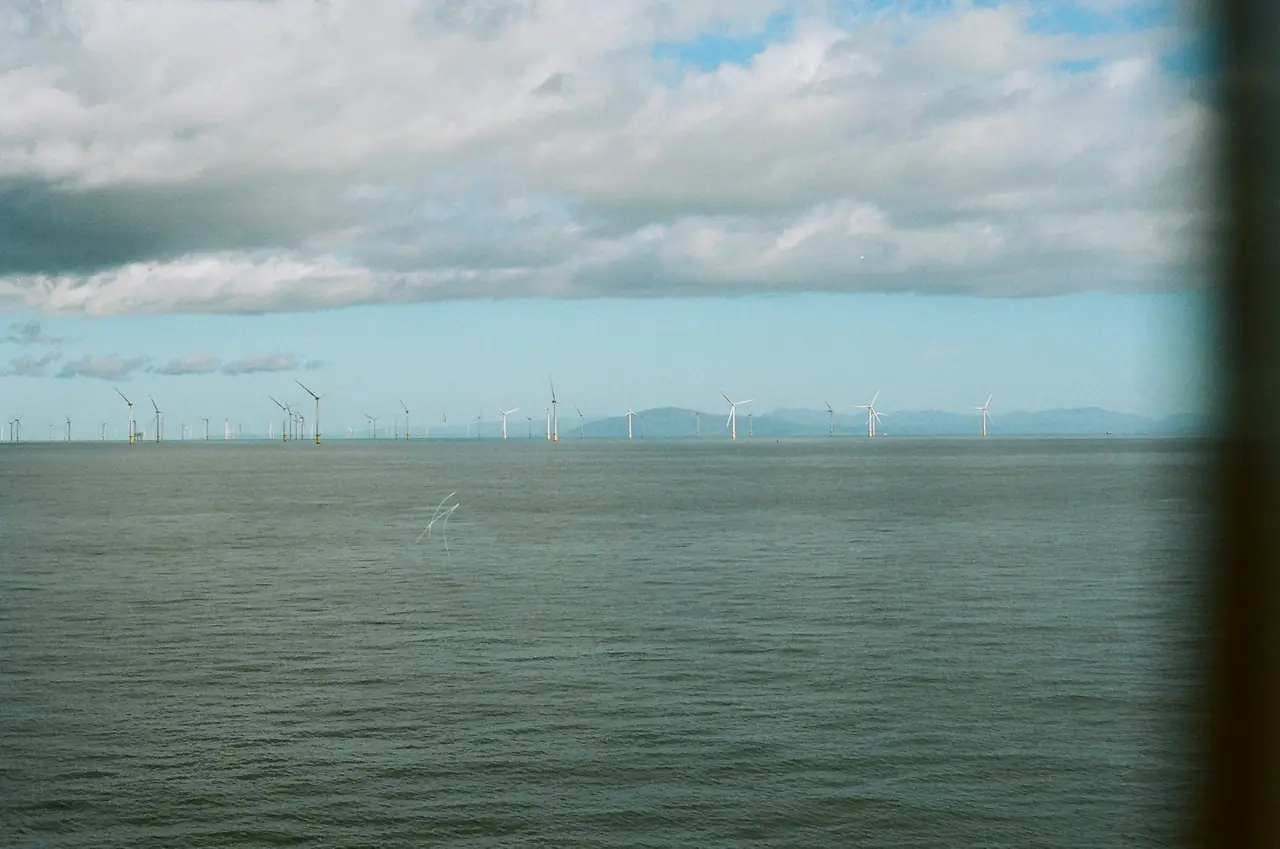
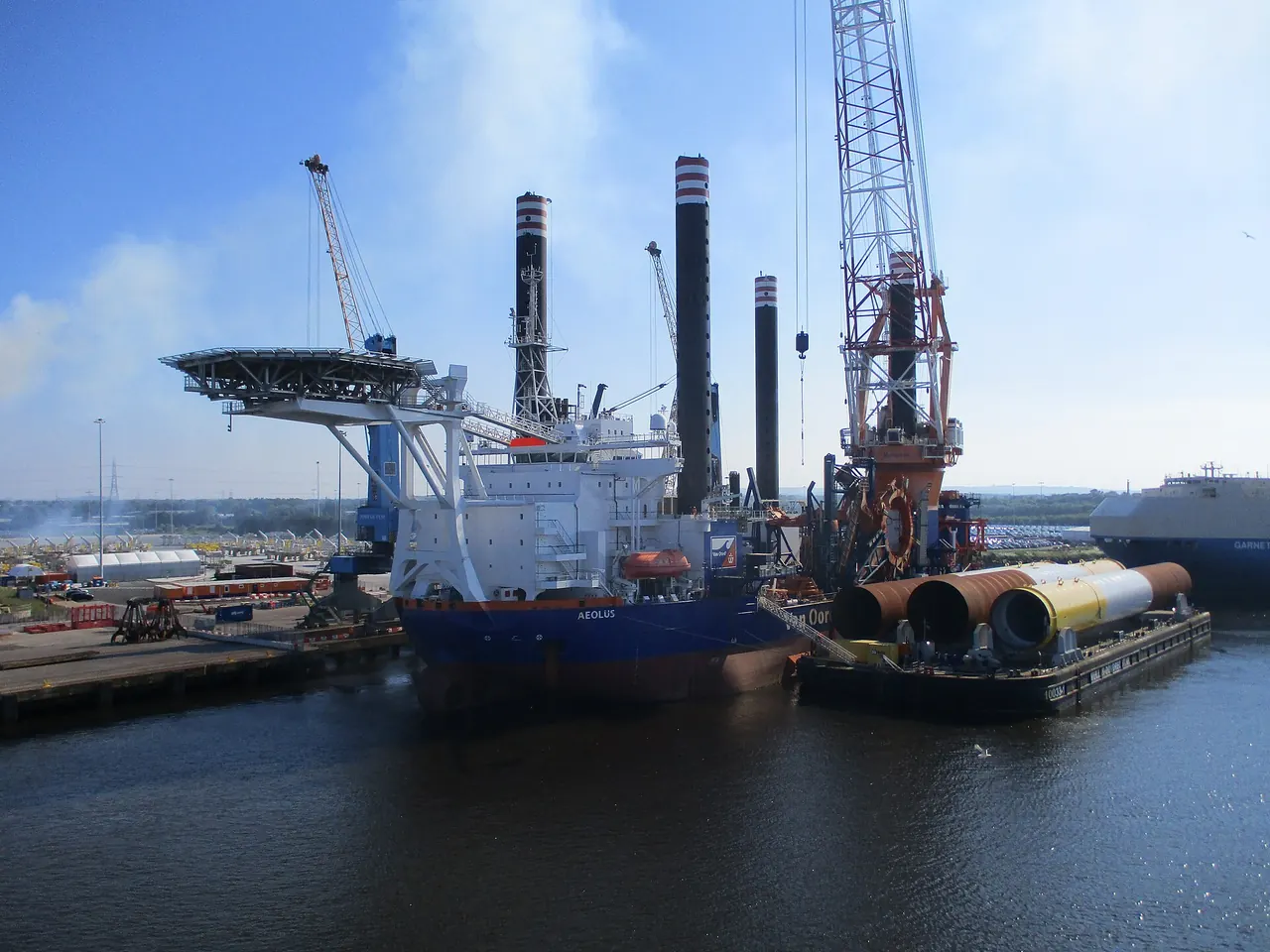
Four years after the grant, the EIB awards a EUR 1.99 million feasibility contract for Morocco's offshore wind
The EIB contract for studies on a planned 1 GW project off Essaouira runs for up to 43 months, while construction is targeted to start in 2029. 1 min read
Four years. That is how long it took to turn an EIB offshore wind grant for Morocco into a consultant contract.
In September 2022 the EIB and Masen, Morocco’s sustainable energy agency, signed a cooperation agreement with a EUR 2 million grant for an offshore wind feasibility study off Essaouira. MEED reported on 3 September that the EIB has now awarded a EUR 1.99 million contract for the feasibility and environmental studies on a planned 1 GW project. Eleven firms bid. Ten were registered in the European Economic Area and one outside it.
Now read the contract terms. It runs for a maximum of 43 months including possible extensions, and construction is targeted to start in 2029. Count 43 months from an award reported in early September 2026 and the window closes in spring 2030. The source does not state the contract start date, so I read this as an open question.
My prediction: the 2029 date moves. The studies can finish early, but I would not plan a supply chain around that. My view is that a 1 GW offshore project that rushes its environmental assessment pays for it later.
It took four years to buy the question.
Which comes first off Essaouira: the study results or the construction date?
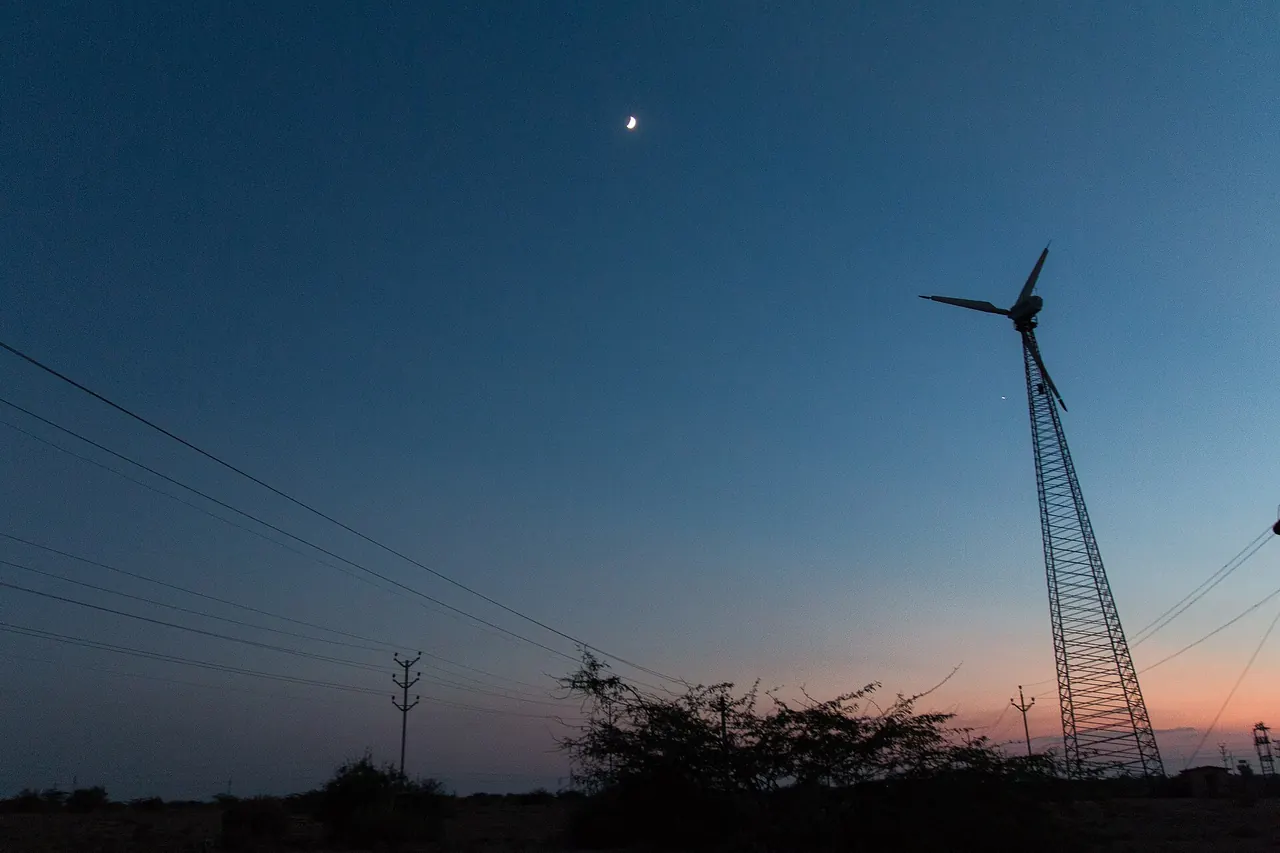
ACWA Power is building 1,500 km of line to carry 1.5 GW of Uzbek wind
A USD 3.06 billion package in Karakalpakstan bundles turbines, batteries and five substations. We read the grid scope as what sets the schedule. 1 min read
ACWA Power said construction has started on three wind plants totalling 1.5 GW in Kungrad district, Karakalpakstan, a USD 3.06 billion programme. The package includes a 300 MW battery system, about 1,500 km of high-voltage transmission line, three new 500 kV switching substations and two upgraded ones.
ACWA guides commissioning in Q1 2027. UzDaily reports that ACWA’s Karakalpakstan projects as a whole are expected to generate about 8.77 billion kWh a year. President Mirziyoyev launched construction on 18 September, according to UzDaily. Together with the 300 MW Nukus 1 and 2 plants, ACWA’s Karakalpakstan wind fleet would reach about 2.3 GW.
Why it matters
Wind at this scale now arrives as a bundle of turbines, batteries and transmission. We read the grid scope as the part that sets the schedule.
What it means for MENA
We read this as Saudi capital exporting a full delivery model. In our view it becomes a yardstick for wind-plus-grid packages across MENA.
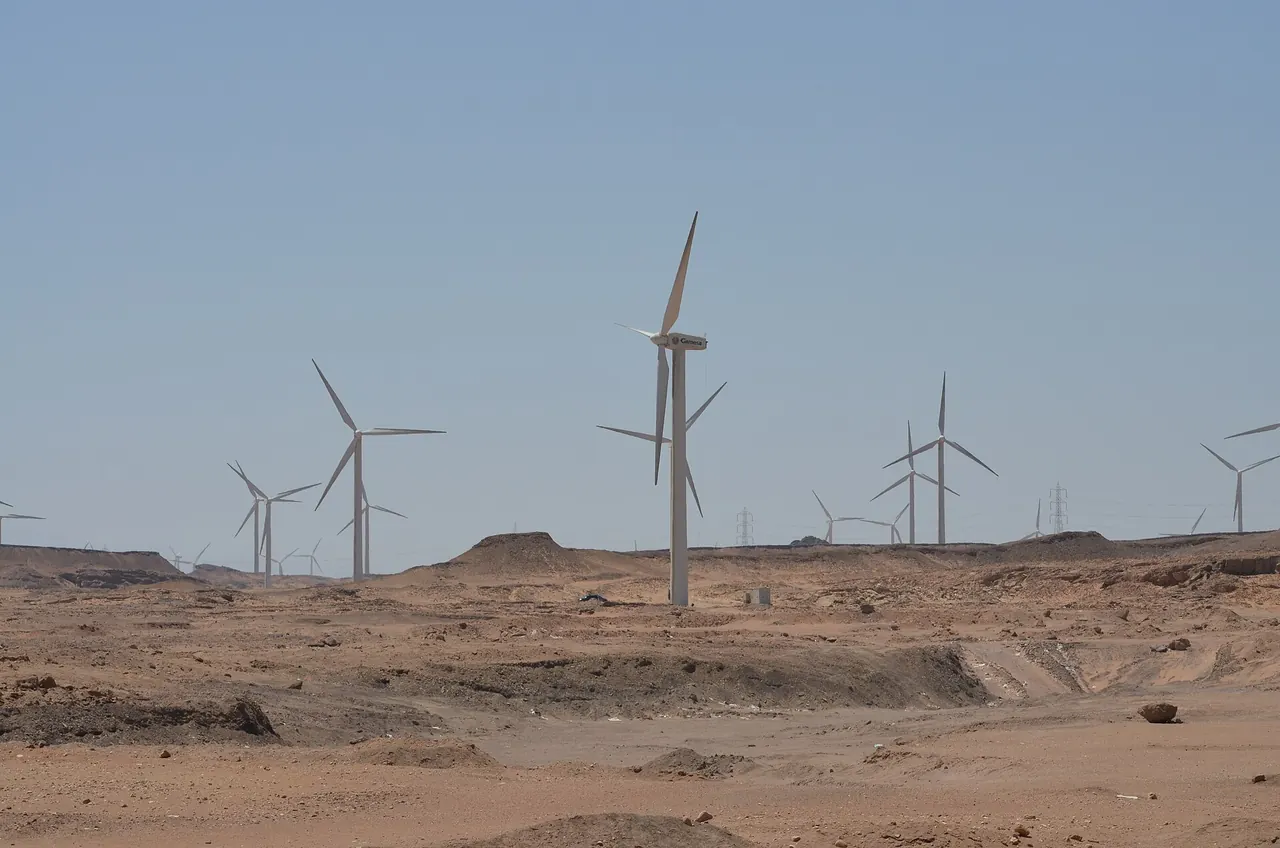
On the Gulf of Suez, the deadliest part of a wind farm may be the line it does not route
A 2007 bird map still sorts Egypt's best wind land. The EBRD plan for a 550 MW plot puts most of the risk on a 47 km overhead line set by the authorities. 1 min read
Six hundred and fifty six square kilometres of state wind concession on the Gulf of Suez. A government-backed study in 2007 marked 60 percent of it as red zone, closed to turbines because of migrating birds.
That map still sorts the new plots. Suez Wind Energy’s southern 550 megawatt plot landed in the orange zone, where further study is required, beside three plants already in the green, inside an Important Bird Area 100 kilometres long. The EBRD rated the project Category A and is financing the 1.06 billion dollar build with up to 200 million dollars. ACWA Power and HAU Energy are among the sponsors.
Then read the biodiversity action plan. Its estimate for that plot, after mitigation, is 34 soaring birds a year, mostly from collisions with the 47 kilometre overhead line rather than the blades. The EBRD page says line routes are determined by the Egyptian authorities and generally follow existing lines.
Our reading
The developer inherits the wire it will be judged on. We think the market prices this backwards. Wind speed and turbine cost get the models, while the deadliest piece of the project may be the one the developer does not route.
The plan has observers on watch twelve hours a day through 28 October. When the next Gulf of Suez round opens, who prices the wire?
Saudi power awards fell from USD 54.2 billion to USD 3.4 billion. Wind's money is waiting on Round 7
MEED data shows a sharp slowdown in 2026 contract awards. Round 7 bids for 2,200 MW of wind were due in September, but awards may slip into 2027. 1 min read
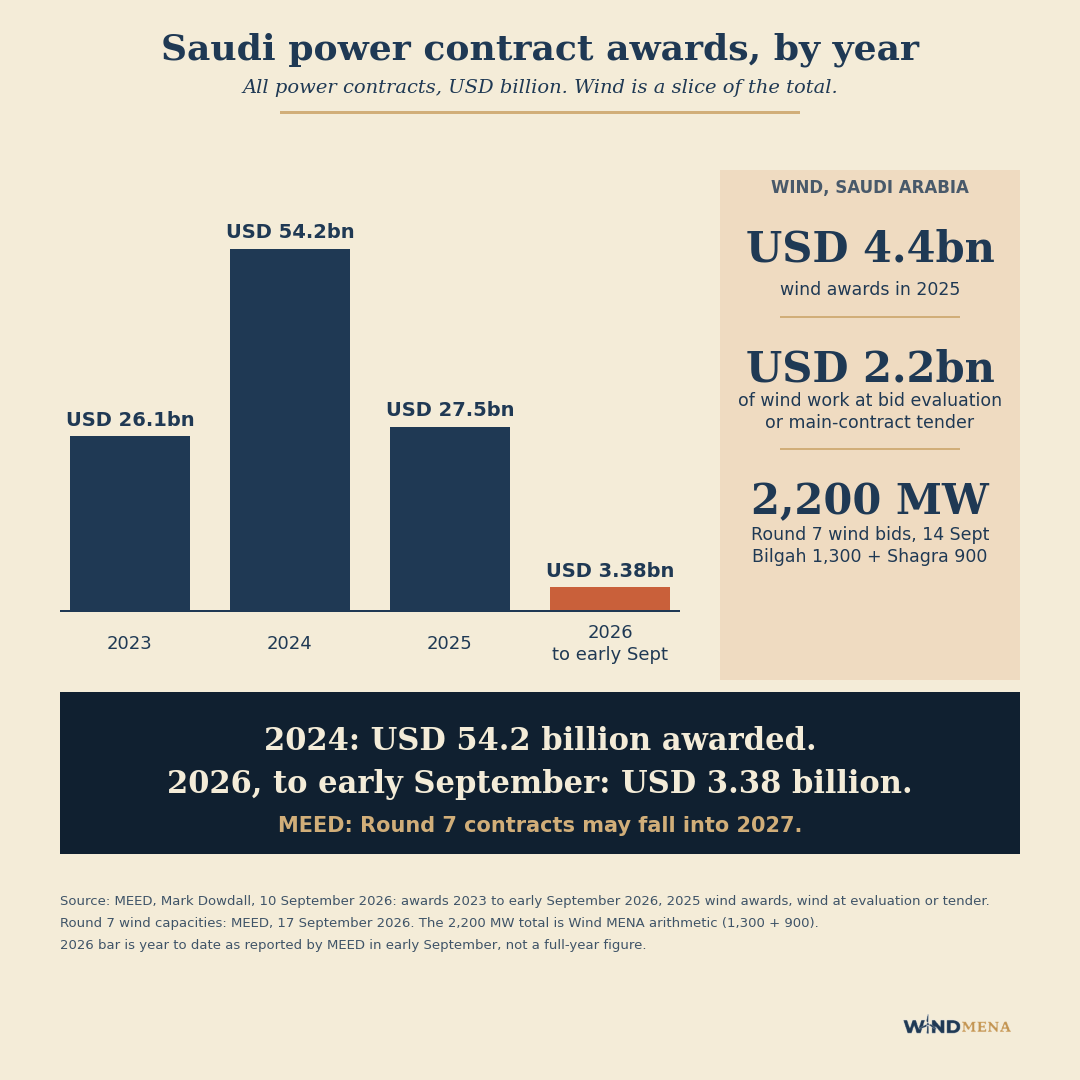
Saudi Arabia awarded USD 54.2 billion of power contracts in 2024. By early September 2026, the year’s total stood at USD 3.38 billion.
MEED’s Mark Dowdall puts 2023 at USD 26.1 billion and 2025 at USD 27.5 billion. Wind took USD 4.4 billion of the 2025 awards, and USD 2.2 billion of wind work is still at bid evaluation or main-contract tender.
Round 7 wind bids were due in September: 1,300 MW at Bilgah and 900 MW at Shagra, 2,200 MW together. MEED says contracts from Round 7 may now fall into 2027 rather than materially lifting this year’s total.
Two cautions. These are all-power figures, with wind one slice of them. And MEED links the slowdown partly to a shift toward battery storage and transmission, alongside Round 7 procurement delays.
Our reading
The wind money is at bid stage, with no awards yet. A bid is a promise. An award is a purchase order, and the supply chain only hears the second one.
Sonelgaz tenders 200 MW of wind in Laghouat and Djelfa, with bids due 25 November
Algeria's only operational wind farm on record is 10 MW near Adrar. The tender lets foreign firms bid alone, requires Algerian firms to partner with a foreign one and includes grid connection. 1 min read
Algeria generates more than 99 percent of its electricity from natural gas, and its entire wind fleet, on IRENA statistics cited by Ecofin Agency, is one 10 MW farm near Adrar. On 30 September Sonelgaz asked the world to build two more, 100 MW each, in Laghouat and Djelfa.
The reported terms say more than the megawatts do. Bids close on 25 November, eight weeks after launch. Foreign firms can bid alone or in consortium. Algerian firms must partner with a foreign one. The scope runs from study and engineering through civil works, supply, assembly and commissioning, with grid connection included.
Two things stand out. First, 200 MW is a third of the 601 MW of renewables Algeria had installed at the end of 2025, per IRENA figures cited by Ecofin Agency. One tender moves the national total. Second, the coverage I found mentions no power purchase agreement, which suggests a build contract rather than a developer-financed IPP. That is my reading, not a confirmed structure.
My prediction: the partnership rule will decide this field before the turbine price does. With eight weeks on the clock, bidders who already have an Algerian partner start ahead, and everyone else negotiates while they price.
In Algeria, the hardest page of the bid may be the partnership agreement.
Will 25 November draw a real field, or only the consortia that formed before the notice landed?
Scatec starts 900 MW Shadwan on a bridge loan, ahead of its project debt
Construction began on 1 October with USD 50 million of Arab Energy Fund bridge financing. Non-recourse debt is expected to close by the end of 2026. 1 min read
Scatec has started building 900 MW of Egyptian wind on a USD 50 million bridge loan, before its long-term project debt has closed.
Construction of the Shadwan onshore wind project began on 1 October, with EDF power solutions targeting a 29 percent equity stake. Capex is USD 716 million and output is about 4 TWh a year. The Arab Energy Fund is providing USD 150 million of three-year equity bridge loans, USD 50 million for Shadwan and USD 100 million for Scatec’s Energy Valley solar and storage project. Non-recourse debt from development finance institutions is expected to reach financial close by the end of 2026, with first-phase commercial operation targeted for the end of 2027.
Why it matters
A bridge loan lets a developer start physical work while lenders finish their own process. For a 900 MW project, we think that can pull a start date forward by months.
What it means for MENA
Scatec has signed mandate letters with a consortium of development finance institutions, and construction now starts ahead of that debt. We read that as Scatec carrying the timing risk until close, which the company guides for year-end. The test is whether the debt lands on schedule and first power follows by end-2027.
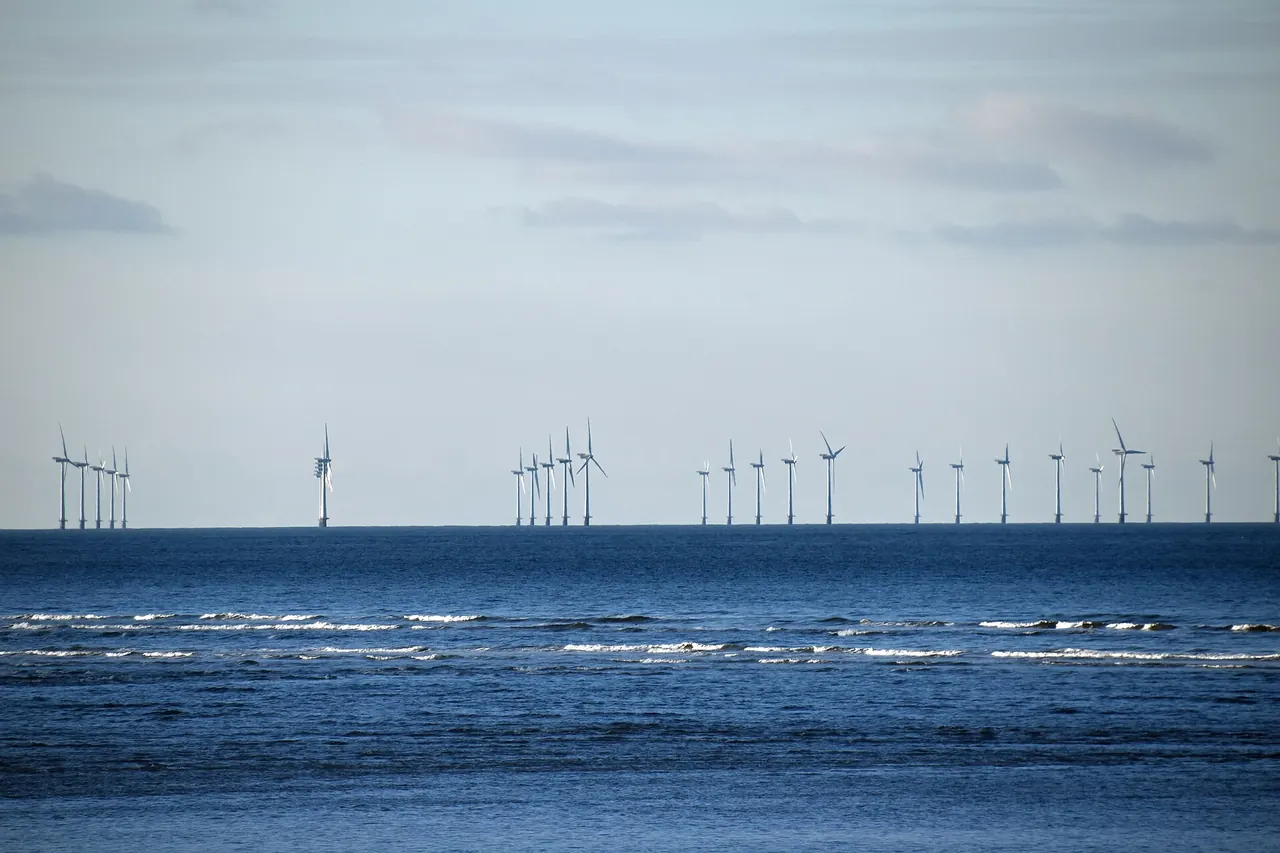
Oman books the world wind conference for December 2027, with two wind farms due first
The first World Wind Energy Conference in the Gulf gives Dhofar II and Jaalan Bani Bu Ali a public deadline. 1 min read
Oman will host the 23rd World Wind Energy Conference (WWEC2027) in December 2027, which Oman Observer reports as the first edition in the Gulf. The World Wind Energy Association board approved the decision, and the announcement came at WindEnergy Hamburg 2026. Nama Power and Water Procurement and WWEA will co-organise, supported by Oman’s Ministry of Energy and Minerals. Nama PWP CEO Ahmed bin Salim al Abri pointed to Dhofar and Al Wusta Governorates as potential centres for utility-scale wind.
Why it matters
WWEA counts more than 600 members across about 100 countries, and its flagship event has now picked a Gulf host for the first time. Developers and financiers will get to size up the market against what has actually been built.
What it means for MENA
The 125 MW Dhofar II Wind IPP (targeting Q3 2027) and the 120 MW Jaalan Bani Bu Ali Wind IPP (2027 startup) will shape what visitors see. If both land on time, Oman arrives with 245 MW of new wind and a pitch for Duqm, Mahout and Sadah. If either slips, the pitch gets harder. A conference date is a deadline with a guest list, and we will be watching the construction calendars.
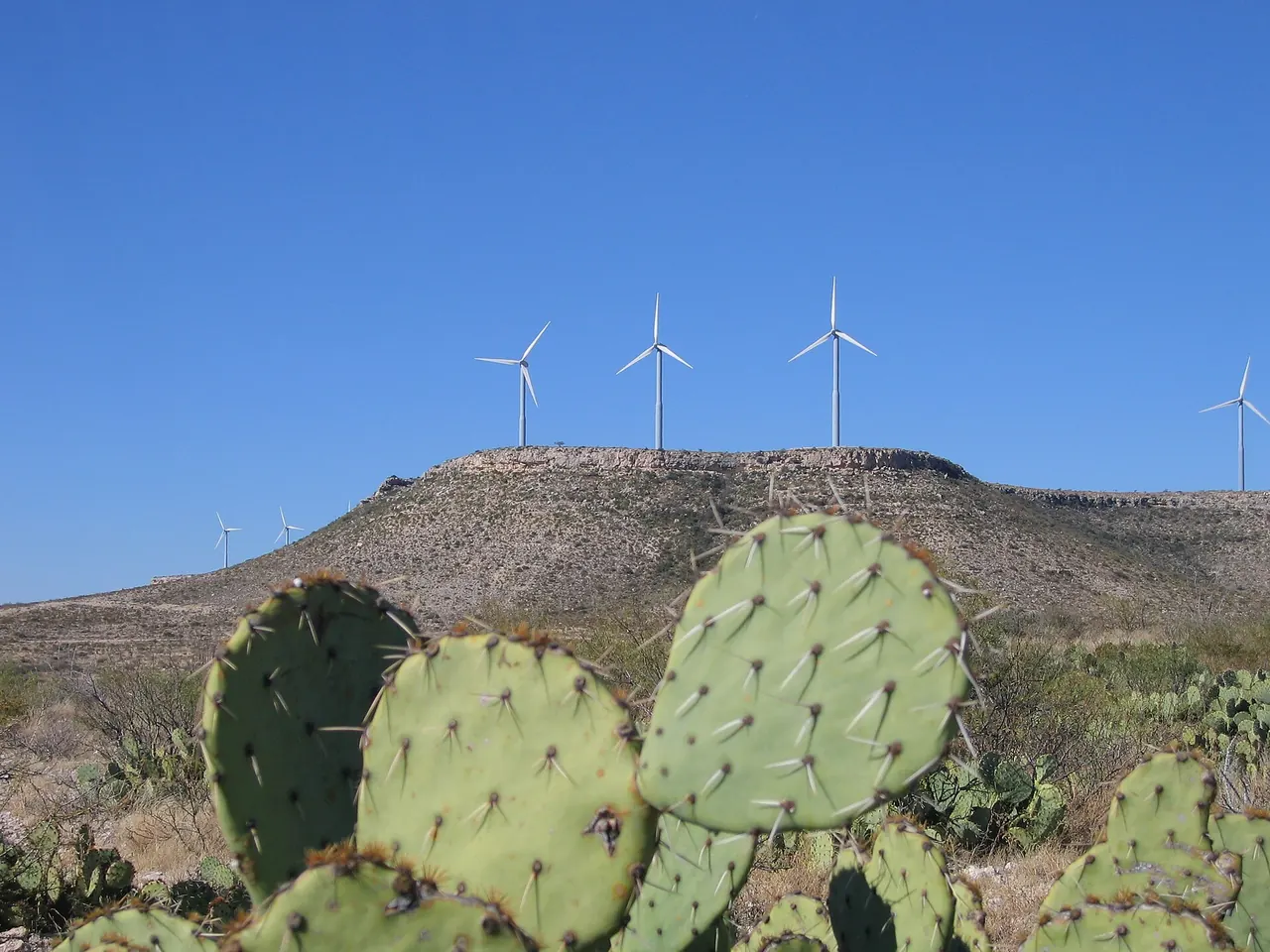
Masdar and Taaleri open the 154 MW Čibuk 2 wind farm, a winner of Serbia's first wind auction
Čibuk 2 stands beside the 158 MW Čibuk 1 in southern Banat. Balkan Green Energy News reports the 312 MW complex as the largest in the Western Balkans. 1 min read
Serbia ran its first wind auction. One of the winners is now sending power to the grid.
Masdar and Taaleri Energia marked the formal start of operation of the 154 MW Čibuk 2 wind farm at a ceremony in Belgrade. The plant stands between the villages of Bavanište and Mramorak in the municipality of Kovin, in southern Banat, beside the 158 MW Čibuk 1 that the same two partners commissioned in 2019. Čibuk 2 secured a market premium at Serbia’s first wind power auction, and its project company signed a power purchase agreement plus balancing and market-premium contracts with state utility Elektroprivreda Srbije. UniCredit and Erste provided the project financing. Nordex supplied the equipment. Balkan Green Energy News reports the combined 312 MW complex as the largest in the Western Balkans, carrying more than EUR 500 million of foreign direct investment and generating the equivalent of the annual needs of an estimated 178,800 households.
Why it matters
An auction result is a price, and a price is only worth what someone builds against it. Čibuk 2 ran the full circuit in a country that had never held a wind auction before. Bid, market premium, PPA, financial close two years ago, turbines turning now. Serbia’s Minister of Mining and Energy, Dubravka Đedović Handanović, said the two Čibuk plants currently account for around 25 percent of the country’s combined wind and solar capacity.
What it means for MENA
Masdar and Taaleri won Čibuk 2 at Serbia’s opening wind auction and carried it to operation. When Saudi Arabia’s NREP and Egypt’s next tranche score these same names, that is the record that should carry weight. A developer who has converted a first national auction into running megawatts has met risks a buyer of finished assets never has.
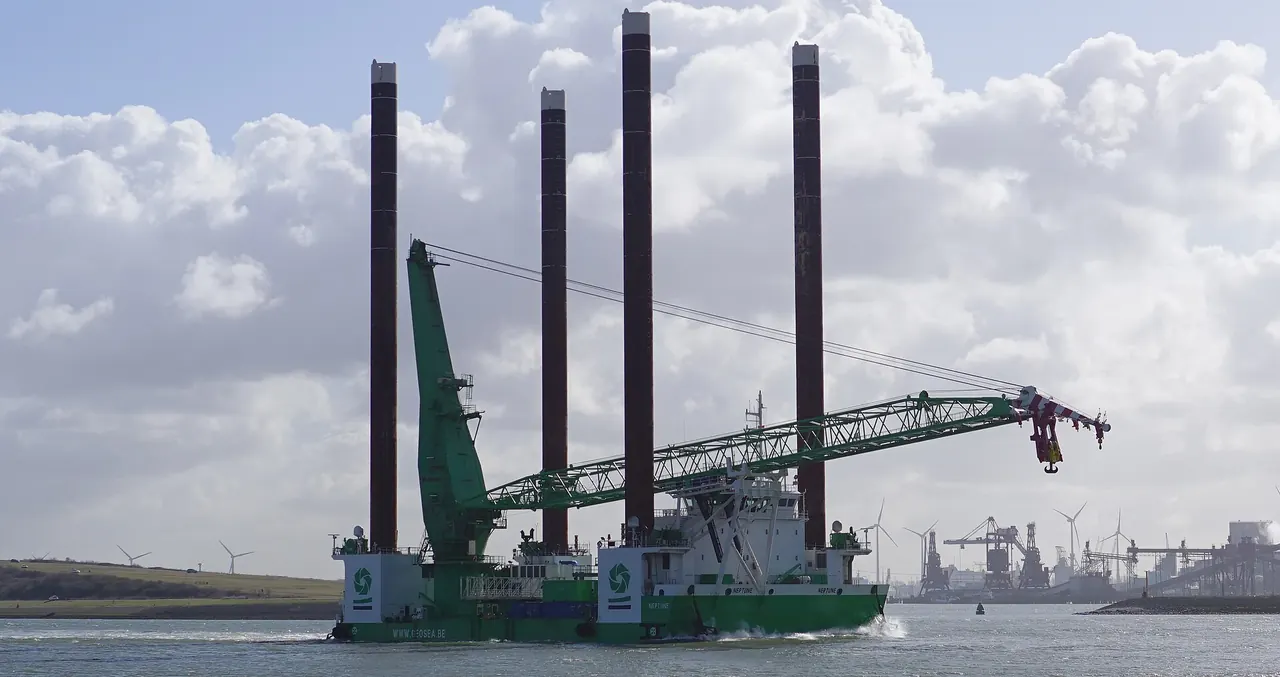
O-Green installs a 9.6 MW wind turbine at Duqm to power Oman's turbine factory
The turbine near the OQ8 refinery stands on a 115-metre tower. Its power goes to Duqm industries, including the neighbouring Mawarid Turbine manufacturing facility. 1 min read
A wind turbine went up beside an oil refinery in Duqm this month, and its electricity will feed the factory meant to build the next ones.
O-Green says it has installed a 9.6 MW turbine near the OQ8 refinery in Oman, on a 115-metre tower with blades close to 100 metres long. Arab News reports it as the largest onshore unit of its kind outside China. The power goes to industries at Duqm, including the neighbouring Mawarid Turbine manufacturing facility. That plant traces to usufruct agreements signed in January between OPAZ, Oman’s special economic zones authority, and Mawarid Turbine, covering three plots at Duqm: one for the factory, one for a single turbine, one for five more. Arab News puts planned annual output at 800 to 1,000 MW, with a first phase costing about 70 million Omani rials, roughly 182 million dollars. O-Green says Omani contractors and specialists worked the job “from engineering and site works through construction and the complex transportation and installation of the tower sections and blades.”
Why it matters
A factory’s power normally arrives from the grid at whatever mix the system is running that hour. This one is being wired to its own product. My read is that captive renewable supply turns an industrial site’s power bill from a tariff into an owned asset, and here it happens on an estate that already runs a refinery.
What it means for MENA
Duqm now has something physical on the plot: a 9.6 MW machine standing near the factory site and feeding it. The test from here is whether the rest of the six turbines in that January allocation go up on schedule, and whether the first blades out of the shed are Omani.
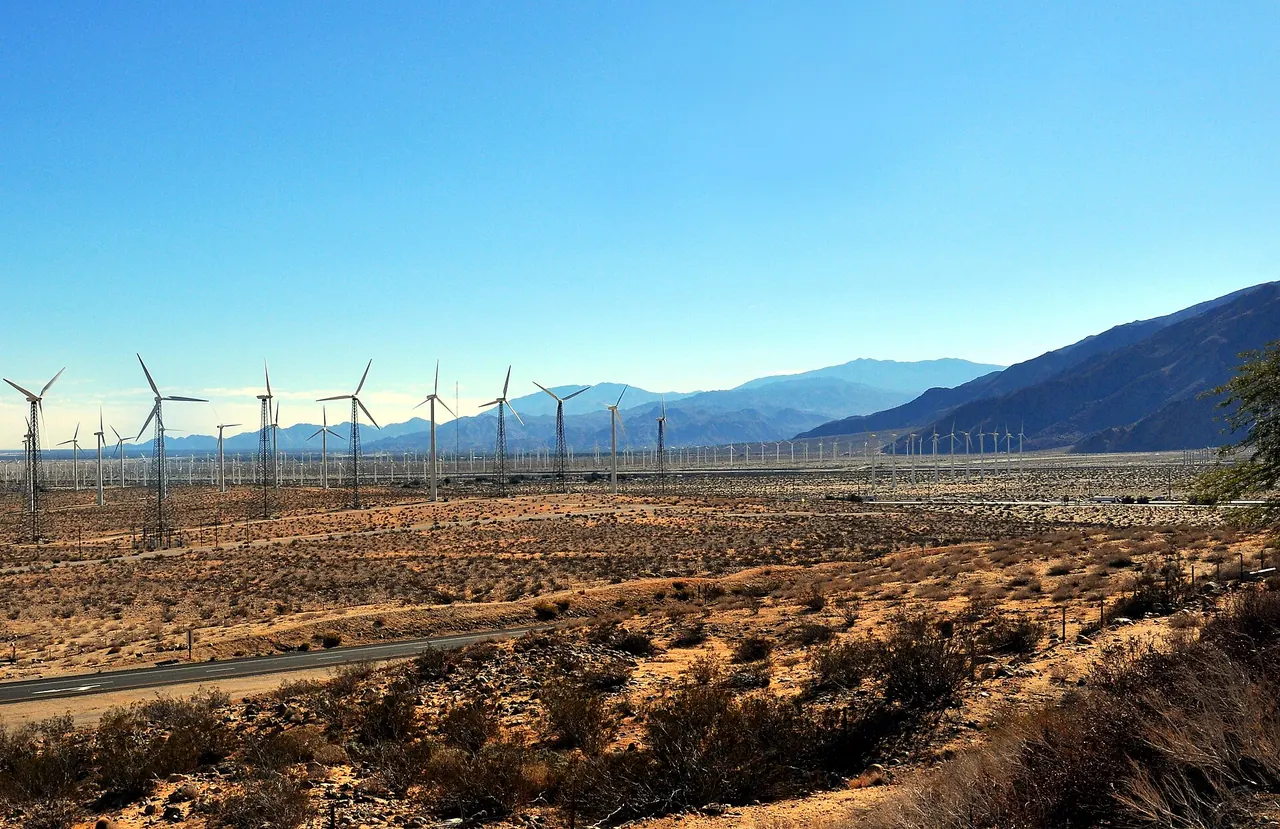
Alcazar closes financing on 131 MW Štip wind farm in North Macedonia on an unnamed corporate PPA
Phase one of Štip reached financial close with about EUR 115 million of senior debt from the EBRD, IFC and Erste Group Bank, and no government offtake support. 1 min read
Alcazar Energy Partners just financed 131 megawatts of wind against a buyer nobody has named.
Alcazar reached financial close on the first phase of the Štip wind farm in North Macedonia, Windtech International reported on 14 September. Twenty-one turbines at 6.25 MW each, 131.25 MW in total, EUR 180 million of investment. Senior debt of roughly EUR 115 million came from the EBRD, the IFC and Erste Group Bank, with Sparkasse Bank AD Skopje supplying a separate local VAT facility. Revenue rests on a long-term offtake agreement with an investment-grade international corporation that the announcement does not name. The plant will run without government offtake support. Phase one is the first of three in a cluster planned at up to 396 MW across Štip, Radoviš and Karbinci.
Why it matters
Two development finance institutions and a commercial bank underwrote senior debt against a corporate offtaker rather than a sovereign-backed tariff. We read this as the structure that financed much of European onshore wind, and Alcazar has now executed it.
What it means for MENA
The wind offtakers we write about here are mostly state entities. Alcazar has now signed the other kind of contract, and its credit team holds a live comparison between a ministry’s covenant and a corporation’s. In our read, what made Štip financeable was a private buyer willing to sign long term. Building a market that produces such buyers is slower work than building the turbines, and it decides who gets to be the counterparty on the next one.
Heavy leading-edge erosion can cut wind output by up to 25%, and MENA builds in Gulf dust
Rolls-Royce runs synthetic desert dust through engines in a £1 billion durability programme. Sandia found blade erosion can cut annual energy production by 5 to 25 percent. 1 min read
In a Rolls-Royce test cell at Sinfin, engineers blow fake Middle Eastern dust through a jet engine on purpose.
The recipe came from geologists and engineers in the DUST group at the University of Manchester, who built a synthetic dust that replicates the fine, talcum-powder-like particles found in desert regions. Standard test dust has the wrong chemistry and would not stress the engine the same way. That work belongs to a one billion pound durability programme aimed at doubling the lifespan of engines such as the Trent XWB-97 by 2028. Modified engines have already returned to service showing a 60 percent increase in time between overhauls.
Aviation folded Middle Eastern dust into a billion-pound durability programme. On the wind side I cannot point to anything comparable.
Sandia National Laboratories measured what erosion does to a blade. Light erosion may cut annual energy production by 5 percent, heavy erosion by as much as 25 percent, and the aerodynamic damage shows up inside the second year of operation.
MENA keeps building wind into desert air.
So I would ask one question earlier than it usually gets asked, and I would point it at the asset rather than the tender: which leading-edge protection system went on these blades, and what erosion curve went into the twenty-year energy forecast? Answer it in the specification and it costs a coating. Answer it in year three and it costs output for the seventeen years still to come.
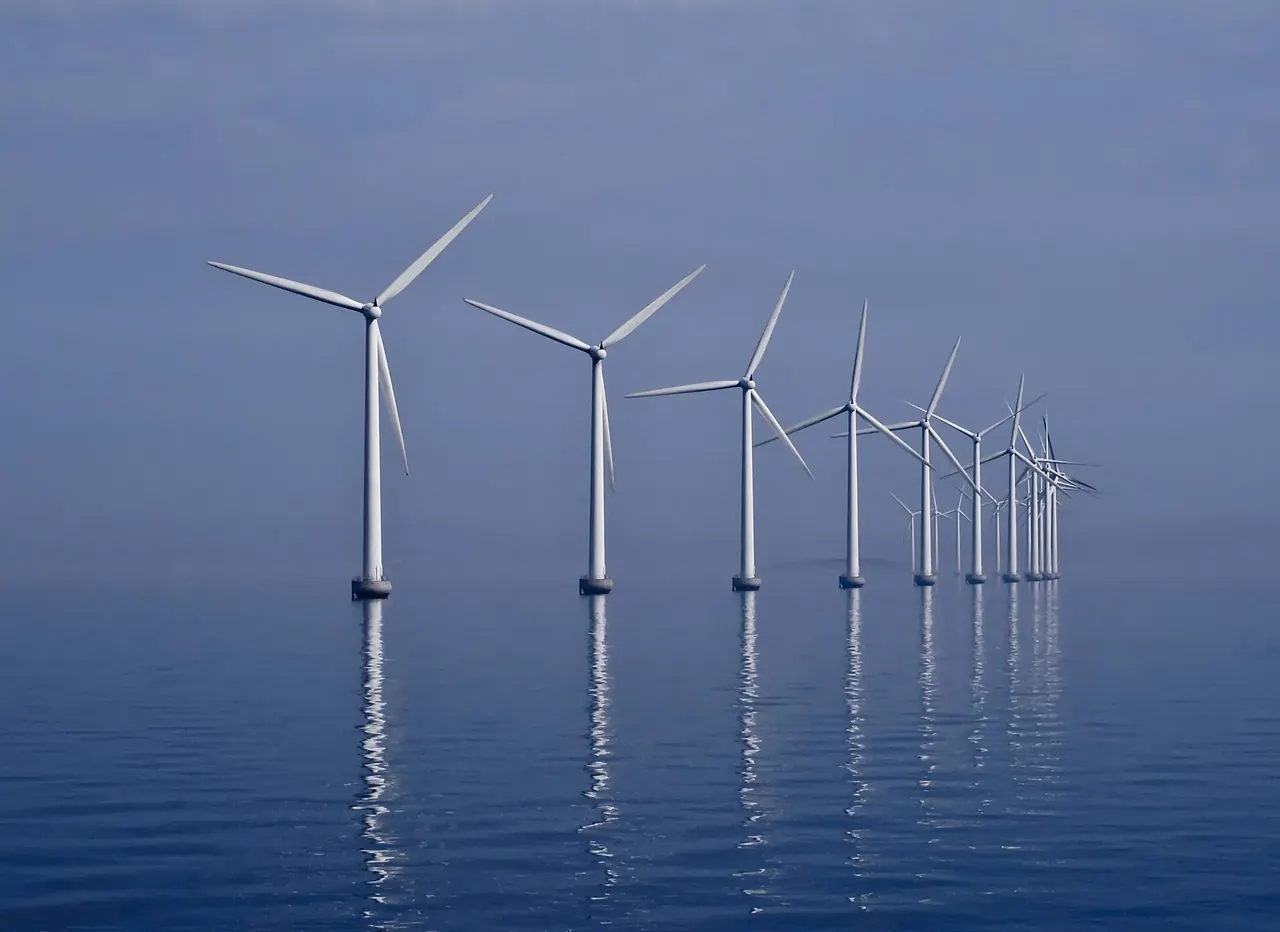
Masdar and RWE agree to consider joint bids in German offshore wind auctions, above EUR 3 billion
A separate Masdar MoU with Luxcara covers storage and offshore wind, potentially above EUR 5 billion. Together they could open the way for more than EUR 8 billion of investment. 1 min read
Two agreements announced last week would take Masdar into German offshore wind at the auction stage.
Masdar signed a memorandum of understanding with RWE to consider joint participation in future German offshore wind auctions, at an indicative investment value of more than EUR 3 billion. Reuters puts the auctions in question at Germany’s 2027 round. A separate MoU with Luxcara, a German energy infrastructure asset manager, covers battery storage, offshore wind and potentially other technologies across Germany and wider Europe, with a potential value above EUR 5 billion. Neither document commits either side to a project: one is an agreement to consider, the other to explore. Masdar and RWE already co-invest in the 630 MW London Array and are jointly advancing the 3 GW Dogger Bank South projects off northeast England.
Why it matters
Masdar says it has invested more than USD 13 billion in Europe and built a portfolio above 15.6 GW, and its first German project is the 476 MW Baltic Eagle, developed with Iberdrola and fully operational since 2025. Considering an auction is a different risk class from acquiring a finished asset. You take development, permitting and price risk before a single foundation exists.
What it means for MENA
An investor that has priced seabed risk in a European auction is a different counterparty to one that only buys operating megawatts. When MENA brings its own first offshore rounds to market, Masdar may already have sat on the bidder side of that process. In my view, that capability is worth more to this region than the euro figure attached to the headline.
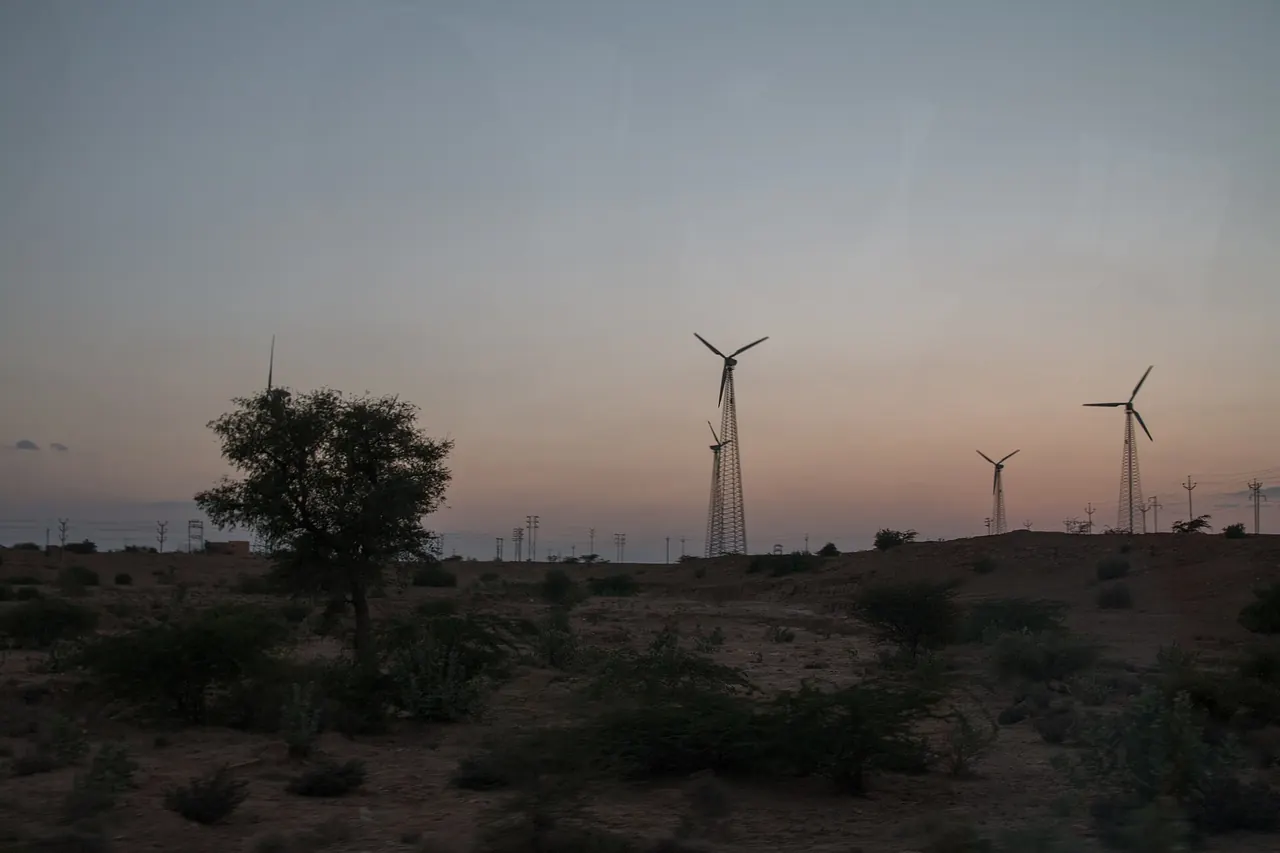
Kazakhstan targets Q3 2029 full operation for Masdar's 1 GW Zhambyl wind plant
The Energy Ministry set the date ten weeks after the 29 June groundbreaking. The project pairs 1,000 MW of wind with 300 MW / 600 MWh of storage for about $1.4 billion. 2 min read
Ten weeks after the capsule went into the ground at Zhambyl, Kazakhstan’s Energy Ministry has put a quarter on Masdar’s 1 GW wind plant. Q3 2029.
The date came out of a meeting between Energy Minister Yerlan Akkenzhenov, Masdar Chief Development and Investment Officer Abdullah Zayed and UAE Ambassador to Kazakhstan Mohammed Saeed Mohammed Al Ariki. The project pairs a 1,000 MW wind plant with 300 MW of storage rated at 600 MWh, on total investment of around $1.4 billion, and construction opened with a capsule-laying ceremony in Zhambyl region on 29 June. The AIIB project file for the same asset, published on 3 April and still listed as proposed with the funding amount to be determined, fills in what the ministry readout leaves out. It counts 140 turbines and two 220 kV overhead lines running roughly 300 km to the existing Zhambyl and Kentau substations, and it states that those lines will be transferred to the Government of Kazakhstan after the scheduled commercial operation date.
Why it matters
Three years and one quarter between a groundbreaking and full operation is a schedule built around more than turbine erection. The AIIB file names the rest of it. Three hundred kilometres of line into two substations. A single-offtaker PPA with the state settlement centre, priced in dollars and paid in tenge at the rate on the day. A Category A environmental classification with five biodiversity receptors rated Critical Habitat and turbines that shut down on demand when priority bird species are flying.
What it means for MENA
Gulf sponsors keep exporting equity, and in our read the terms they accept abroad tend to become the terms they argue for at home. A developer willing to build 300 km of transmission and hand it to a government has priced that somewhere, and we have not seen it in a headline tariff. Who builds the wire, who owns it after commercial operation, and who carries it until first power is, in our view, a line item MENA procurement rarely publishes and every serious bidder models.
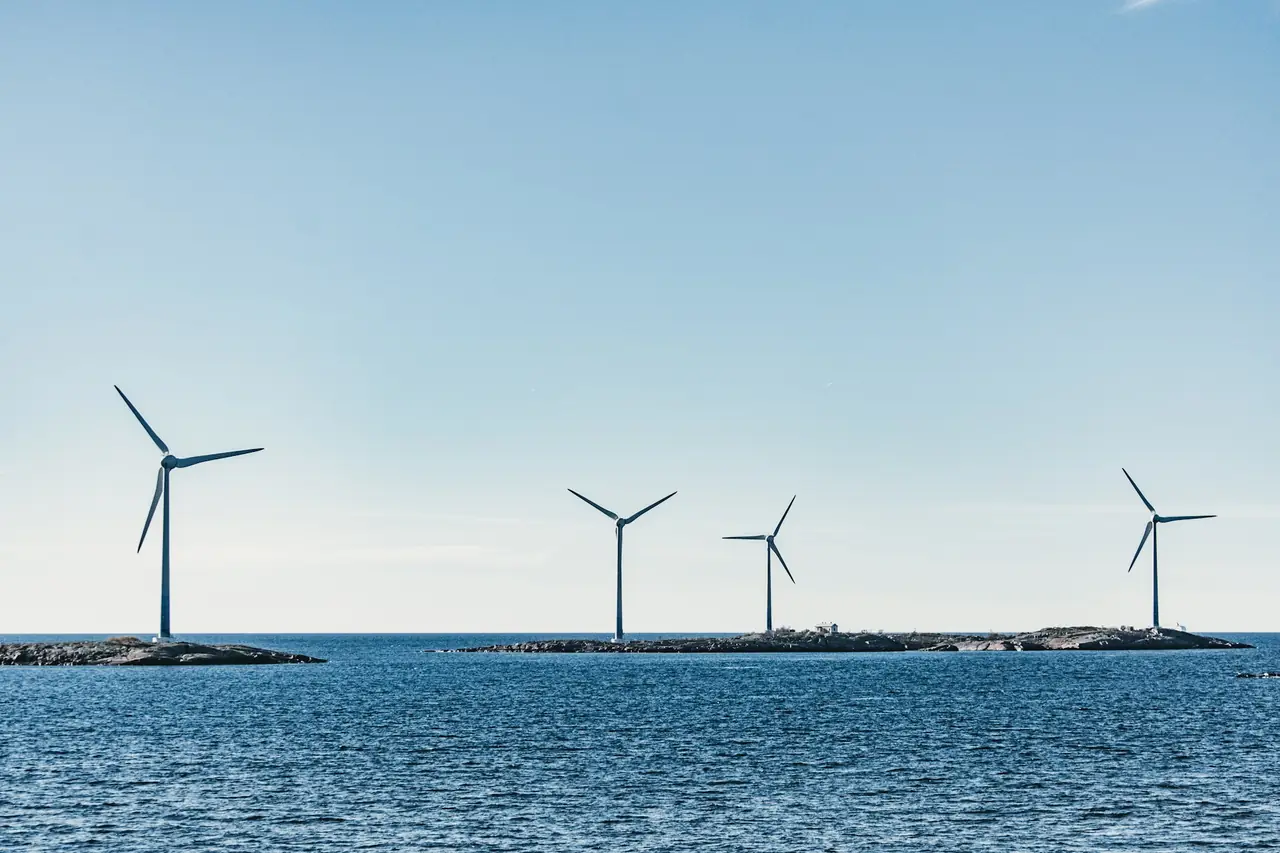
EIB appoints OWC-led consortium for feasibility study on Morocco's first offshore wind farm
The two-year study, endorsed by MASEN, targets the Atlantic coast near Essaouira and covers site selection, a met campaign, ports, grid integration and permitting. 2 min read
Morocco has picked the coast, the gigawatt figure and the construction year for its first offshore wind farm, and last week the European Investment Bank appointed the consortium that will work out whether the thing can actually be built.
The EIB picked the consultancy OWC to lead a full feasibility study for the project, which MASEN has endorsed and which targets the Atlantic coast near Essaouira. Joining OWC are PHENIXA and SOFECO, both part of Ginger Group, alongside Gaïa Terre Bleue and NOVEC, with ABL covering marine work, ports and harbours. EIB is funding the two-year study through the Facility for Euro-Mediterranean Investment and Partnership Trust Fund. The scope covers site selection, a meteorological measurement campaign, concept design, ports and logistics, the regulatory framework, grid impact and integration alongside Moroccan grid specialists, and the environmental and social impact assessment. EIB and MASEN signed a cooperation agreement on offshore wind in September 2022 with a EUR 2 million grant, and the technical-assistance tender that followed was cancelled in July 2024 before being relaunched.
Why it matters
Read that scope list again. Site data, port capacity, grid rules, permitting law. We would argue every offshore market needs those four before its first auction can clear, and they take years to produce because they cannot be imported from someone else’s coastline. World Bank Group estimates put Morocco’s technical offshore potential at roughly 200 GW, about 22 GW of it suitable for fixed-bottom and 178 GW for floating. Potential is the cheap part.
What it means for MENA
The regional offshore conversation trades in gigawatt figures and end-of-decade dates, and this award is a reminder that four years separated the 2022 EIB-MASEN agreement from the study that starts the real clock. Morocco is buying the unglamorous layer first. A met campaign, a grid study, a legal framework. Plans had advanced to a proposed 1 GW project near Essaouira with construction targeted to start by 2029, per the Union for the Mediterranean as of June 2025. My read: whoever eventually bids that gigawatt will price it off data this consortium is now being paid to collect, which makes the met campaign more worth watching than the tariff talk.
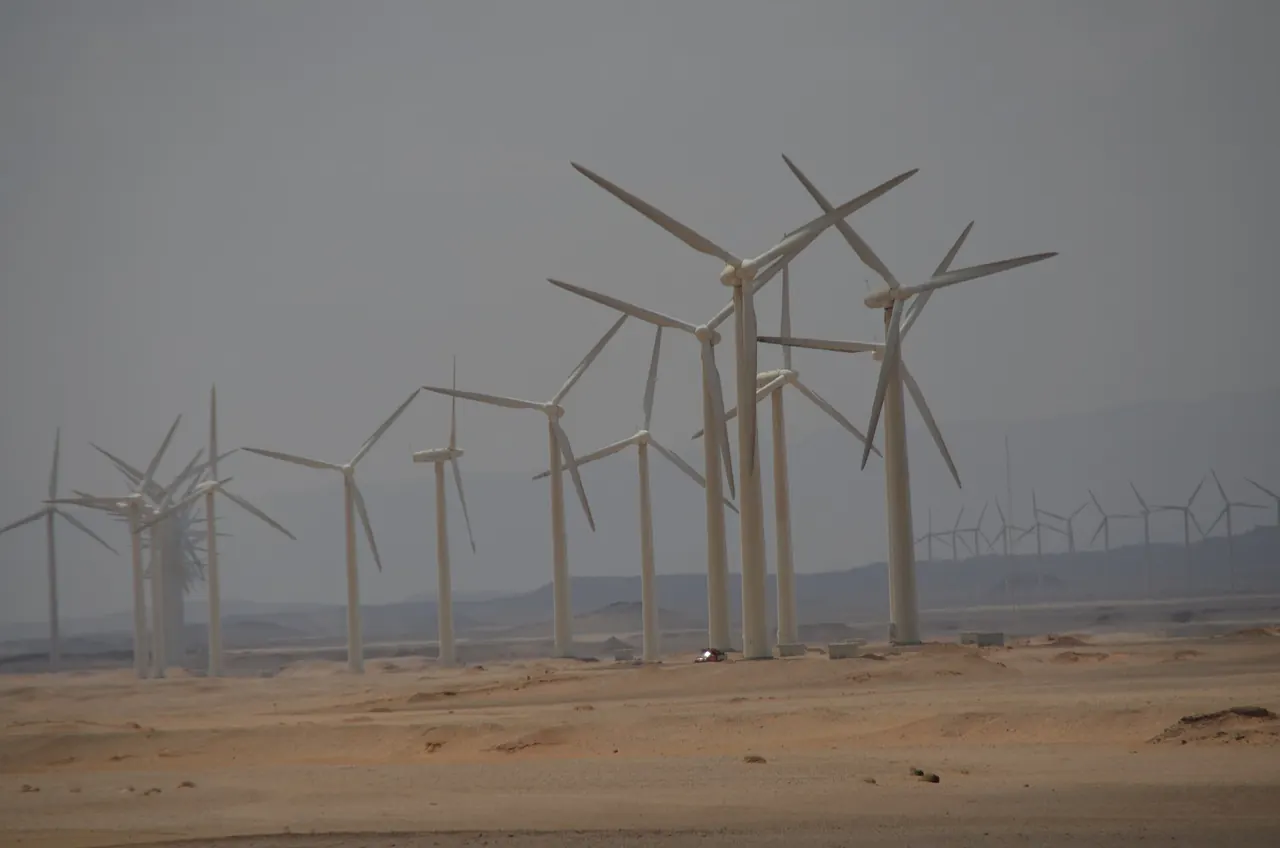
Alcazar signs terms to buy Egypt's 580 MW Gabal El Zeit wind farms from NREA
The fund would take full operational responsibility for three Red Sea wind farms with turbines averaging eight to ten years of service, selling to EETC under a 25-year PPA. 1 min read
Daniel Calderon’s firm has been putting new renewable capacity into Egypt since 2014. In June it signed terms to buy 580 megawatts that were already turning.
Gabal El Zeit is three operational wind farms on the Red Sea coast, Siemens Gamesa machines averaging eight to ten years of service. Under the terms Alcazar Energy Partners agreed with the New and Renewable Energy Authority, the fund assumes full operational responsibility, extends the asset’s useful life and sells the output to EETC on a 25-year power purchase agreement.
Calderon, Alcazar’s co-founder and managing partner, said in June: “Alcazar Energy is very pleased to contribute, with this project, to Egypt’s privatization efforts supported by the IMF. Together with our 500 MW NIAT Wind project, this investment will also help mobilize close to USD1.0 billion of capital for Egypt’s clean energy sector over the coming months.”
I read the contract as arithmetic first. Machines with eight to ten years behind them, contracted to sell power for twenty-five more, finish at thirty-three to thirty-five years in service. Whoever signs that is underwriting the service crew as much as the wind speed.
What holds my attention is the direction of travel. Alcazar arrived in Egypt as a greenfield investor and built there: four projects at Benban totalling 256 MWp, then a 2 GW onshore wind platform agreed with the government in November 2024. Now it is buying what the state already built. The announcement calls Gabal El Zeit the first strategic renewable power asset offered under Egypt’s privatisation framework.
If this one clears, a state-owned megawatt in this region earns twice. Once from the grid, once from the sale. Which fleet goes on the block after it?
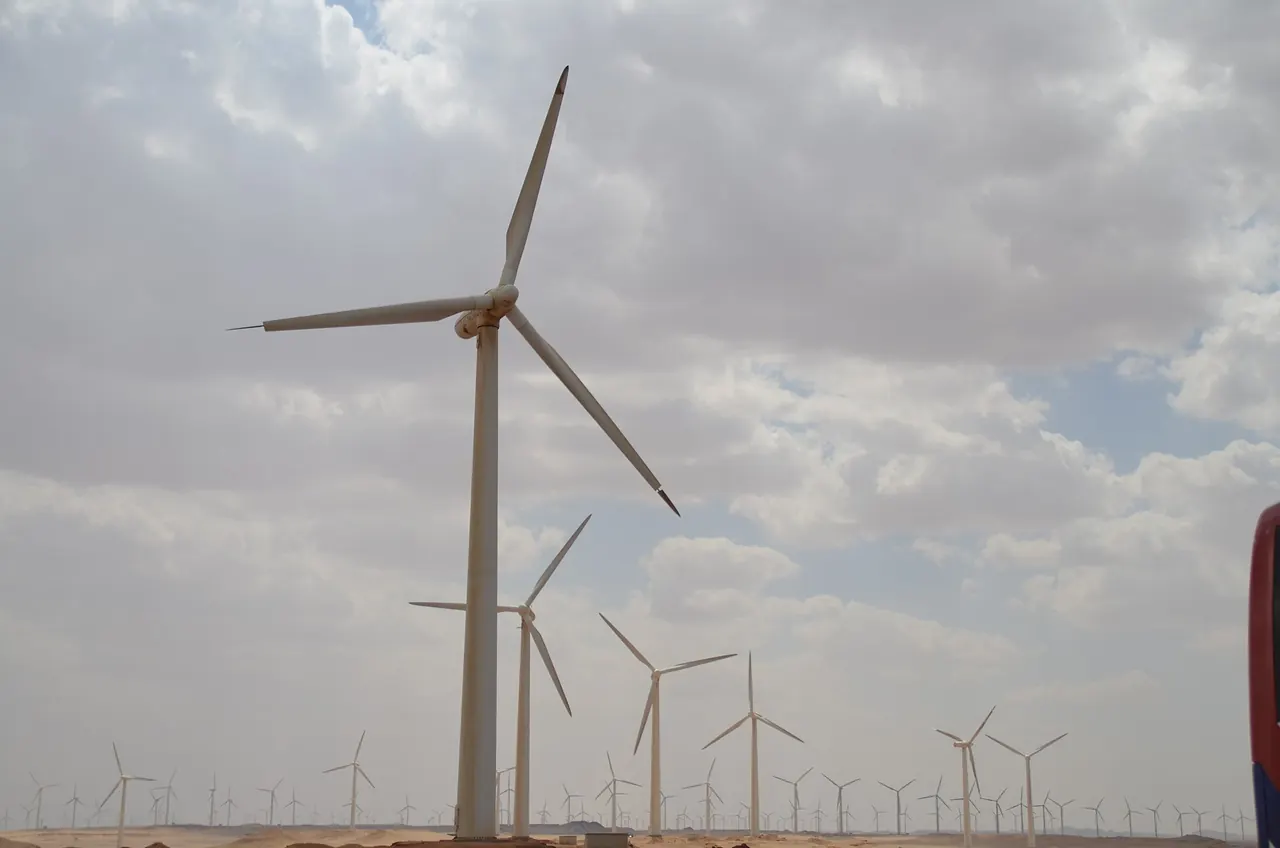
PowerChina's Egyptian wind portfolio passes 1.8 GW across three projects
The contractor counts the operating 500 MW Amunet farm plus the 1.1 GW Gulf of Suez and Ras Ghareb projects under construction, with Elalamya on civil works. 1 min read
One contractor has now built or is building more than 1.8 gigawatts of Egyptian wind.
PowerChina said this month that its Egyptian wind portfolio has passed 1.8 GW across three projects: the 500 MW Amunet farm in the Gulf of Suez, now operating, plus the 1.1 GW Gulf of Suez project and the Ras Ghareb project, both still under construction. The company has worked in Egypt since 2012. It also named Elalamya General Contracting, the Egyptian civil works firm it first engaged on Amunet in 2023 and has since taken onto the other two sites. Amunet was poured in temperatures above 40 degrees Celsius, with concrete scheduled outside the hottest hours and turbine lifts timed against wind speed. Last month PowerChina began work on Sungrow’s battery manufacturing plant at Ain Sokhna, on a 50,000 square metre plot.
Why it matters
Turbines are bought in a global auction. Foundations are poured by whoever is already on that coast with the crews and the batching plant. My read is that the second market is far smaller than the first, and when one contractor builds two projects at once, a single schedule slip can land on two balance sheets.
What it means for MENA
We expect Saudi Arabia and Oman to convert larger wind pipelines into construction next. I think their sponsor lists will look nothing alike and their contractor lists may look almost identical. Egypt is where that shows up first, because Egypt has two of these sites under construction with the same contractor and the same civil works subcontractor.
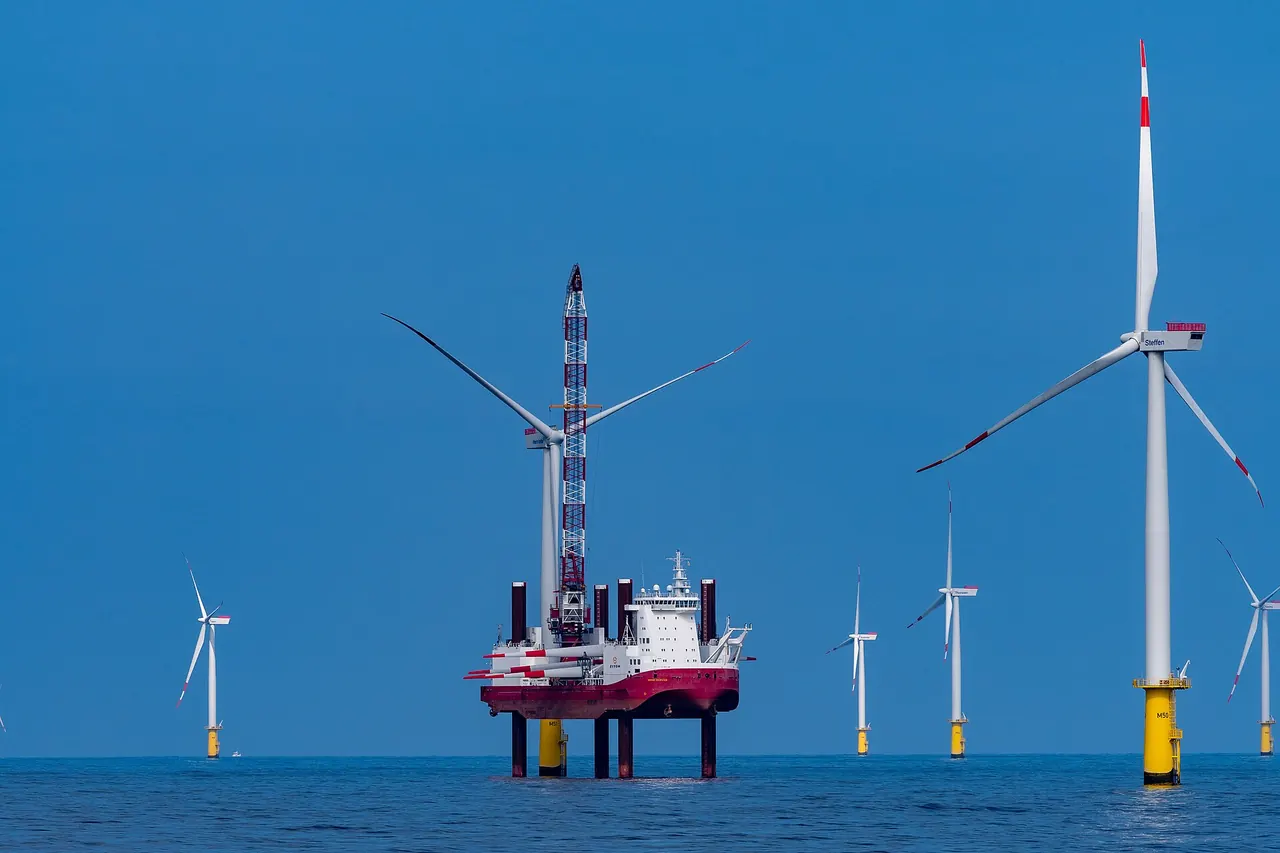
Oman's first wind turbine factory signs a university to train about 321 Omani graduates
Mawarid Turbine and the National University of Science and Technology agreed in February to train graduates in blade manufacturing and nacelle assembly for the Duqm plant. 1 min read
Oman’s first wind turbine factory has a Chinese EPC contractor and a Chinese technology licensor. The part it went to a university for was people.
On 4 February this year, Mawarid Turbine Company and the National University of Science and Technology signed a cooperation agreement to qualify approximately 321 Omani graduates for the plant being built in the Special Economic Zone at Duqm. Oman News Agency described the group as the first national batch to receive specialised industrial training in wind turbine manufacturing. Mustafa bin Mohammed al Hinai, CEO of Mawarid Turbine, and Dr Ali bin Saud al Bimani, the university’s Vice-Chancellor, signed it. Dr Abeer bint Ali al Kalbani, who directs national competency development and local content at Mawarid Turbine, said the programme would start that same month and would concentrate on blade manufacturing and the assembly of nacelle units. I have not found a published account of where that cohort stands today, so read this as February’s plan rather than this month’s result.
Four months later, on 10 June, the Oman subsidiary of China Energy Engineering Corporation’s Shanxi institute took the EPC contract for roughly 90,000 square metres of workshops and supporting facilities at Duqm. Shanghai Electric Wind Power holds the technology licence and the knowledge-transfer role, which includes sending Omani engineers and technicians to China for training.
What I keep coming back to is the sourcing pattern. The plant is Omani-owned, Chinese-built and Chinese-licensed. The workforce is the one input Oman went to a domestic university to secure.
In my reading, most localisation targets in this region are written as percentages and gigawatts. My view is that blade layup and nacelle assembly are hand skills that take years to become reliable, and 321 is a number you can count.
Who is running the second batch?
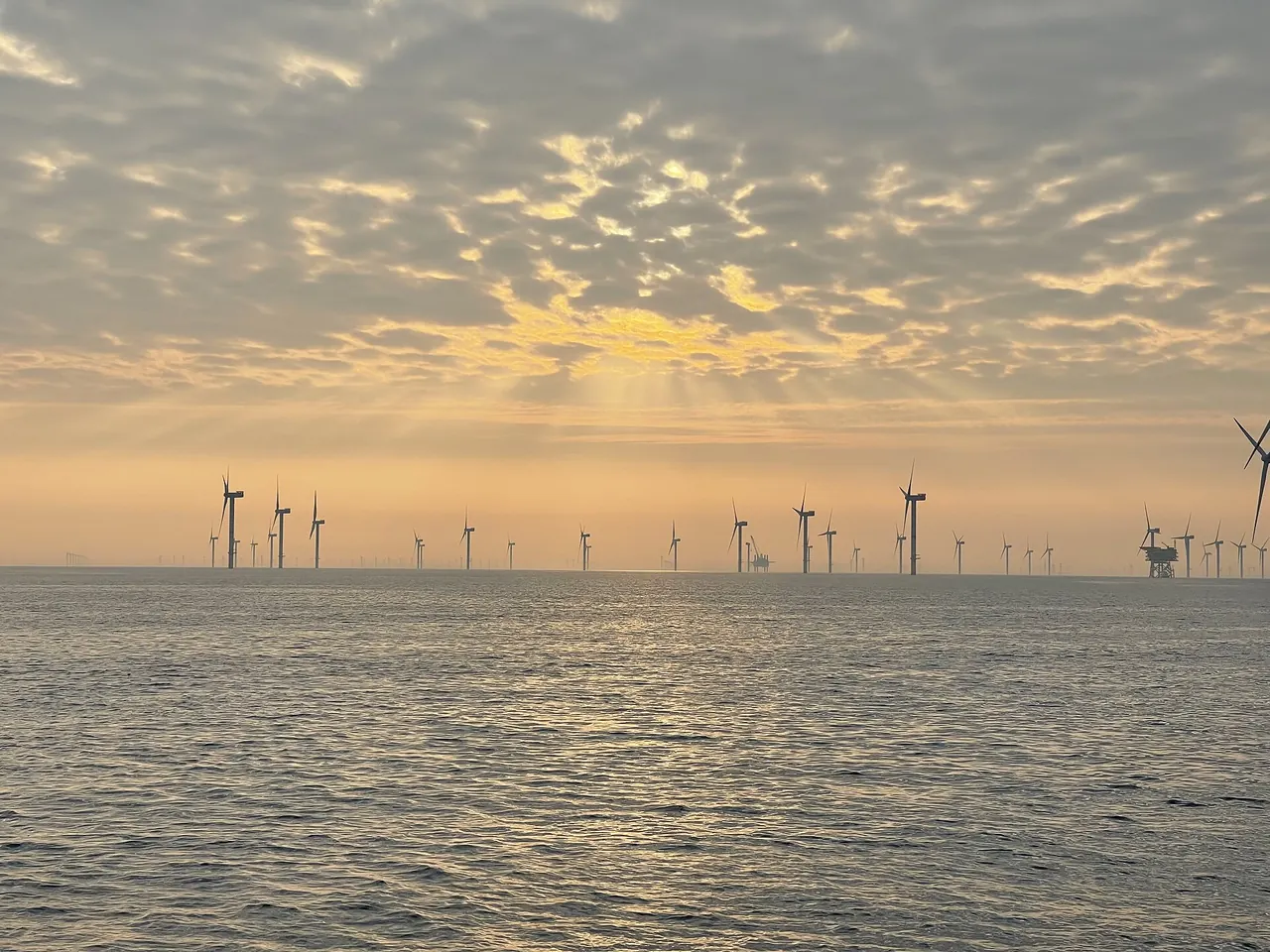
Masdar's 2 GW Bahrain wind deal cites three credentials that read as a near-shore specification
In May 2024 Masdar and Bapco Energies agreed to explore up to 2 GW of near-shore and offshore wind in Bahrain, citing London Array, Dumat Al Jandal and the UAE Wind Program. 1 min read
Masdar listed three of its own wind projects as credentials in the Bahrain announcement. Read together, they are a specification.
In May 2024 Masdar signed an agreement with Bapco Energies to jointly explore the development of and investment in wind projects in Bahrain with a capacity of up to 2 GW. The agreement covers near-shore and offshore wind farms. Masdar’s release called it Masdar’s first agreement in the Kingdom and the first project of its kind in the region and the Middle East. Mark Thomas, Bapco Energies Group Chief Executive Officer, called it a bold step towards the ambitions set out in Bahrain’s National Energy Strategy, which targets a 30 percent emissions cut by 2035 and net zero by 2060.
Now read the three reference projects Masdar put in the same release.
The 630 MW London Array in the UK, which powers half a million British homes. That is the offshore build.
The 400 MW Dumat Al Jandal in Saudi Arabia. That is the regional onshore build.
The 103.5 MW UAE Wind Program, which in Masdar’s own words uses technology to capture low wind speeds at utility scale. That is the resource problem.
Three competencies, in three separate places. What I keep coming back to is that a near-shore Gulf wind farm would be the first job asking all three to work at once: marine construction, regional operating conditions, and machines that earn a return in slow air. Bahrain’s entry point is water.
Two gigawatts of exploration is a headline. A low-wind-speed turbine turning in salt water is an engineering brief.
That agreement was signed more than two years ago and I make no claim about where it stands today. The question I would put to the room is narrower. When a Gulf state does go offshore, does it import the North Sea playbook or write its own?
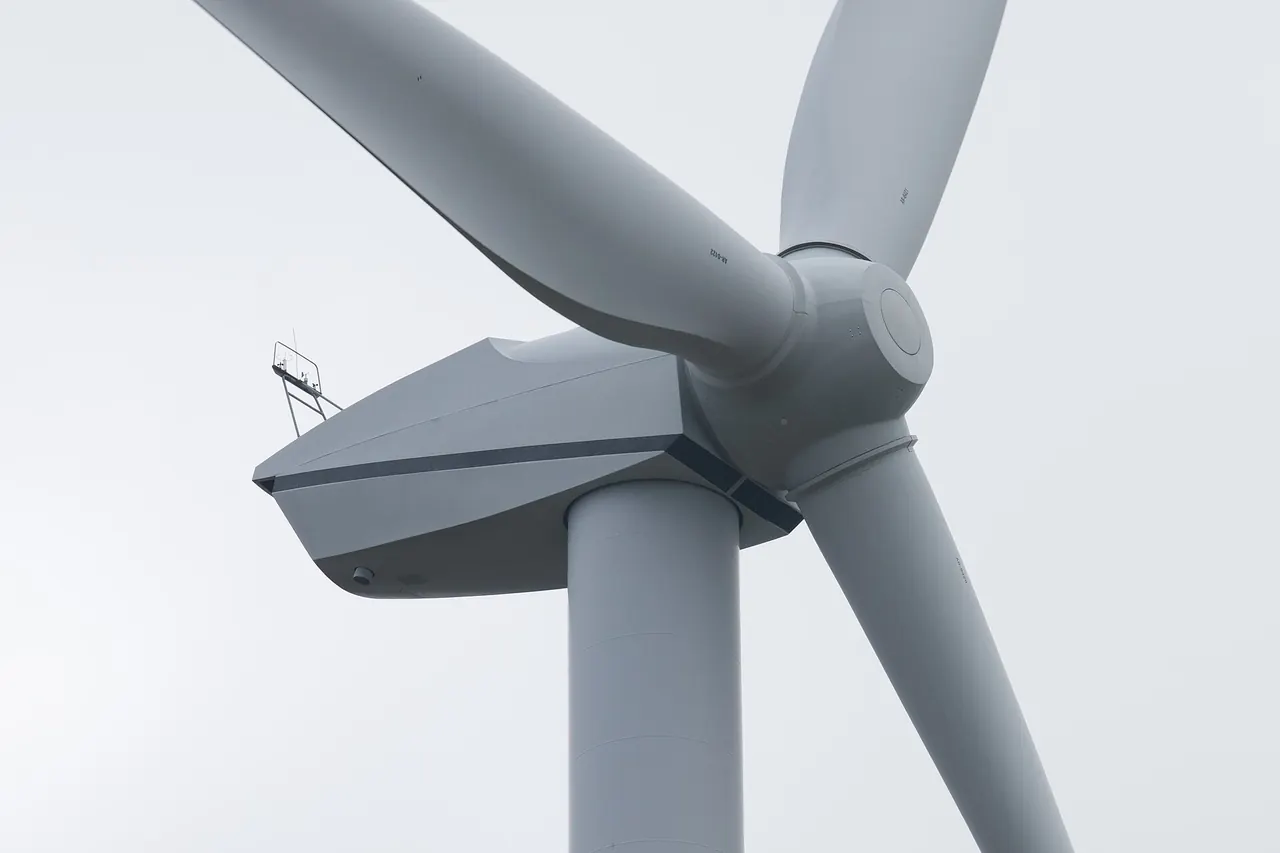
Syria's 700 MW wind deal with Marv Energy plans 140 turbines from one factory in Homs
Syria's Ministry of Energy signed with Marv Energy in February. The company says production will take place at its Homs plant, in phases, over five to seven years. 1 min read
Seven hundred megawatts. One hundred and forty turbines. One factory in Homs that has to build them.
In February, Syria’s Ministry of Energy signed a wind power agreement with Marv Energy at the ministry’s headquarters in Damascus. Energy Minister Mohammad Al-Bashir signed for the government, board member Valerina Elias for the company. Deputy Minister for Electricity Affairs Omar Shaqrouq said the 700 MW will feed the national grid rather than any single province, and that turbine sites will be chosen on measured wind speeds across the country. No locations have been named. Elias said production will take place at the company’s plant in Homs, in phases, over five to seven years, and called the project a “proof stage” for Syrian industry.
Do the division. 700 MW across 140 machines gives 5 MW per turbine, a mainstream onshore size today. Spread over five to seven years, the build rate sits somewhere between 100 and 140 MW a year. For scale, the same ministry signed in November for eight power plants totalling 5,000 MW.
Hold that annual rate against the regional one. GWEC’s latest report puts Africa and Middle East additions at 2.6 GW in 2025, up 32%, with Saudi Arabia taking 1,512 MW of that on its own. Cumulative installed capacity across the region reached 15.2 GW.
What I keep returning to is the order of operations. Saudi Arabia and Oman are building turbine plants into markets that already carry order books, and GWEC counts those announced manufacturing investments among the things that could take the Middle East past 18 GW of new onshore wind by 2030. The Homs plan puts the factory first and asks a phased build to keep it running.
Localisation in this region has generally followed demand. Can it lead it?
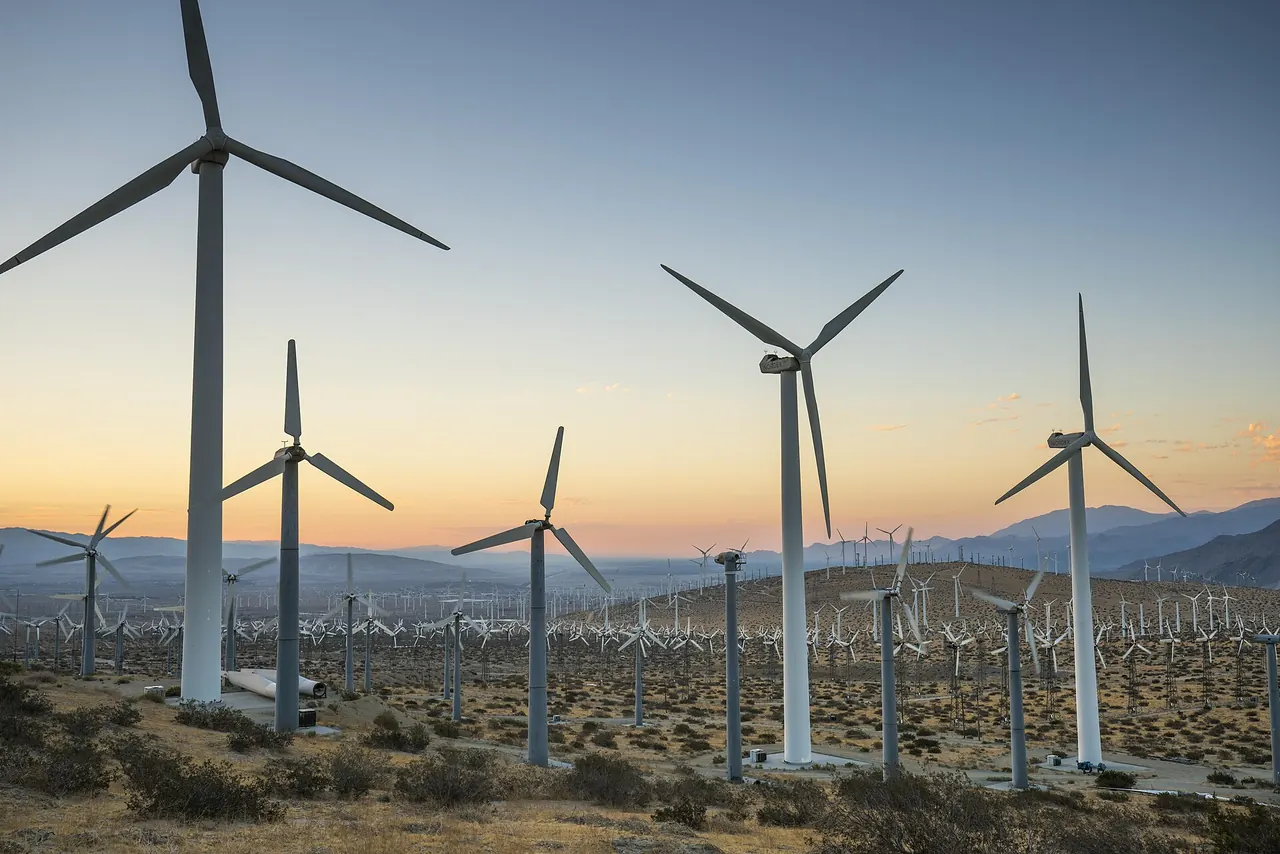
Oman's 125 MW Dhofar II wind farm will free about 76 million cubic metres of gas a year
Nama PWP's CEO put the gas figure beside 396,754 MWh of annual output. Oman shipped 11.9 million tonnes of LNG in 2025, above its 10.4 Mtpa liquefaction capacity. 1 min read
Nama Power and Water Procurement’s chief executive gave a number at the Dhofar II signing that I have rarely seen repeated. The wind farm will free up around 76 million cubic metres of natural gas a year.
The rest of the project reads normally. Dhofar II is 125 MW, twenty Windey WD200 turbines at 6.25 MW each, 215 metres to the tip, built and owned by Sembcorp and OQ Alternative Energy under a 20-year power purchase agreement, commercial operation targeted for the third quarter of 2027. Annual generation of roughly 396,754 megawatt-hours. Ahmed bin Salim Al Abri put the gas figure beside it in the same statement.
Divide one by the other. Every megawatt-hour Dhofar II makes hands Oman back about 192 cubic metres of gas. Read backwards, my arithmetic puts that close to what a combined-cycle plant burns to produce the same unit.
Then look at where Omani gas goes. The country shipped 11.9 million tonnes of LNG in 2025, eighth largest exporter in the world at 2.7% of global trade, against installed liquefaction capacity of 10.4 million tonnes a year. The International Gas Union put Oman above nominal capacity for the year. My read is that feedstock, more than nameplate, is what limits those trains.
I read Dhofar II’s contract as paying Oman twice. Nama PWP buys electricity at a tariff. The state collects molecules back, in a system whose export plants ran past their nameplate last year.
We keep judging Gulf wind tariffs against the domestic cost of gas. What does the same tariff look like priced against the export gate?
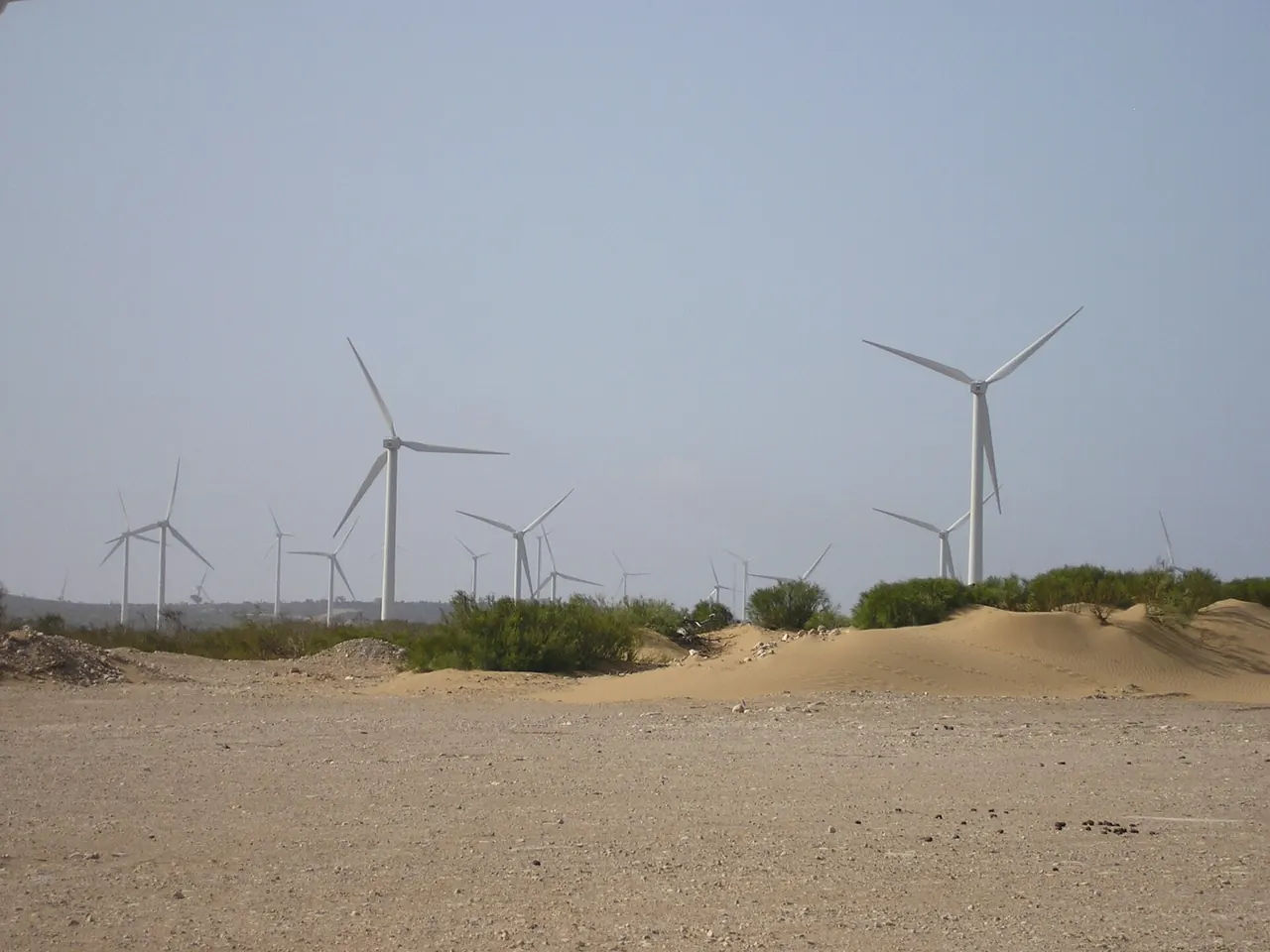
Morocco's wind output rose 43% in 2024 on 18.5% more capacity, ANRE data shows
Installed wind reached 2,390 MW at end-2024 and generation 9,363 GWh, 21% of Moroccan electricity. IPPs took 47% of wind output and private operators 43%. 1 min read
Morocco’s wind fleet grew 18.5% in 2024. Its wind output grew 43%.
Two projects account for most of the new capacity: Jbel Lahdid, 270 MW near Essaouira under an IPP contract with ONEE, and the 100 MW repowering of Koudia al Baida in Tetouan, delivered with MASEN. That took installed wind to 2,390 MW at the end of 2024, or 20% of the country’s total generating capacity. Generation reached 9,363 GWh, up 43% on 2023, covering 21% of all Moroccan electricity and 80% of renewable output. The figures come from ANRE, Morocco’s electricity regulator, in its latest annual report. In June 2026 ACWA Power Maroc received approval to add 40 MW at Khalladi near Tangier, taking that site from 120 MW to 160 MW; the existing 40 turbines there produce roughly 397 GWh a year.
Why it matters
Capacity gets announced, generation gets paid. When a fleet’s output climbs at more than double the rate of its capacity, the newest machines are doing disproportionate work, whether through siting and rotor size or a strong wind year. Every market with a 2030 renewables target is making capacity promises. Morocco’s regulator publishes the generation side against them at national scale.
What it means for MENA
Look at who sells the electricity. ANRE puts 47% of 2024 wind output with independent power producers and 43% with private operators in the liberalised market. Roughly nine tenths of Moroccan wind generation moved under a private contract. My read is that Morocco’s target of more than 52% renewables by 2030 rests as much on that market structure as on the next tender round. And the Koudia al Baida 100 MW arrived by repowering ground that was already producing, which I read as how a mature fleet keeps growing after the easy sites are taken.
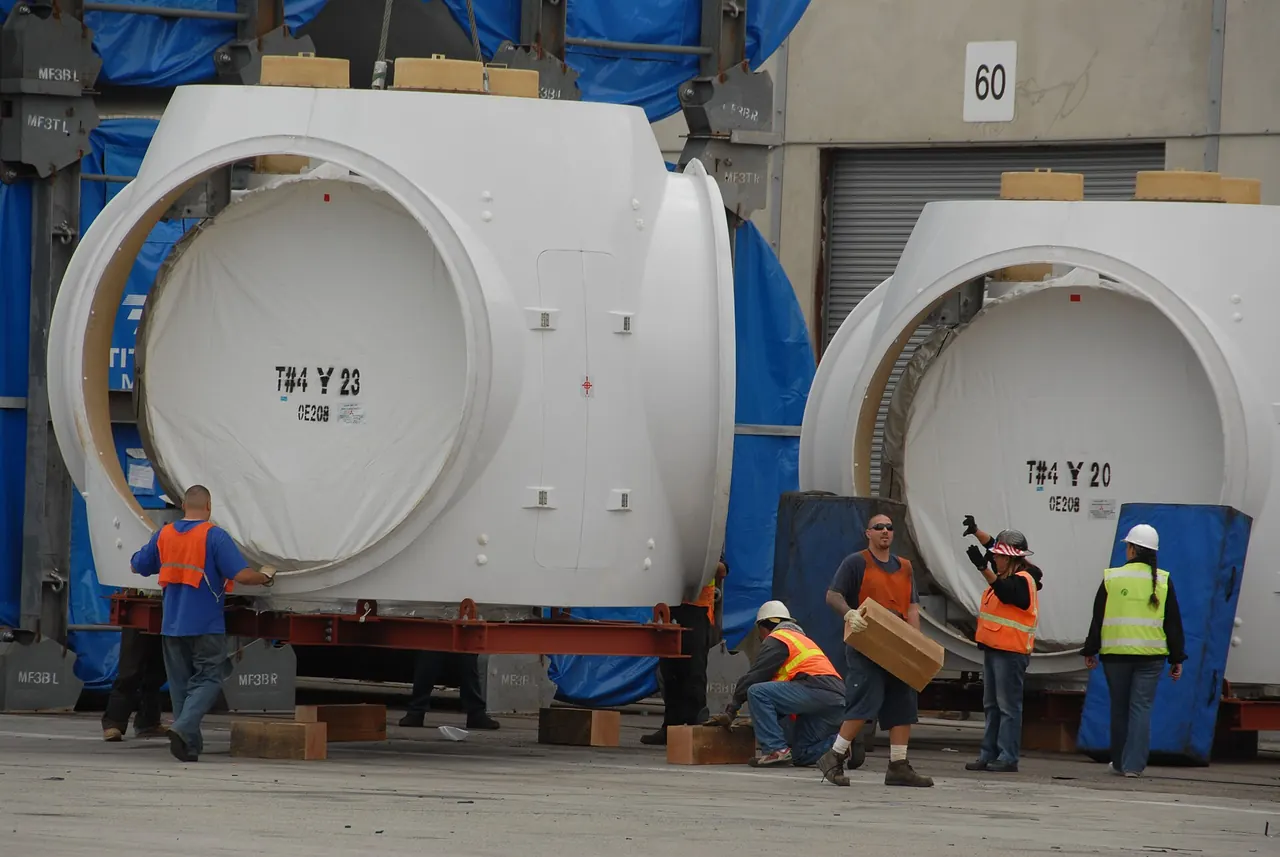
Alfanar puts about USD 100 million more into Senvion India, the wind turbine maker it owns
The Saudi group is investing an additional 9.5 billion rupees in Senvion India, acquired in 2021, to fund its product roadmap, growth capital and project pipeline. 1 min read
Alfanar wrote a 100 million dollar cheque this month, and it did not go to a wind farm.
The Saudi engineering and construction group is investing an additional 9.5 billion rupees, about 100 million dollars, into Senvion India, the wind turbine manufacturer it acquired in 2021. The first 3.2 billion rupees arrived in August and the remainder follows in the next few weeks. Senvion India will spend it on its long-term product roadmap, on growth capital for its business in India and globally, and on accelerating its project pipeline. Chief executive Shreyas Suvarna said the company will deepen its research and development capabilities and support customers “throughout the 25-year lifecycle of their assets”. Senvion India builds roughly 1.5 GW of turbines a year and launched a 4.2 MW machine with a 160 metre rotor in 2024.
Why it matters
My read is that turbine manufacturing has consolidated into a short list of European and Chinese OEMs, and the independents that survive between them tend to do so because a shareholder keeps funding the product roadmap through the thin years. That is what I think this money buys. It is a slower and far less visible use of capital than acquiring operating megawatts, and the return shows up in a turbine model three years from now rather than in a quarterly generation figure.
What it means for MENA
When Gulf capital goes into wind abroad, in the deals we track it usually buys equity in projects. Alfanar bought the turbine maker, and with it the turbine platform. Manufacturing joint ventures deliver a plant and jobs, and I would want to know where the design authority ends up. A Saudi group already owns an independent turbine platform outright, and every megawatt of that manufacturing capacity is in India. The question I would ask is whether the next MENA group that wants a turbine platform buys one or builds one.
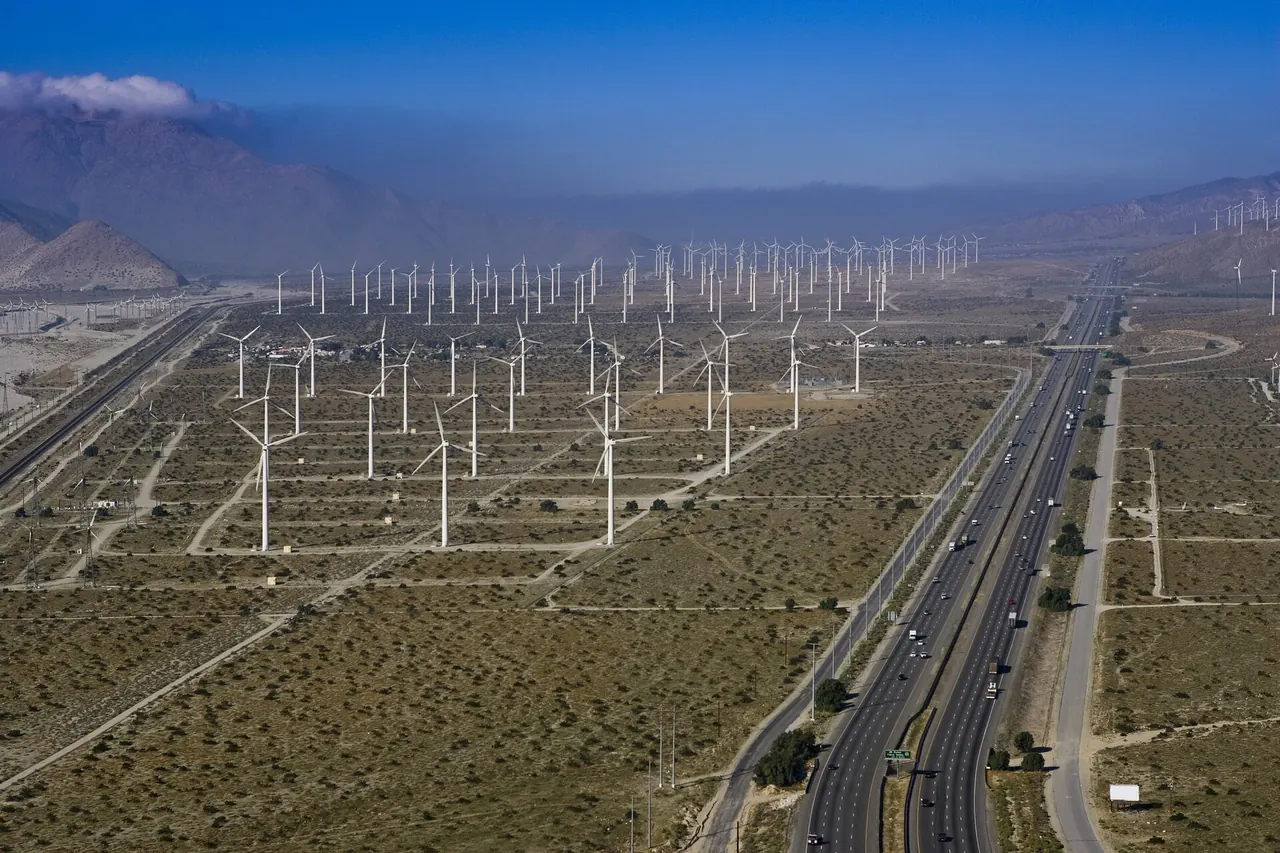
Oman tenders a renewables study for Musandam, where peak demand is forecast at 130 MW by 2031
Nama PWP put the Musandam study on sale on 24 August, covering solar, wind, hybrids and storage, with bids closing on 24 September. 1 min read
Musandam is home to about 54,000 people, an Omani enclave bordered by the UAE. Its power system has the same isolation. The Oman Observer reported in 2023 that the governorate is served by local standalone systems unconnected to the national grid.
On 24 August, Nama Power and Water Procurement (Nama PWP), the country’s sole power buyer, put a tender on sale for the Musandam Renewable Energy Feasibility Study. A techno-economic consultant will assess solar PV, wind, hybrid configurations and battery storage, then judge which of them is technically and economically justified there. Documents are available until 3 September. Bids close on 24 September at noon Oman time.
Here is the number that makes this worth watching. Nama PWP’s seven-year statement, published in March, forecasts Musandam peak demand growing from 91 MW in 2024 to 130 MW in 2031. Average demand moves from 52 MW to 73 MW. About 5% a year, on a system whose peak will be around 130 MW five years from now.
Set that against what this region now tenders. My read is that Musandam’s entire projected 2031 peak is the size of one mid-sized wind farm.
That gap is the point. In my view MENA built its wind procurement for gigawatts, with twenty-year offtake and development-bank debt stacks. Musandam poses a smaller and harder question. Does the same technology, and more importantly the same contract structure, work at a fraction of that size?
Nama PWP has weighed two routes here. One is connecting Musandam to the neighbouring UAE network. The other is building generation locally. The tender closing on 24 September pays someone to price the second route properly.
So my question for anyone developing wind in the Gulf. If the study comes back saying wind works in Musandam, is there a developer in this market built to deliver at that size, and a contract structure to put it under?
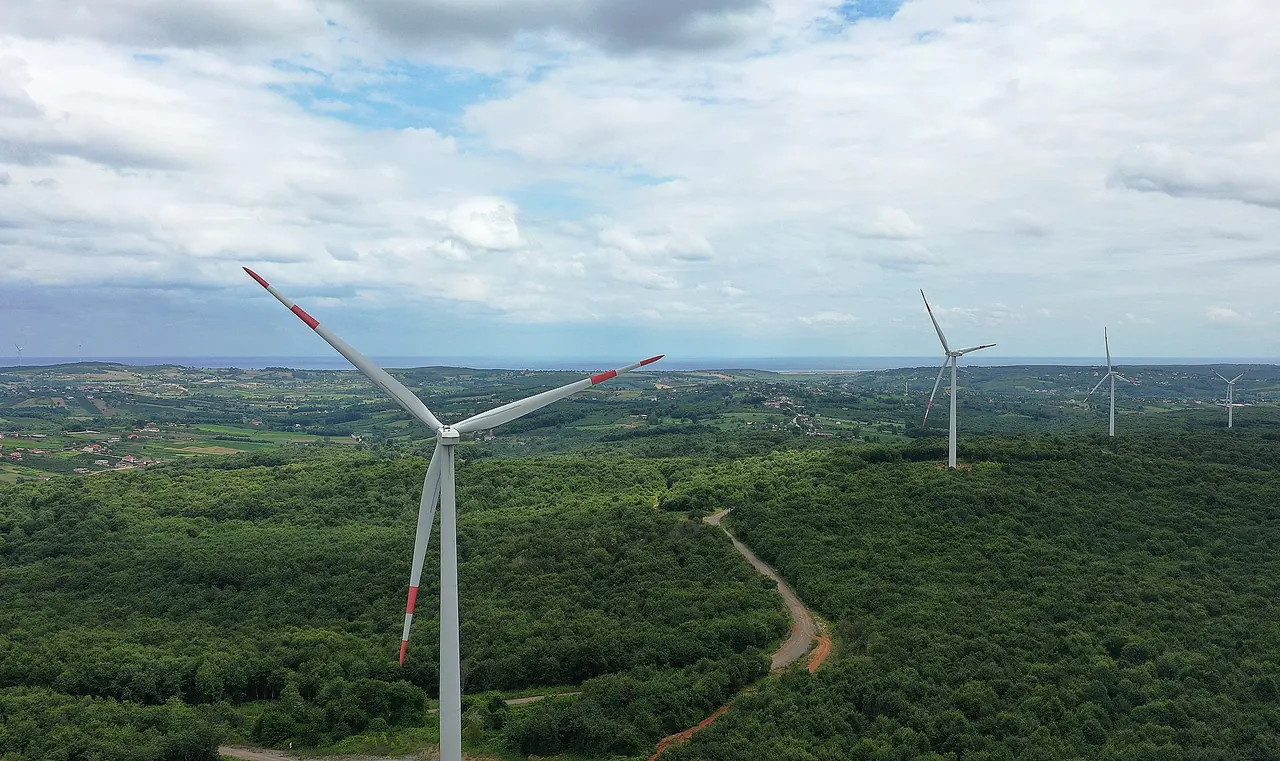
Goldwind's 82 MW Manisa order puts its Turkish medium-speed fleet on course to pass 150 turbines
Goldwind signed with Aksa Energy for 11 GWH182-8.0 MW turbines at the 82.16 MW Manisa wind-plus-storage project, with long-term service support included. 1 min read
Eleven turbines. That is the whole order, and it is the least interesting number in the announcement.
Goldwind has signed a collaboration agreement with Aksa Energy for the 82.16 MW Manisa wind-plus-storage project in Türkiye, built around 11 GWH182-8.0 MW machines on 110 metre hubs using the company’s medium-speed permanent magnet technology. Aksa Enerji’s own market disclosure puts the plant at 82.16 MWe alongside 90.5749 MWh of storage, with the first turbines due to commission in May 2027. Goldwind is also providing local project execution and long-term service support. Then comes the line underneath all of it: after this project, the number of Goldwind medium-speed turbines in Türkiye is expected to pass 150 units.
Why it matters
An 82 MW order decides very little. A 150-machine national fleet decides a lot. My read is that this is roughly the density at which spare parts depots, resident technicians and remote monitoring stop being the cost of winning work and start paying for themselves. A turbine sale closes once. The service agreement behind it earns for years, and I would argue that is where OEM margin lives.
What it means for MENA
Run the same arithmetic on any MENA market where one supplier keeps winning repeat orders. The servicing problem scales with the fleet. I would want the service plan inside the bid evaluation rather than the warranty appendix: who staffs the depot, where the blade crew is based, and what year eight costs.
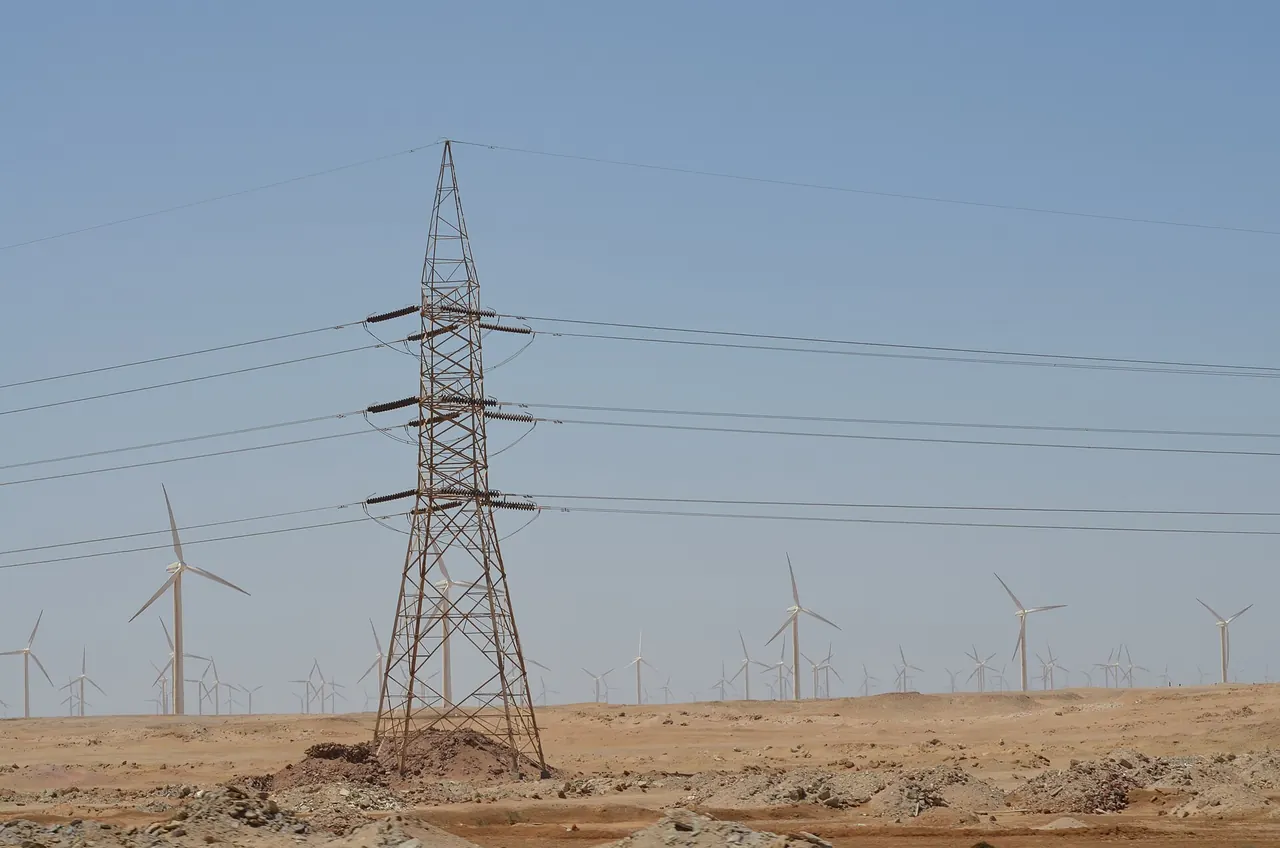
Alcazar's 500 MW Egyptian wind pair heads for construction before its grid line routing is fixed
Two 250 MW farms near Ras Ghareb are guided to start construction this quarter, at a cost of USD 572 million per the EIB's project summary. Routing of the two 220 kV lines is still to be confirmed. 1 min read
More than a thousand people will build Egypt’s next 500 MW of wind. About fifty will stay to run it.
Alcazar Energy’s NIAT and Rasgha projects, two 250 MW farms on a 73 square kilometre site on the west bank of the Gulf of Suez near Ras Ghareb, are guided to start construction this quarter, and forty days of the quarter are left. The European Investment Bank’s project summary puts the cost at USD 572 million, and the EIB and EBRD are among the development finance institutions considering financing. The design calls for 100 turbines at 5 MW each, hub height 90 metres, rotor diameter 145 metres, and the project is expected to use Siemens Gamesa machines. Two 220 kV overhead lines will connect the farms to the Infinity and West Bakr S4 substations, with final routing and specifications still to be confirmed. EETC takes the output under a 25-year power purchase agreement and owns the grid works from the on-site point of common coupling onward, with up to 2.5 TWh a year expected and operations from Q4 2028.
Why it matters
This project states wind’s employment trade plainly. A construction workforce that would fill a mid-sized factory shrinks to a headcount that fits on a bus. My read is that countries wanting durable industrial jobs out of wind have to win them upstream in the factory and downstream in service, because the build phase gives them back.
What it means for MENA
The number I keep returning to is neither the megawatts nor the dollars. The civil clock is fixed at this quarter. The routing of the two 220 kV circuits that will move the power is still open, and EETC is responsible for the grid connection works from the point of common coupling onward. When a project’s concrete date is more settled than its transmission plan, I would model the transmission plan first. Every Egyptian wind farm that follows needs a confirmed line to somewhere.
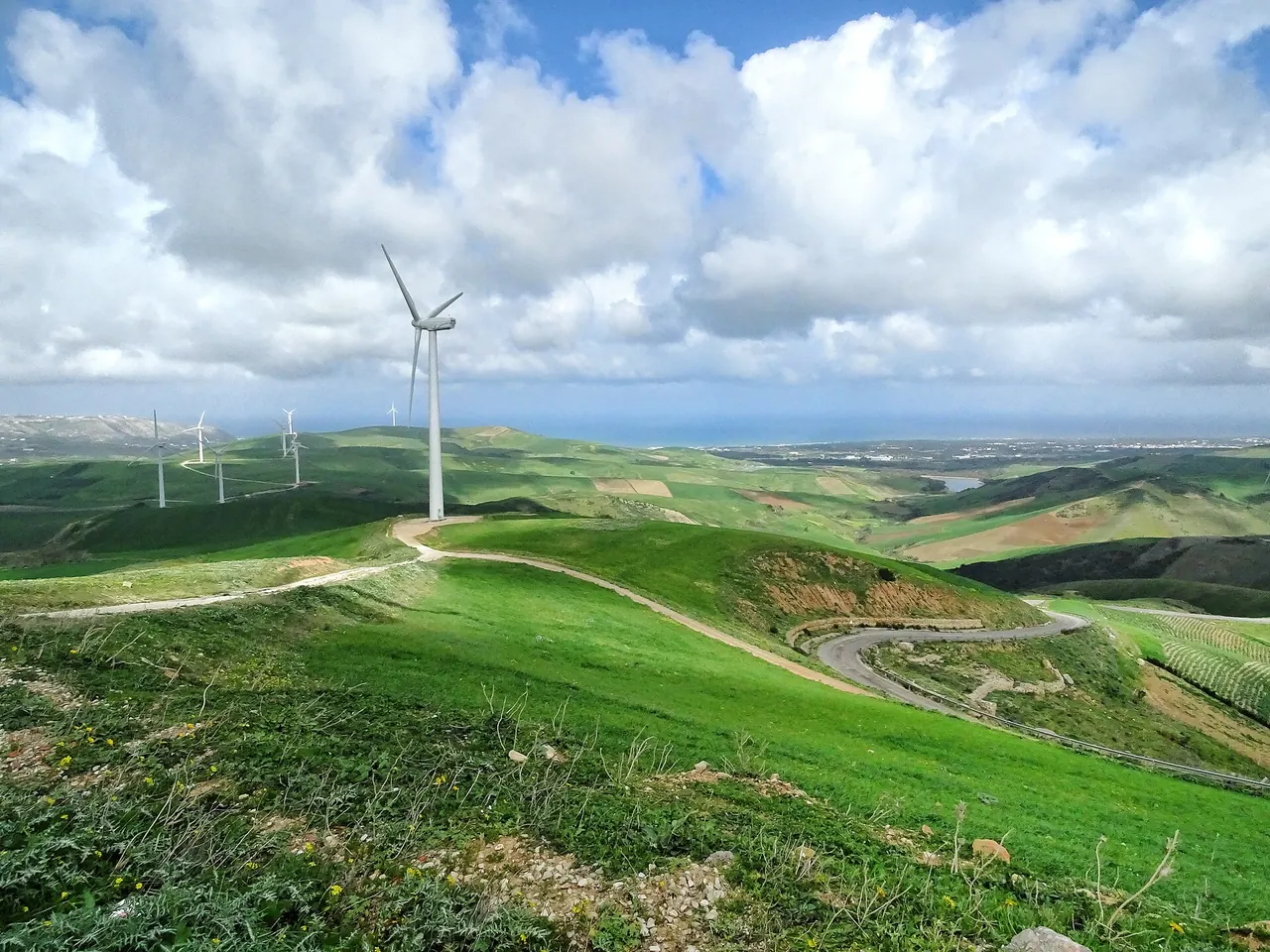
Tunisia can tender 1,200 MW of wind; another 800 MW waits on wind speed assessments
Of six wind sites cleared in December, three totalling 1,200 MW go to tender. Three more, 800 MW, wait on wind data: over three times Tunisia's roughly 245 MW fleet. 1 min read
Tunisia can put 1,200 MW of wind out to tender. It cannot put out the other 800.
In December the High Committee for Private Electricity Generation cleared six wind sites. Three go to market: Djebel Tebaga in Kebili at 600 MW, Djebel Abderrahman in Nabeul at 400, El Guettar in Gafsa at 200. Three do not, and the dividing line the committee drew is wind data. Zaghouan at 200 MW, Ksar El Jeri in Medenine at 500 and Oum Dharbane in Kasserine at 100 will only be tendered once wind speed assessments finish.
That is 800 MW parked at the cheapest stage of the whole chain. It is also more than three times everything Tunisia has connected since its first megawatt-scale wind plant in 2000. ANME counts the national fleet across Sidi Daoud, Métline and Kchabta at roughly 245 MW.
Now look at the Tunisian wind PPA Scatec won this year. Scatec and Aeolus took El Fahs, 75 MW, a 25-year contract with STEG dated 23 January, EUR 100 million of capex, financial close guided to the first half of 2027. Scatec’s own announcement describes a site with “long-term high-quality wind data”. That sentence is the asset.
My working assumption is that lenders want around a year of on-site measurement before they will underwrite a yield. So a met mast sets the clock at Zaghouan, Ksar El Jeri and Oum Dharbane long before any bank gets a say.
We keep explaining slow MENA wind build-out with capital costs and grid capacity. Both are real. Both arrive late. You cannot bid a site you have not measured.
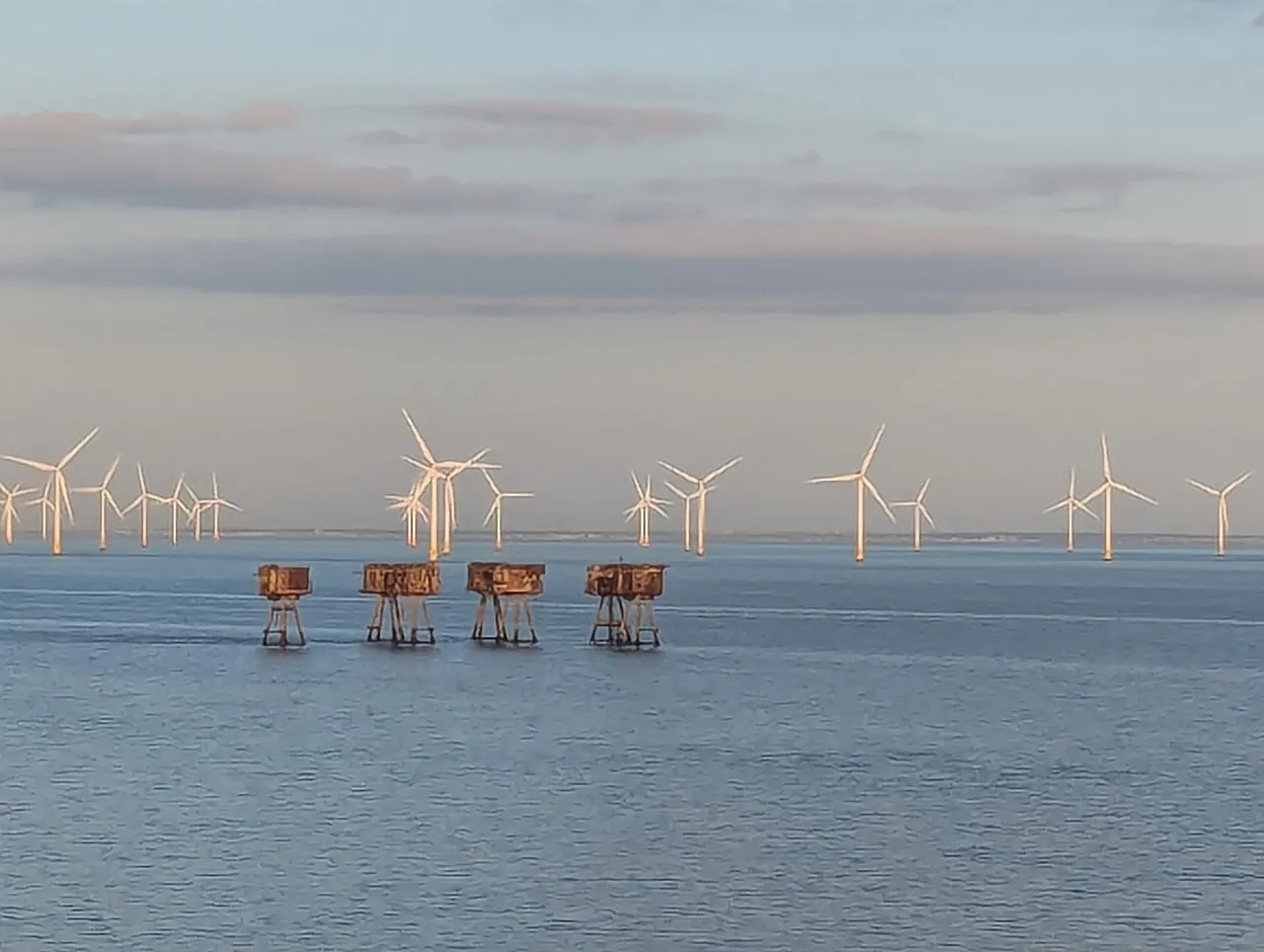
Masdar and ScottishPower finish 95 foundations at the 1.4 GW East Anglia Three offshore farm
The GBP 4 billion project 69 km off Suffolk, owned 50:50, has turbine installation under way and is expected to be fully operational by year end. 1 min read
Ninety-five foundations are now fixed into the seabed 69 kilometres off the Suffolk coast, and a large share of the money behind them is Abu Dhabi’s.
Masdar and ScottishPower Renewables have completed foundation installation at East Anglia Three, the 1.4 GW offshore wind farm they own 50:50. Each foundation measures 20 metres high and eight metres wide and weighs more than 400 tonnes. The monopiles beneath them weigh 1,200 to 1,800 tonnes, reach 67 to 84 metres and measure up to 10.6 metres across, the largest ever installed from a jack-up vessel in Europe. Turbine installation has started on the GBP 4 billion project. Charlie Jordan, chief executive of ScottishPower Renewables, put the scale at “more than 200,000 tonnes of steel anchored spot on into a seabed area the size of almost 43,000 football pitches”.
Why it matters
A project this size gets financed long before it gets built. Completing the foundations on a build the partners expect to be fully operational by year end is, in our reading, the point where offshore wind stops being a lending decision and becomes a power plant.
What it means for MENA
Abu Dhabi money is behind the largest monopiles ever installed from a jack-up vessel in Europe, and Husain Al Meer’s offshore team is collecting the delivery record that goes with them. The equity ticket gets the headlines. I would watch the record instead. Whoever eventually builds the first offshore wind farm on a MENA coastline will want a sponsor who has already put 95 foundations in the water somewhere.
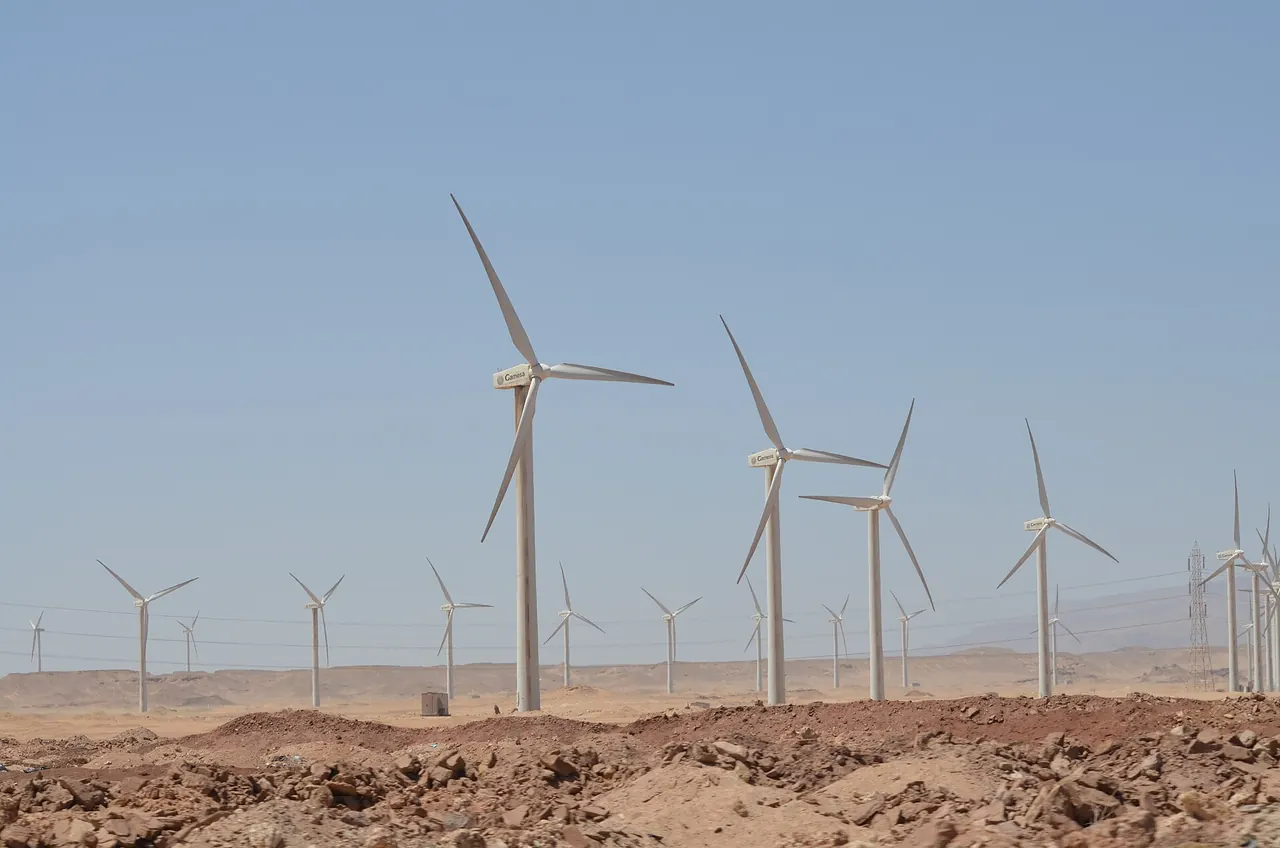
EBRD weighs up to $192 million of senior debt for Scatec's 900 MW Shadwan wind plant
Shadwan Wind at Ras Shukeir holds a 25-year EETC PPA and is expected to benefit from an EU first-loss guarantee under the EFSD+ Hi-Bar programme. 1 min read
A 900 MW Egyptian wind plant is lining up European public money to take the first loss.
The EBRD disclosed on 14 August that it is considering senior debt of up to 192 million dollars for Shadwan Wind, a 900 MW plant at Ras Shukeir in the Red Sea Governorate. Scatec sponsors it through a dedicated project company, Shadwan Wind Power, which signed a 25-year power purchase agreement with the Egyptian Electricity Transmission Company in June 2025. Per the disclosure, the plant is expected to benefit from a first-loss risk guarantee under the EU’s EFSD+ Hi-Bar programme, meaning a public guarantor absorbs the earliest losses before senior lenders are touched.
Why it matters
The credit enhancement is the part worth reading. We read an EU first-loss guarantee on a gigawatt-scale onshore wind plant as a marker of which slice of the risk European public capital will stand behind, and which slice it still wants a commercial lender to carry.
What it means for MENA
When Shadwan’s debt is arranged, the final split between the EBRD ticket and the guarantee is the number I would want in hand before pricing an Egyptian wind bid in 2027.
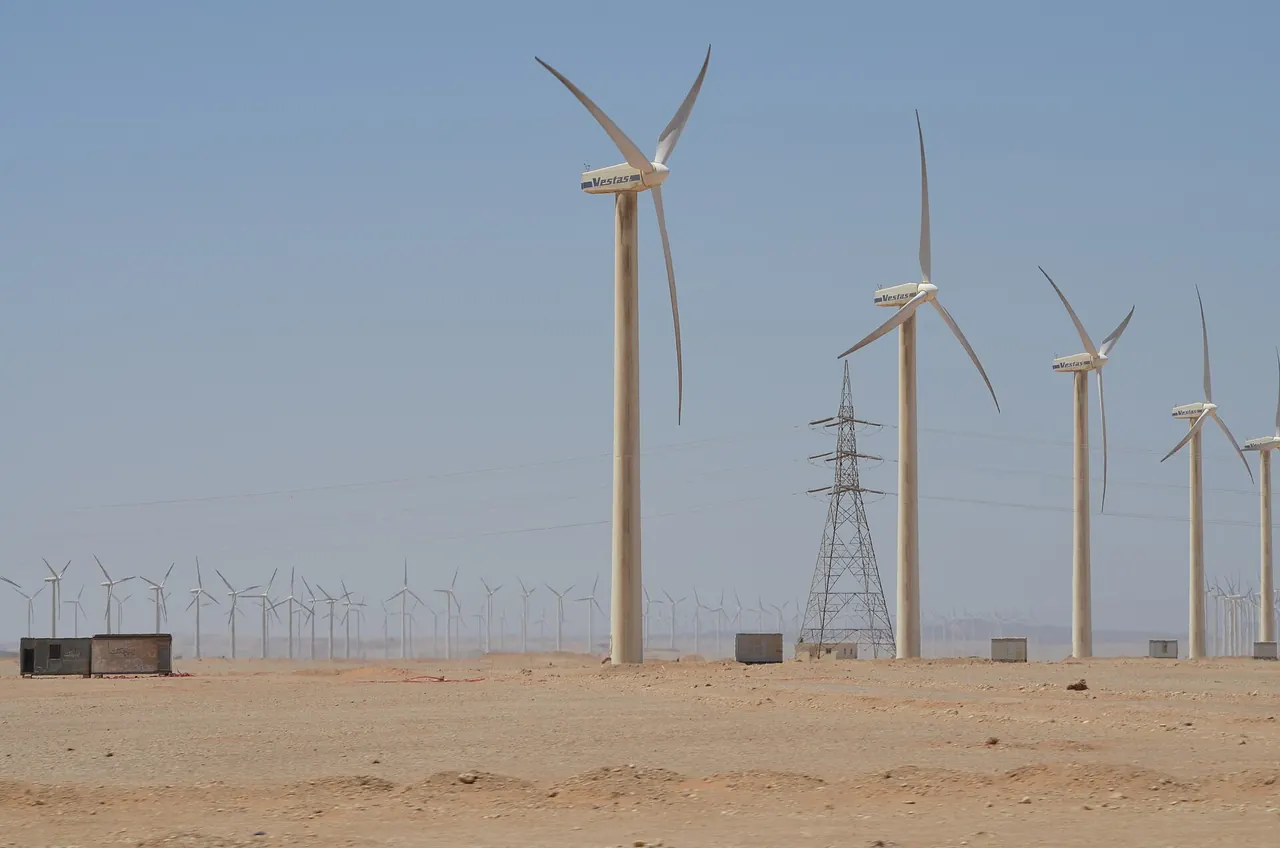
EETC chair Mona Rezk signs Egypt's wind PPAs and the contracts for the wires
EETC's FY2025/26 plan approves EGP 44.9 billion of investment, a 3.4% transmission loss target and three more control centres for renewable integration. 1 min read
Three signatures in eighteen months tell you more about Egyptian wind than any capacity announcement.
Mona Rezk chairs the Egyptian Electricity Transmission Company. In early August she signed the 407 MW Zafarana power purchase agreement with Alcazar Energy. In July she signed a contract worth more than USD 40 million with India’s Bajel Projects for two sections of a 500 kV overhead line. Before both, in February 2025, she signed the capacity purchase agreement for AMEA Power’s two standalone battery projects totalling 1,500 MWh.
EETC is the offtaker on the Egyptian wind PPAs we track. One counterparty, one balance sheet, and one chairperson who also signs the contracts for the wires that move the power.
Which makes her budget report the document worth reading. EETC’s general assembly approved EGP 44.9 billion for FY2025/26, with 53 percent going to finish projects already started and 47 percent to new build, replacements and regional control. Fixed assets are forecast at EGP 202.7 billion. The transmission loss target for the year is 3.4 percent. Seven regional control centres operate today, and three more are being built or upgraded specifically to manage renewable integration. When Rezk reported FY2024/25, renewables reached roughly 14 percent of installed capacity.
Three control centres is a far smaller number than the wind book they are meant to dispatch, and I think it is the one that decides whether 2028 arrives on schedule.
Who signs both sides of the trade in your market, and have you read their capex plan?
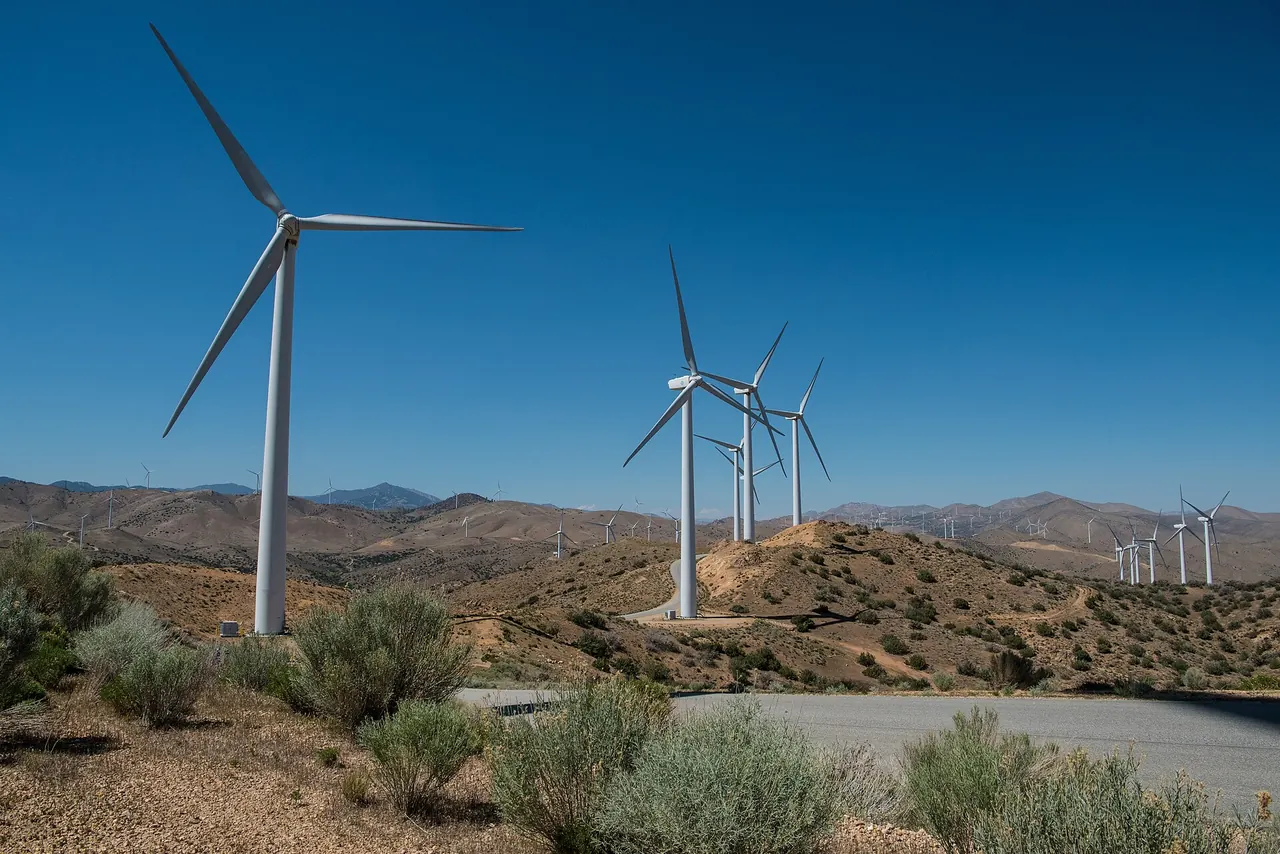
Iraq's first wind projects arrive as a 600 MW Diyala land title and a 500 MW feasibility study
In June Iraq approved 20,000 dunams in Diyala for a 1.6 GW solar and wind complex. The National Investment Commission had already completed a 500 MW wind study. 1 min read
In Iraq, wind is arriving as paperwork first: a land title in Diyala and a feasibility study in Baghdad.
In June, the Ministry of Finance’s State Real Estate Department approved 20,000 dunams in Diyala Governorate for a 1.6 GW hybrid complex: 1,000 MW of solar and 600 MW of wind on plot 91/1 in the Al-Jazira area. The allocation answered a request from the Diyala Investment Authority, closed out reviews that ran through 2025 and 2026, and formally classified the site as an investment opportunity.
The groundwork started earlier. The National Investment Commission completed a feasibility study for a 500 MW plant, confirmed by spokesperson Hanan Jassim in early 2025 and reported as the country’s first wind power project. Location and timeline stayed undisclosed.
Why it matters
Iraq has already awarded 7.5 GW of solar to TotalEnergies and other foreign and local developers, in a power system working to close a persistent supply shortage. Wind entering the same investment machinery widens the diversification effort beyond a single technology.
What it means for MENA
In our read, regional wind markets tend to begin this way, land and feasibility files first, tenders later. Egypt, Saudi Arabia and Oman all moved from paper to procurement. Iraq now holds the paper. A 600 MW wind block in Diyala plus a 500 MW NIC project would give the region a wholly new wind market to price.
The question worth watching: are the NIC’s 500 MW and Diyala’s 600 MW one story or two, and who bids first?
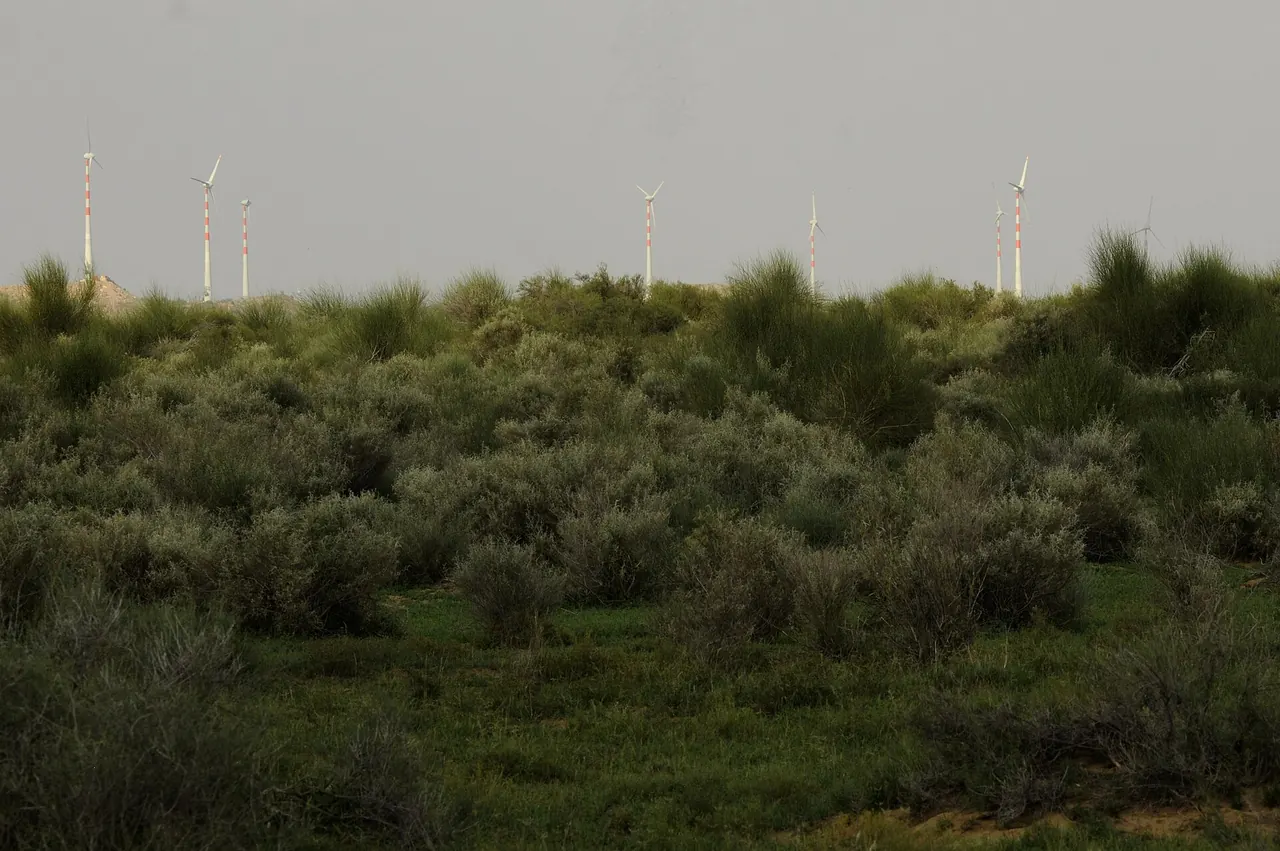
Oman's Riyah wind farms and North Oman Solar report roughly 150 jobs and 30% local spend
OQ Alternative Energy says Omanis made up about 40% of the development and construction workforce across the three projects, which total more than 330 MW. 1 min read
Thirty six turbine generators shipped in. Roughly 150 jobs.
Oman’s Riyah 1 and Riyah 2 are due online by the end of this year, and OQ Alternative Energy has published its local-content numbers. Across the two wind farms and the North Oman Solar plant, more than 330 MW combined, around 30 percent of total project spend stayed inside the national economy. Omani nationals made up about 40 percent of the development and construction workforce. Roughly 150 direct and indirect jobs, plus a community hiring programme agreed with authorities in Wilayat Adam, Shaleem and Al Jazir.
Kumail Said, acting chief executive of OQAE: “Exceeding our in-country value target by three times reflects this commitment and was deliberately planned.”
I want readers to weigh that 150 properly. Two wind farms at 200 metre tip heights, what OQAE calls the longest inland convoy the country has moved, and the resulting employment would fit in a single school hall. By OQAE’s account, the projects beat their in-country value target three times over. I read the number as smaller than gigawatt headlines suggest, and far more concentrated in a handful of towns.
That arithmetic gets tested at scale next, as gigawatt-class wind farms elsewhere in MENA move toward commissioning. Each will produce its own version of the Riyah figures, and for the ones I track I have not found published local-content or employment numbers.
Ask a MENA developer for a local-content percentage and you get one. Ask which wilayats and which trades, and in my experience the room goes quiet. Oman answered.
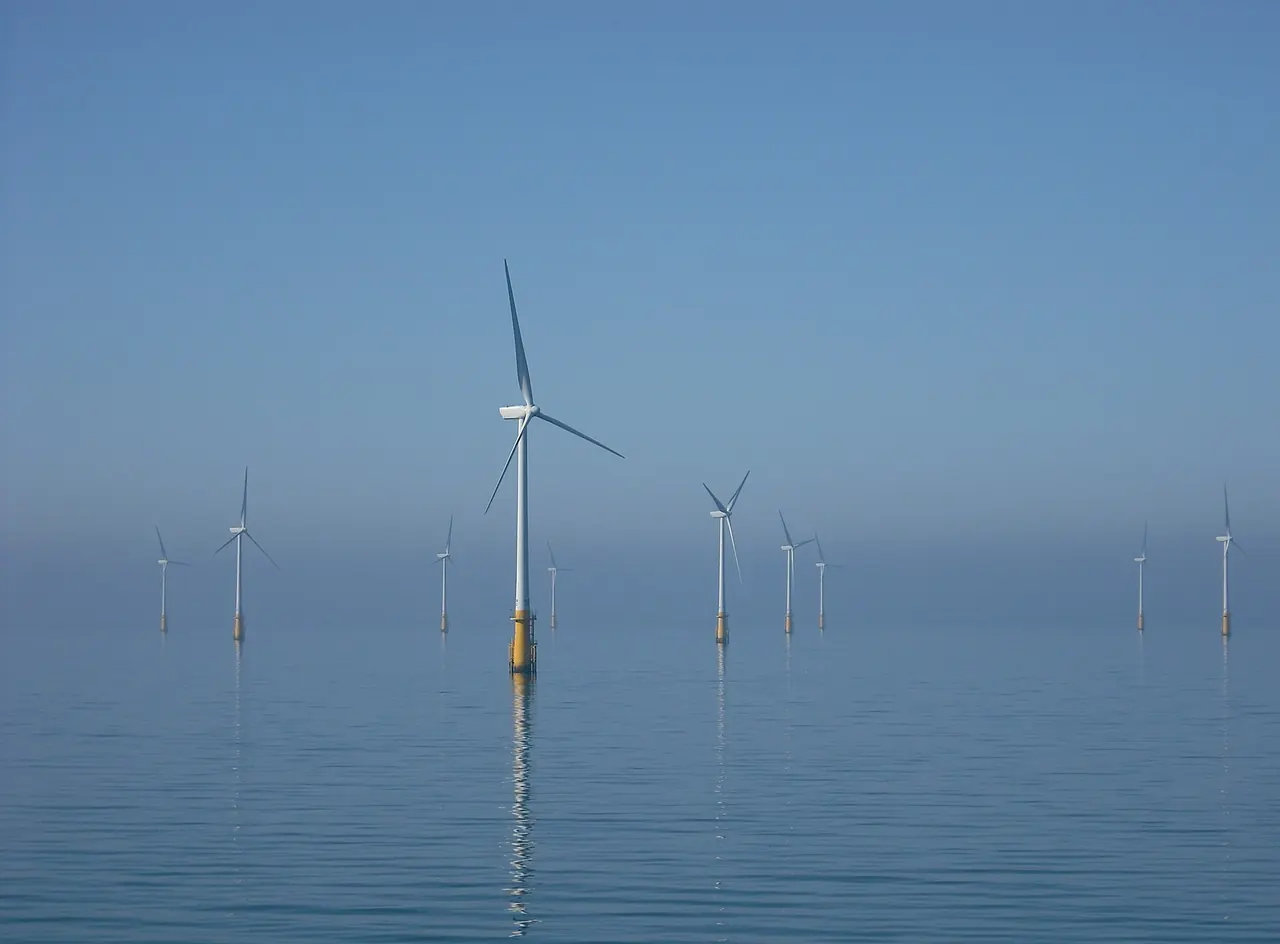
Türkiye sets its first offshore wind auction for the first quarter of 2027
Energy Minister Alparslan Bayraktar said the tender will be published in September, with details due ahead of COP31 in Antalya. The target is 5,000 MW offshore by 2035. 1 min read
Türkiye’s first offshore wind auction now has a date.
After publishing draft rules, the energy ministry has fixed the calendar: tender published in September, auction held in the first quarter of 2027. Energy Minister Alparslan Bayraktar announced the timetable Wednesday and said details would come ahead of COP31, which Antalya hosts in November. Industry feedback on the draft specification closes August 17, with the final rules built from those responses. The target stands at 5,000 MW of offshore wind by 2035, backed by an auction system that has run 7,800 MW of YEKA competitions since 2016 plus 3,800 MW allocated across 2024 and 2025.
Why it matters
Targets invite headlines; auction dates move supply chains. A fixed Q1 2027 bid window gives turbine makers, vessel operators and lenders something they can price. Türkiye comes to the table with more than 15,000 MW of wind already on its grid.
What it means for MENA
For MENA, this is an offshore wind auction next door with a hard date. I expect whatever price and localisation terms clear in Q1 2027 to be the reference numbers when Red Sea and Atlantic tenders open.
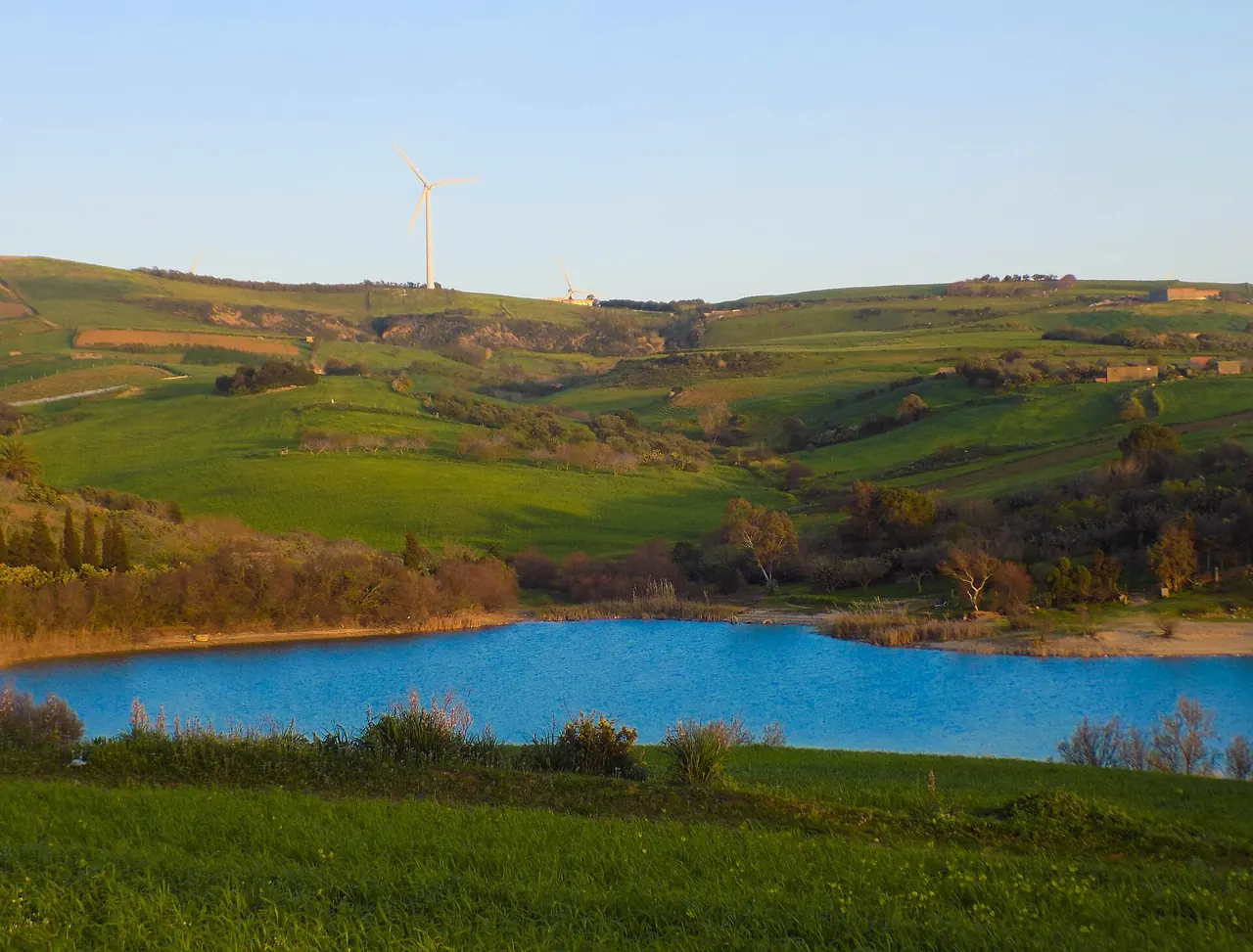
Tunisia operates about 245 MW of wind and has drawn up a pipeline eight times that size
In January Tunisia cleared wind lots at Tabaga, Jebel Abderrahmane and El Guettar, and Scatec, with partner Aeolus, was awarded a 25-year PPA with STEG for the 75 MW El Fahs project. 1 min read
Tunisia operates three wind farms. This year it cleared eight fleets’ worth of capacity for tender.
The operating base: about 245 MW, all built by state utility STEG. 55 MW at Sidi Daoud in the northeast, then about 190 MW at the Metline and Kchabta farms near Bizerte. In January the High Committee for Private Electricity Generation cleared a tender book that dwarfs it: 600 MW at Tabaga in Kebili, 400 MW at Jebel Abderrahmane in Nabeul and 200 MW at El Guettar in Gafsa, with another 800 MW across Zaghouan, Ksar El Jerri and Oum Darban queued behind wind measurement campaigns. A 77.25 MW Zaghouan farm won direct approval on top.
Private capital has already moved. Scatec, partnered 50/50 with Aeolus of the Toyota Tsusho Group, was awarded a 25-year PPA with STEG in January for the 75 MW El Fahs project: EUR 100 million of capex, financial close targeted for the first half of 2027, Scatec’s first wind project in the country.
In our coverage, MENA wind conversations tend to default to Egypt, Saudi Arabia and Morocco. Meanwhile Tunisia drew up a pipeline eight times its fleet, awarded a 25-year PPA to international sponsors and set a 35 percent renewables target for 2030. Execution is the whole question now: which of the three cleared lots reaches financial close first?
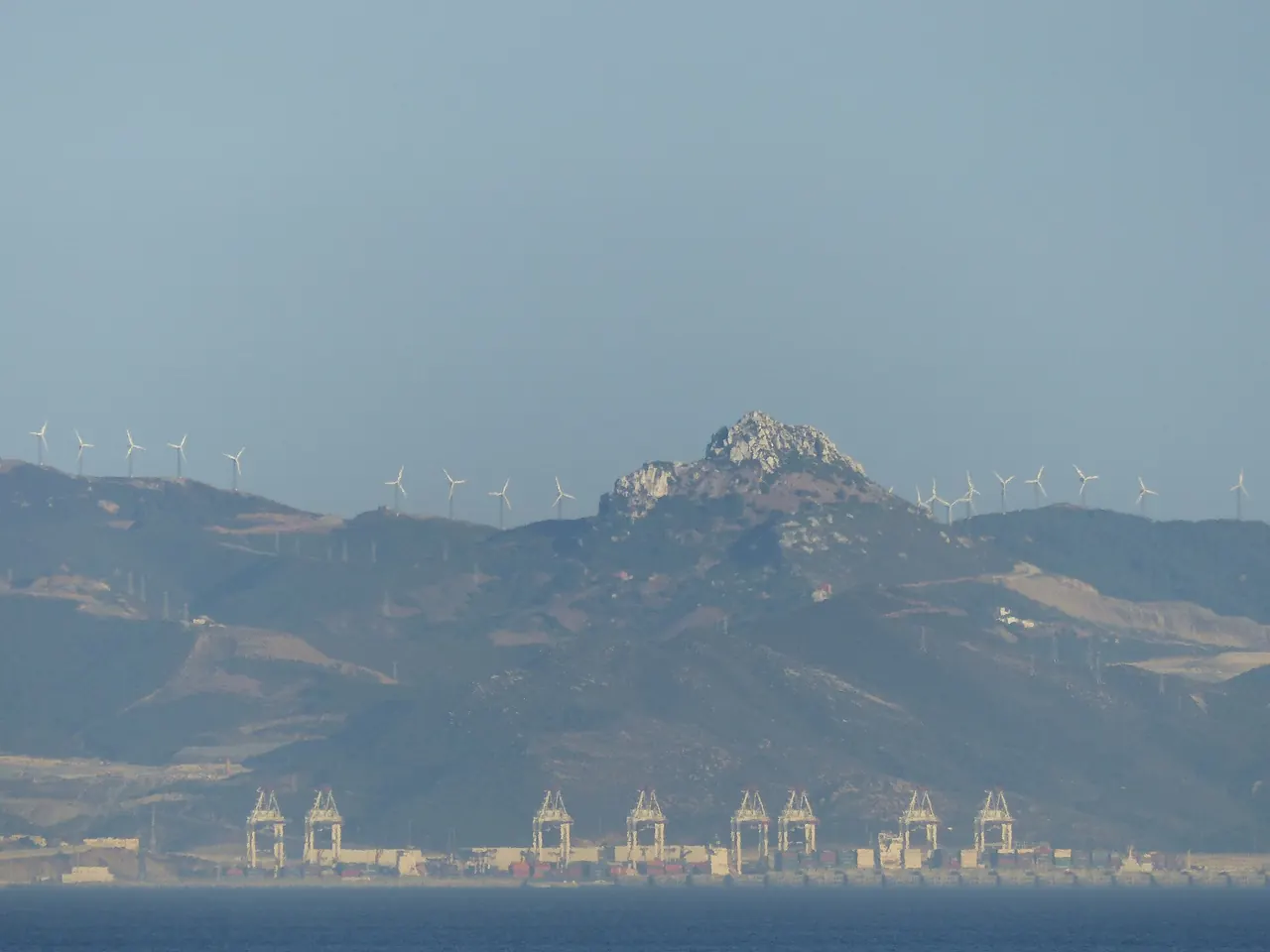
From a Jordan grant to Ras Shokeir's commercial close, MENA wind runs on three kinds of money
A UAE-funded 25 MW farm in Ma'an, USD 226 million of ADB, AIIB and Standard Chartered debt for Bash II, and Ras Shokeir's pending close span the region's cost of capital. 1 min read
Five turbines in Ma’an will cost Jordan nothing. Nine hundred megawatts at Ras Shokeir will cost exactly what Egyptian wind risk is worth. Both get called MENA wind.
In early August, Jordan’s Samra Electric Power Generation Company signed the EPC contract for a 25 MW wind farm at Batn Al Ghul with SITE Technology General Contracting. The UAE government funds all of it, under a February agreement with Masdar. Cost of capital: zero.
In May, ACWA Power secured 226 million dollars of debt for the 300 MW Bash II farm in Uzbekistan, with ADB, AIIB and Standard Chartered at the table. The multilaterals anchor the stack, and the debt covered more than two thirds of project cost.
And right now, the consortium of ENGIE, Orascom Construction and Toyota Tsusho’s Aeolus is working toward financial close on the 900 MW Ras Shokeir BOO project. ENGIE’s stated target was early third quarter of 2026. The window is open.
It is easy to read the region’s record-low tariffs as proof that MENA wind is cheap. I read them as proof that MENA wind runs on three kinds of money at once: gifted, blended and commercial. A grant produces no price signal at all. A blended stack produces a softened one. Only a commercial close tells you what the market charges for Egyptian wind risk, which makes Ras Shokeir’s financial close the most informative number MENA wind will print this quarter.
Money in this region costs anywhere from nothing to everything. The spread between those three stacks says more about where this market goes after 2030 than any tariff on an auction slide.
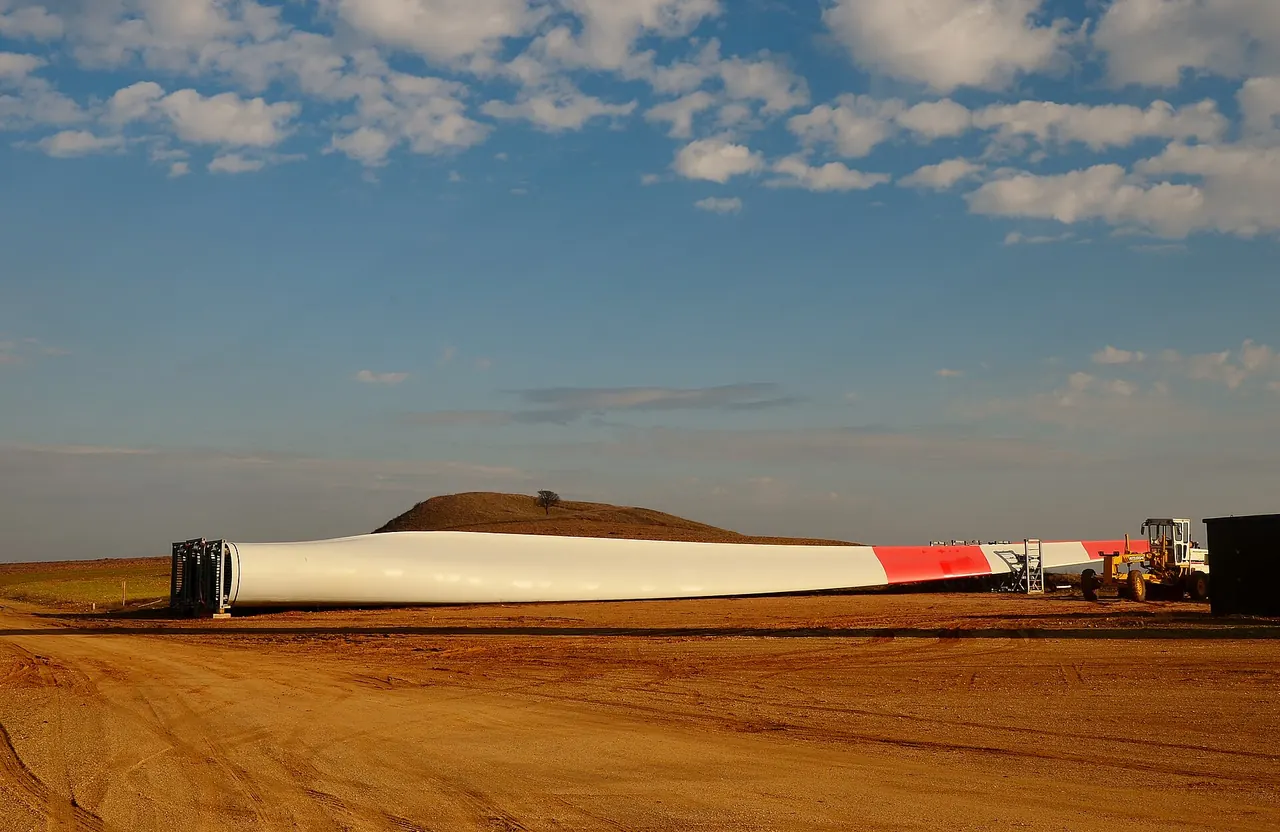
Nordex lands a 72-turbine, 525 MW order for Türkerler's YEKA-5 Sivas wind project
The N175/6.X turbines start installation in Q3 2027 on 108 metre towers, with service extendable to 25 years. Nordex calls it the biggest single turbine deal in Türkiye. 1 min read
Seventy-two turbines in one contract: by Nordex’s count, Turkish wind just set its own record.
Nordex will supply and install 72 N175/6.X turbines for Türkerler Holding’s YEKA-5 R25 Sivas wind project, a package of around 525 MW that Nordex regional Vice President Ender Özatay calls “the biggest single turbine deal in the Turkish wind energy market.” The Delta4000 machines will stand on 108 metre towers, with first installation starting in the third quarter of 2027. The contract carries a 10 year Premium Service agreement extendable to 25 years. Türkerler, active across construction, energy and electricity distribution, is a repeat Nordex customer.
Why it matters
My read is that onshore wind’s growth now runs through markets that can absorb half a gigawatt in a single contract, and Türkiye’s YEKA auction rounds just produced one. A service option stretching to 25 years also tells you how far past commissioning the value of a deal like this extends.
What it means for MENA
We read this as the procurement outcome MENA markets running factory-plus-project packages are buying toward. Özatay credits the win to the N175 technology and “our strong local supply chain.” For MENA tender committees weighing local content against price, the OEM itself is saying local supply helped land the record order.
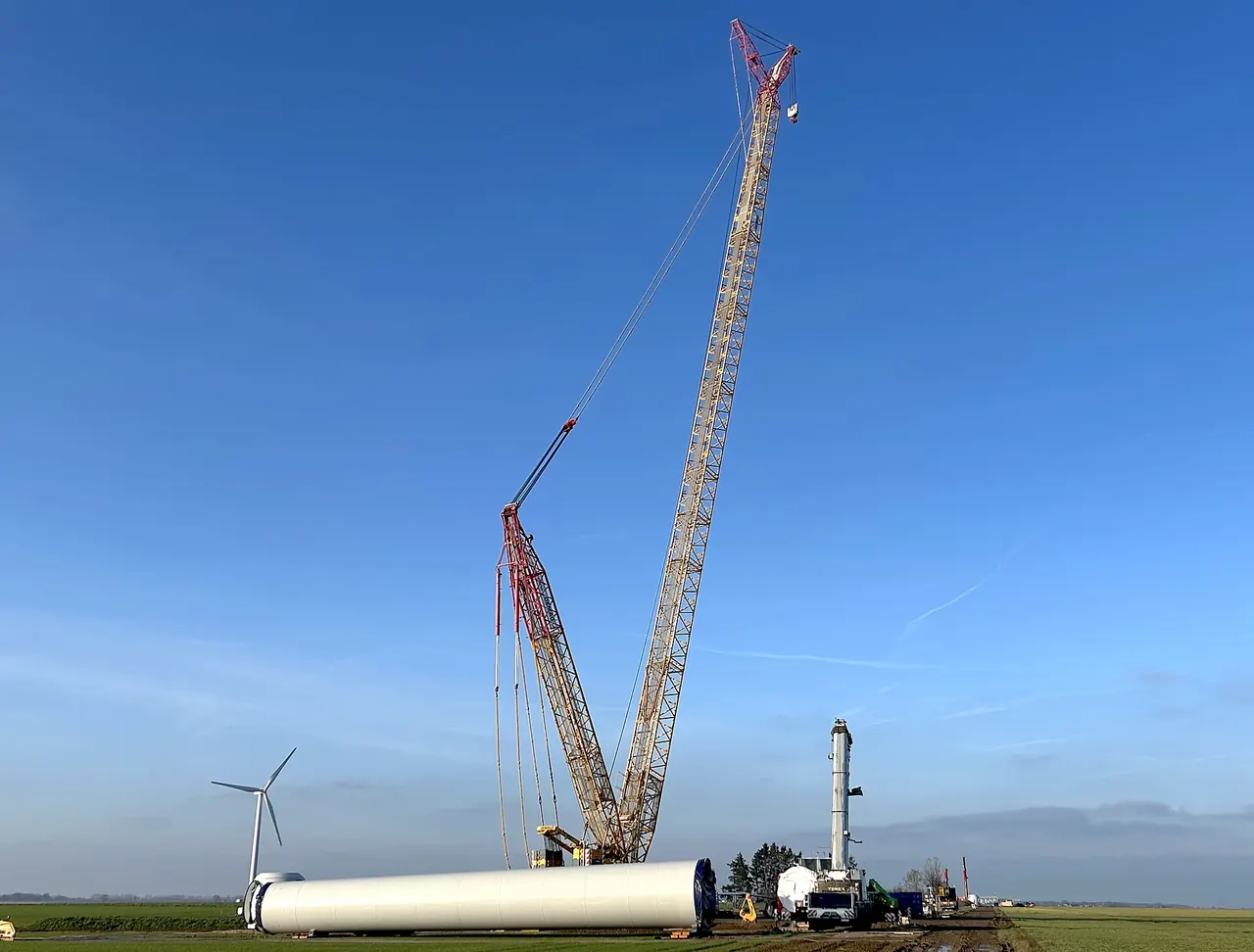
Turbine makers earn better margins on service, and Dumat Al Jandal's 20 years went to Vestas
Nordex posted a 19.2% service EBIT margin against 12.2% on projects in Q1. Saudi Arabia's first utility-scale wind farm came with a 20-year Vestas service agreement attached. 1 min read
Nordex earned a better margin last quarter maintaining turbines than building them. Service EBIT margin, 19.2 percent. Projects, 12.2 percent.
Vestas shows the same split. Its service agreements add up to 39.8 billion euros of expected future contractual revenue, and Service earned a 16.3 percent EBIT margin in Q1 against 3.2 percent for the group.
Now look at how MENA buys wind. Dumat Al Jandal, Saudi Arabia’s first utility-scale wind farm, went up with 99 Vestas V150s and a 20-year Active Output Management service agreement with the manufacturer attached. The project was forecast to create 800 construction jobs and 150 posts for operations and maintenance. We bought the turbines. Someone else booked the twenty years after.
Aviation worked this out here a long time ago. Global maintenance, repair and overhaul spend hit 136 billion dollars in 2025 and heads toward 193 billion by the end of the decade. The Middle East’s commercial fleet grows 5 percent a year through 2036, the fastest in the world after India’s. My read is that the fleet pulled hangars, licences and technicians in behind it.
Wind’s version of that base is still being drawn. GWO and GWEC put global technician demand at 628,000 by 2030 to service a 2.1 terawatt fleet, and their outlook profiles six markets in depth: Australia, Brazil, France, Germany, India and the United States.
Every megawatt this region commissions generates a twenty-year service bill. I would like more of those invoices written locally.
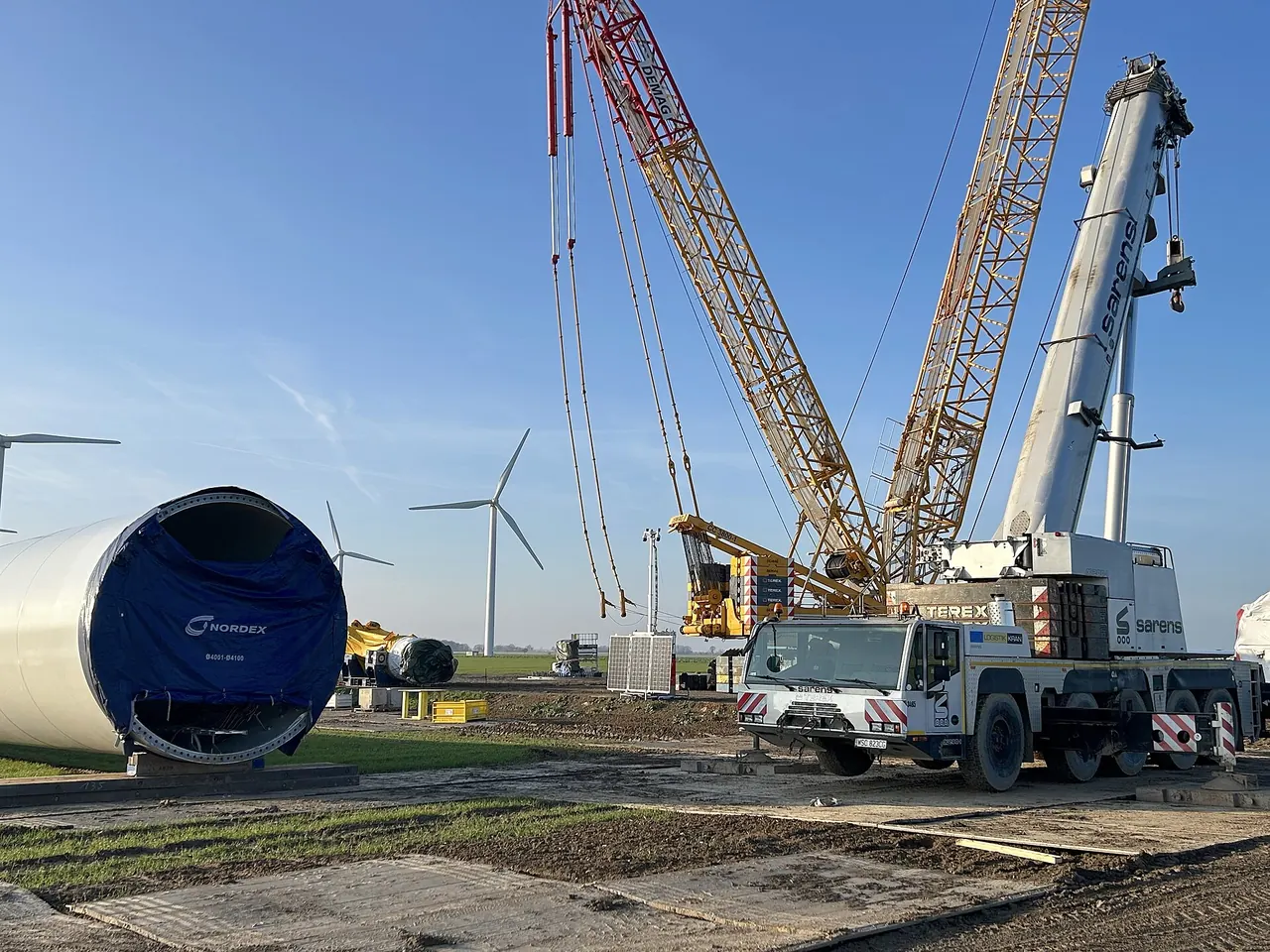
Yanbu port lands nine wind turbines, including 27 blades, for Saudi Arabia's Setara and Shaqra projects
The Pacific Titan docked at King Fahd Industrial Port with one of the largest cargoes the port has handled, the Saudi Press Agency reported on 5 August. 1 min read
Nine complete wind turbines, 27 blades included, came off a single vessel at Yanbu this week, and the Saudi Press Agency called it one of the largest shipments the port has ever handled.
The Pacific Titan docked at King Fahd Industrial Port on the Red Sea carrying the turbines and other components, bound for the Setara and Shaqra wind projects, the Saudi Press Agency reported on Wednesday. Saudi Arabia’s Ministry of Energy coordinated the delivery with other government agencies. Both projects sit inside the National Renewable Energy Program, which the ministry runs through the Saudi Power Procurement Company, the Kingdom’s principal electricity buyer. SPPC prepares the project studies, launches the generation schemes and signs the power purchase and storage agreements with developer consortia. Saudi Arabia is targeting around 50 percent of its electricity generation mix from renewables and storage by 2030.
Why it matters
A wind build-out lives or dies on the physical chain between a factory gate and a foundation. A berth that cannot take oversized cargo quietly caps how fast a country can install. In our reading, ports rarely appear in the headline numbers, yet they set the real ceiling on how quickly a pipeline turns into megawatts.
What it means for MENA
I think every wind market in the region will meet this same test, from Egypt’s Gulf of Suez to Morocco’s Atlantic coast and Oman’s Dhofar and Duqm sites, and I expect the next decade of equipment to be bigger than the last. Tariff records get the attention. We would rank a proven berth higher right now, because a cheap megawatt that cannot be delivered is a spreadsheet entry rather than electricity.
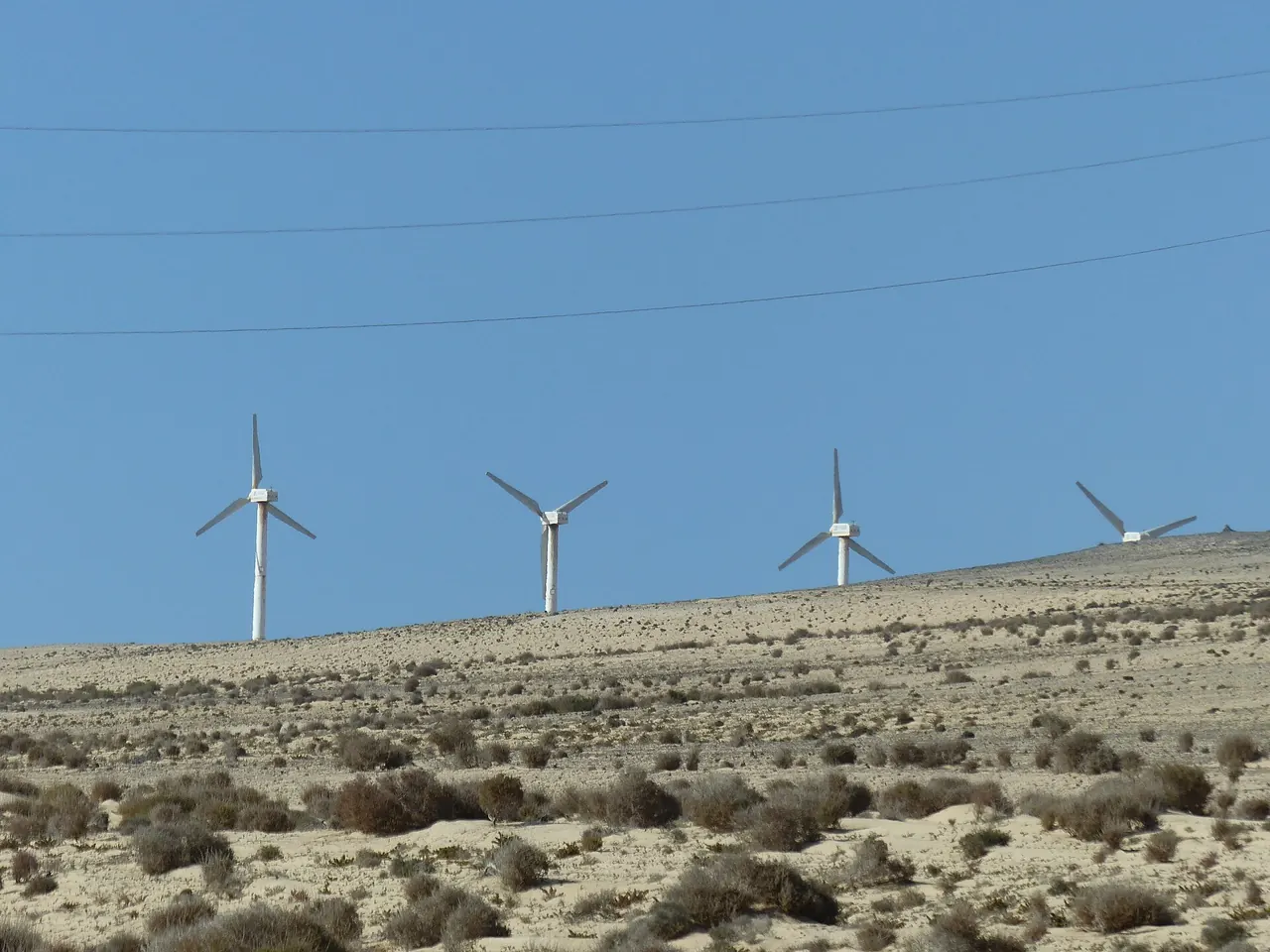
EETC signs PPA with Alcazar Energy for a 407 MW wind plant at Zafarana
The plant targets 2028 operation and around 775,000 households. EETC chairwoman Mona Rezk tied it to upgrading Egypt's unified national grid. 1 min read
Egypt’s newest wind offtake landed in Zafarana.
The Egyptian Electricity Transmission Company has signed a power purchase agreement with Alcazar Energy for a 407 MW wind plant in the Zafarana region, Egypt Oil & Gas reported on 3 August. Mona Rezk, EETC’s chairwoman, signed for the state grid operator; Mohamed Zidan, Alcazar’s senior director in Egypt, signed for the sponsor. The plant targets 2028 operation and is projected to supply around 775,000 households. The report discloses no tariff, turbine supplier or financing structure.
Why it matters
Our read is that the binding constraint on new wind has moved from wind resource to grid access and offtaker credit. Rezk tied the agreement directly to upgrading Egypt’s unified national grid so it can carry expanding renewable capacity to load centres.
What it means for MENA
Egypt has pulled its target of 45% of generation capacity from renewables forward to 2030 from 2035 under the updated Integrated Sustainable Energy Strategy. In my view a jump that steep needs new territory and more output from ground the state already holds. Zafarana now carries a new project from a sponsor with a UAE-based advisory team that earlier this year signed a USD 420 million deal to operate, maintain and upgrade the 580 MW Gabal El-Zeit farm on the Red Sea. One fund is set to run part of Egypt’s older wind fleet and build part of its newer one at the same time. Watch whether that dual position starts shaping how Cairo prices its next round.
Saudi Arabia's 75% localisation mandate set against the wind factories MENA actually built
Türkiye ties YEKA support to 51% domestic content and 65% for towers and blades. Morocco and Oman built plants after securing demand, and Egypt has a Sany memorandum. 1 min read
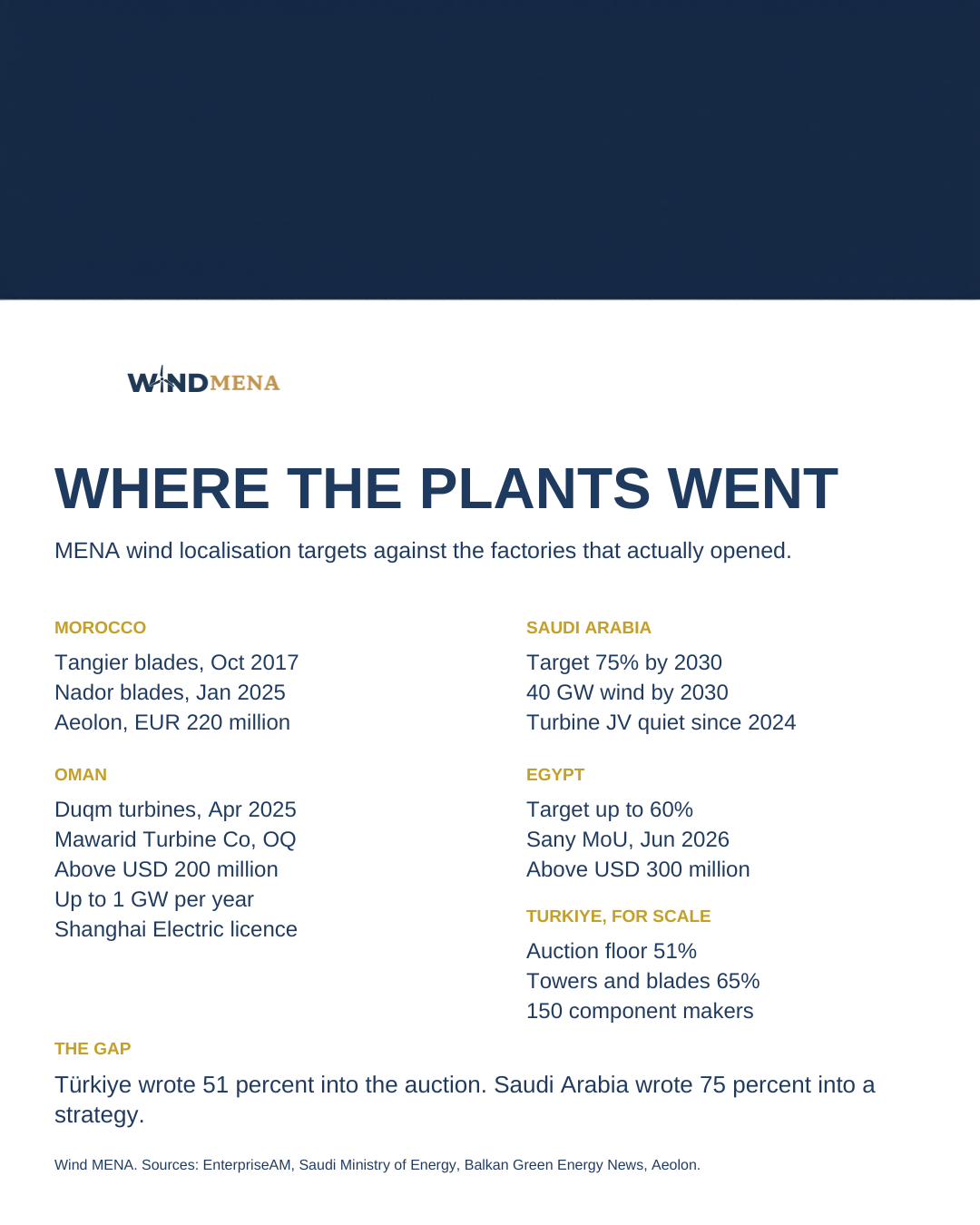
Saudi Arabia wants 75 percent of its renewable equipment made at home by 2030. It is the most aggressive localisation mandate in the region. The turbine joint venture PIF’s localisation arm signed with Envision Energy in 2024 has been quiet since.
Türkiye chose a lower number and put it somewhere harder. To win state support in a YEKA auction, every component has to clear 51 percent domestic content, and towers and blades have to clear 65. Miss it and you do not win. Türkiye now counts roughly 150 wind component manufacturers.
The MENA plants that actually exist followed the same logic. Morocco has been making blades in Tangier since October 2017 and added Aeolon at Nador, a EUR 220 million plant and the company’s first outside China. Oman broke ground at Duqm in April 2025, above USD 200 million, up to 1 GW a year on Shanghai Electric technology. Egypt has a Sany memorandum from June and a target of up to 60 percent.
Morocco and Oman answered the demand question before pouring concrete. Morocco pointed its plants at export markets. Oman had OQ take equity in the wind projects that will buy the turbines.
The number a country publishes tells you its ambition. The number it writes into a bid tells you where the factory goes.
Jordan signs EPC contract for 25 MW Batn Al Ghul wind project, fully funded by the UAE
Samra Electric Power Generation Company hired SITE Technology General Contracting for five turbines in Ma'an Governorate, under Jordan's February agreement with Masdar. 1 min read
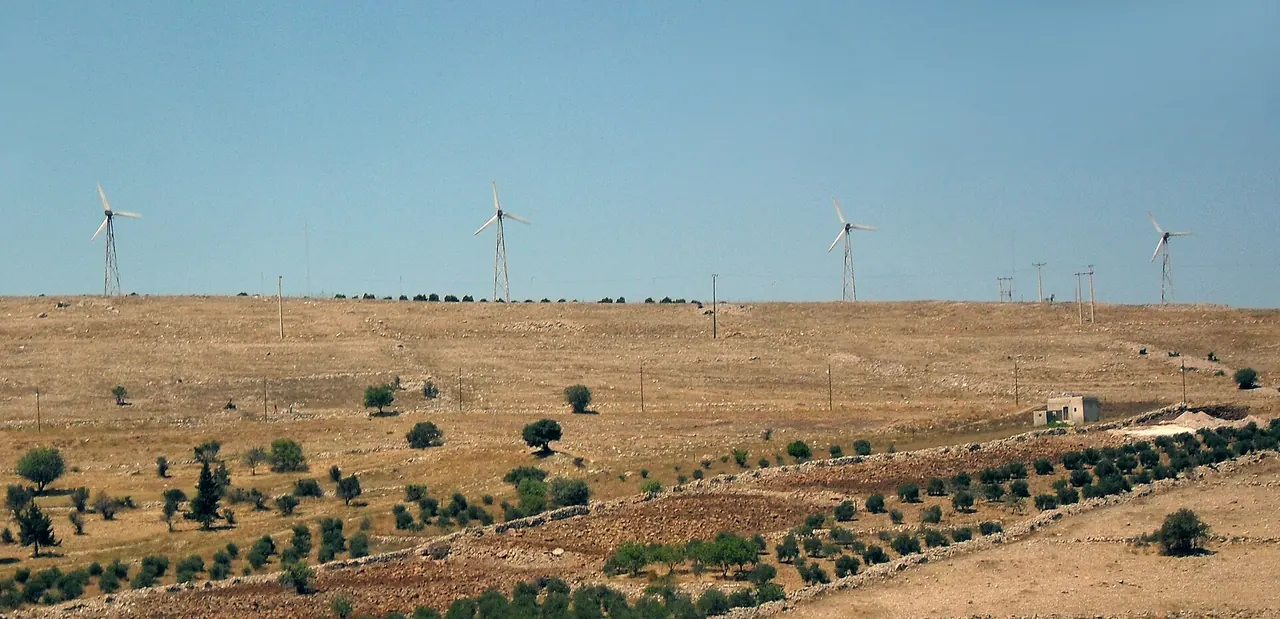
Five turbines in Ma’an, 25 megawatts, and Abu Dhabi is paying for all of it.
Jordan’s Samra Electric Power Generation Company has signed the EPC contract for the Batn Al Ghul wind project with SITE Technology General Contracting. The scope covers design, supply and installation of five turbines with a combined 25 MW in Ma’an Governorate, funded entirely by the government of the UAE. The contract sits under the cooperation agreement Jordan’s Ministry of Energy and Mineral Resources signed with Masdar in February. Renewables currently supply about 27 percent of Jordan’s electricity, and the 2025 to 2035 energy strategy approved by Cabinet in May targets 40 percent by 2035.
Why it matters
The global wind build-out runs on auctions, PPAs and merchant equity. This one runs on bilateral government funding, with a foreign state as financier and a state-owned Jordanian generator as the contracting party. In our read, that structure barely registers in the capacity statistics, and it is one of the few routes that still moves steel in markets too small or too grid-constrained to attract private developers on price alone.
What it means for MENA
Masdar already holds 50 percent of the 117 MW Tafila wind farm and runs the 200 MW Baynouna solar plant, so Jordan is familiar ground. The number worth watching is not 25. In June, Prime Minister Jaafar Hassan and Masdar CEO Mohamed Jameel Al-Ramahi discussed wind projects totalling 2,000 MW, with technical studies being finalised ahead of implementation. If any meaningful share of that arrives through the same bilateral channel rather than a tender, Jordan becomes the working template for how second-tier MENA wind markets get built.
Egypt rated 380 sq km of Beni Suef land at 2 GW for wind or 20 GW for solar
At that ten-to-one ratio, Egypt's 3,028 MW wind fleet would cover about 575 sq km. Its next big wind farm, ENGIE's 900 MW Ras Shokeir, is again on the Gulf of Suez. 1 min read
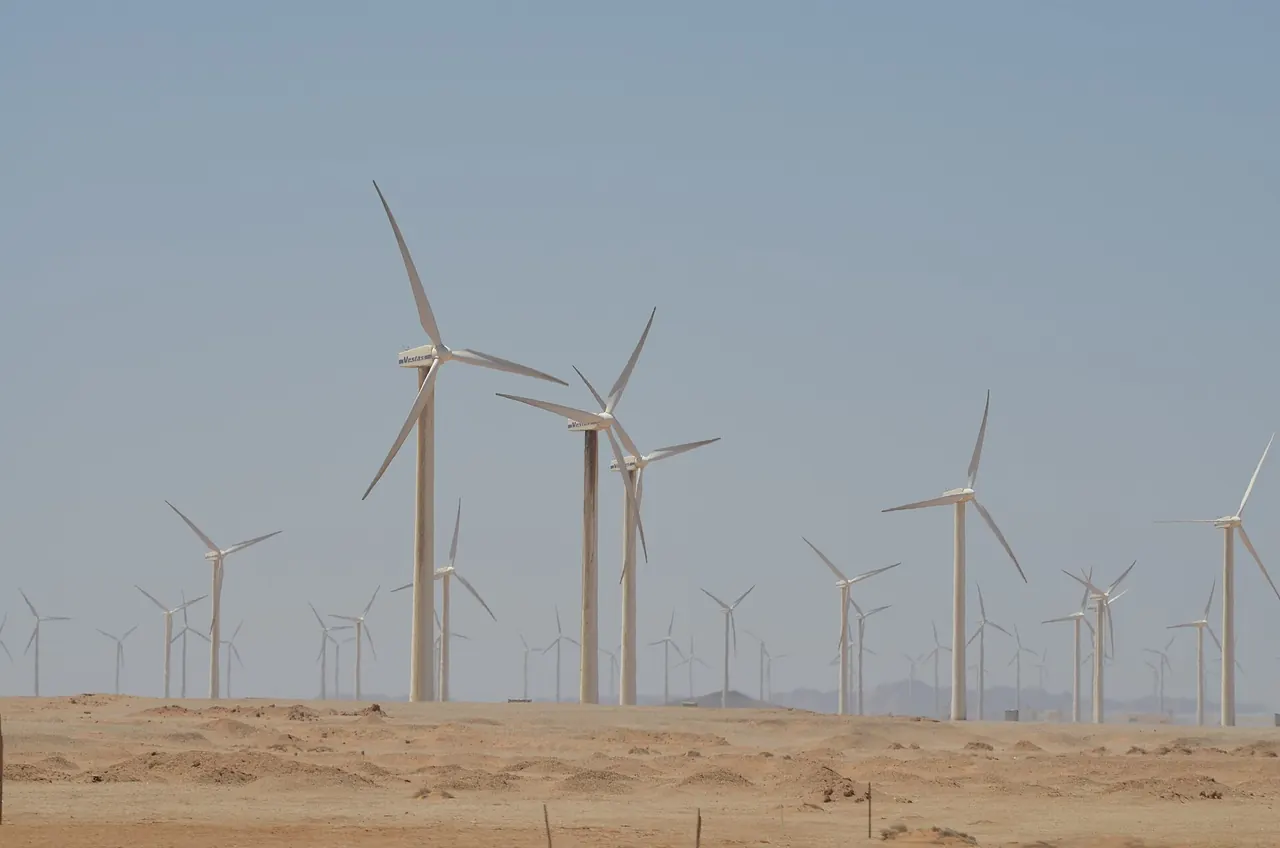
Egypt offered 380 square kilometres of Beni Suef to private renewable investors and rated the same ground twice: 2 gigawatts if you build wind, or 20 if you build solar.
That ratio comes from the government’s own land allocation, reported by Renewables Now on 1 July. Ten to one, on identical dirt, before anyone opens an argument about resource quality or capacity factor. Apply it to Egypt’s entire operating wind fleet, 3,028 MW at the end of 2025 per IRENA, and the arithmetic returns roughly 575 square kilometres. Fill that same ground with panels instead and it carries about 30 GW.
My read is that this is why inland Egyptian land offers keep resolving to solar, and why Egyptian wind has clustered on the coast. ENGIE’s consortium already operates Red Sea Wind Energy (654 MW) and Ras Ghareb (262.5 MW). Its next project, the 900 MW farm with Orascom Construction and Aeolus, is near Ras Shokeir in the Gulf of Suez, with the first 300 MW due in December 2027.
Ten to one is a penalty wind clears only where the resource is exceptional. In Egypt I think that still means the Gulf of Suez, and the queue forming there is a number I have not seen published.
So here is what I keep coming back to. Does Egypt’s first serious inland wind farm get built because a developer finds a better site, or because the corridor runs out of room?
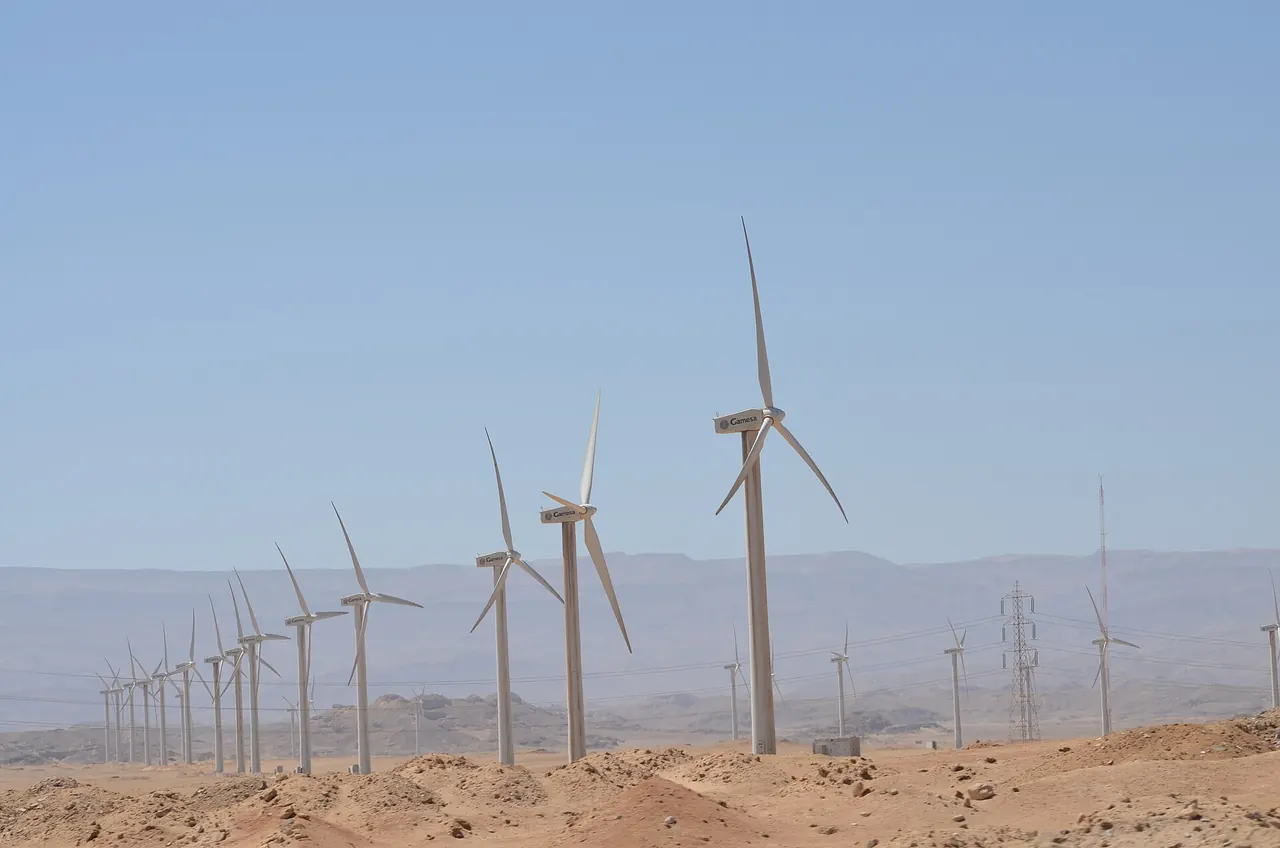
35 of 104 towers on Hans Bruins' second Egyptian wind farm were made in Egypt
The Ras Ghareb Wind Energy and Red Sea Wind Energy CEO told EnterpriseAM that customs clearance fell from weeks to four or five days between his first and second projects. 1 min read
Thirty-five out of 104.
That is how many towers on Hans Bruins’ second Egyptian wind farm were made in Egypt, produced by NSF to Goldwind’s specification. On the first project, built with Siemens Gamesa, only parts of the towers came from local steel.
Two farms, and the country went from pieces of a tower to a third of them.
Bruins runs Ras Ghareb Wind Energy and Red Sea Wind Energy. Eight years in Egypt, three utility-scale wind farms. He gave EnterpriseAM the sequence in February this year: “You first start with assembling components, and once you’re good at that, then you can start to manufacture them locally.” Towers go first because a tower is mostly empty. In his words, “you’re basically transporting a lot of air.”
I would hold that 35 next to every turbine-factory memorandum signed in this region. Announcements arrive in gigawatts. Localisation arrives in towers.
The number that stayed with me is a different one. On project one, customs clearance “sometimes ran into weeks, even months.” On project two it dropped to four or five days. Bruins credits the Finance Ministry’s digitalisation. For components Bruins describes as costing “an awful amount of money per day” when customs holds them, four days against four weeks moves a construction schedule further than a memorandum does.
EnterpriseAM asked in its headline whether Egypt is building a wind industry or hosting one. Two projects answer building, slowly, from the heaviest component up. The 2 GW-a-year turbine factory Egypt signed an MoU for in June answers something faster.
Which answer does the third project confirm?
Masdar buys brand-new wind in Spain as Alcazar takes on Egypt's older Gabal El-Zeit fleet
Masdar is taking 49.99% of a 705 MW Repsol portfolio valued at EUR 849 million, all online since 2025. Alcazar signed definitive agreements to acquire the 580 MW Gabal El-Zeit wind farm, with USD 420 million of external financing. 1 min read
Every turbine in the Spanish fleet Masdar just bought into started spinning in 2025 or later.
Repsol confirmed on 11 June that Masdar is taking a 49.99% stake in a 705 MW Spanish portfolio: 13 wind farms totalling 402 MW and six solar parks totalling 303 MW, all of which entered operation in 2025 or the first quarter of 2026. The transaction values the portfolio at EUR 849 million. Repsol calls it its eighth renewable asset rotation, 3,850 MW cumulative. Masdar’s own stated logic is to “add high-quality operating assets in key markets”. Once it closes toward the end of this year, Masdar holds 4.1 GW operating across the Iberian Peninsula.
Hold that against what another UAE-headquartered investor signed in Egypt the same week. Alcazar Energy Partners signed definitive agreements to acquire Egypt’s 580 MW Gabal El-Zeit, a Siemens Gamesa fleet grid-connected in 2018 and averaging eight to ten years of service, under a 25-year PPA with EETC and USD 420 million of external financing to extend the asset’s useful life.
Two deals, three days apart, opposite ends of the age curve. In Spain the buyer inherits a clean operating record and a merchant capture rate it has to forecast. In Egypt the buyer has to prove that a turbine at year eight still has seventeen good years left in it.
I think the Egyptian bet is the harder one, and it is the one the region needs to win.
So who is pricing year-twelve reliability better: the sponsor buying new abroad, or the sponsor underwriting old in the region?
Egypt plans to add 21 GW of renewables by 2029, with wind rising fivefold to 15 GW
A roadmap presented to Prime Minister Mostafa Madbouly takes renewables from 9.5 GW to 30.7 GW by end-2029, against 11.21 GW planned by end-2026. 1 min read
Egypt has just written a plan to add 21 gigawatts of renewables in four years. Nine tenths of it arrives in the last three.
Minister of Electricity and Renewable Energy Mahmoud Esmat presented the roadmap to Prime Minister Mostafa Madbouly this month. Installed renewable capacity triples from 9.5 GW today to 30.7 GW by the end of 2029, with renewables reaching 42% of power generation by 2030. Wind carries the largest single block in that plan: it rises fivefold to 15 GW, ahead of solar at 12.7 GW, with hydro flat at 2.98 GW. The near-term step is far smaller, 11.21 GW by the end of 2026 against 8.54 GW at the end of last year. Renewables produced a record 35.19 TWh in 2025, 14% of generation. Gas still supplies 79%.
Why it matters
MEES frames the roadmap as a way to cut gas out of the generation mix and ease Egypt’s reliance on LNG imports. A gas producer that now imports LNG has answered with more wind capacity than solar capacity. I read that ordering as a fuel-substitution bet rather than a diversification one, and it is an argument that travels to every import-exposed grid.
What it means for MENA
We find the ambition credible. The calendar is where the risk sits. Roughly 19.5 GW has to be contracted, financed and connected between 2027 and 2029, after Egypt reaches only 11.21 GW next year. Whether EETC can award and evacuate at that cadence is what the 15 GW number actually tests.
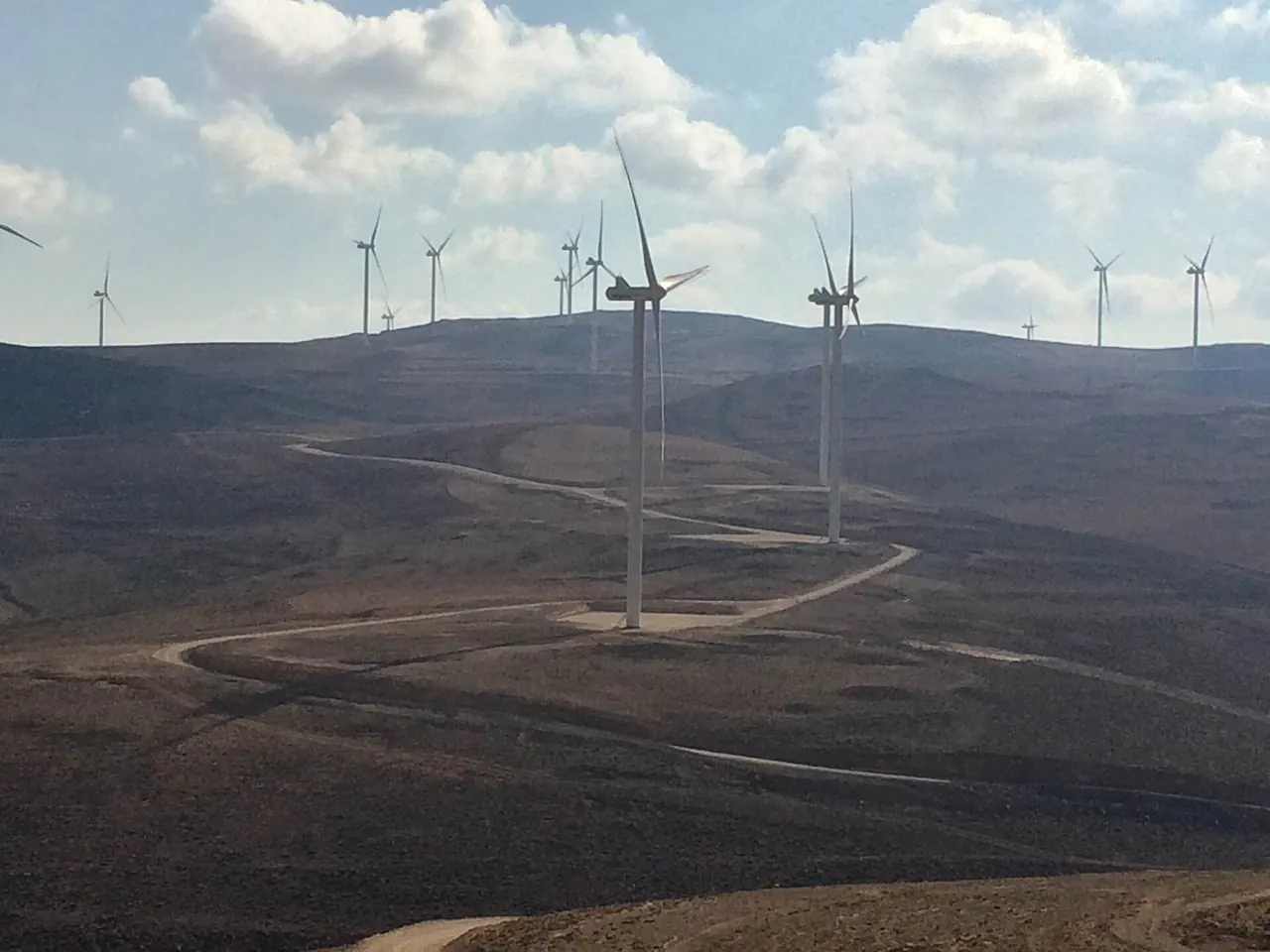
MENA added 886 MW of wind in 2025, and Egypt built 829 MW of it
IRENA puts the ten-market MENA fleet at 6,943 MW at end-2025. Eight markets added nothing, while Türkiye alone added 1,910 MW. 2 min read
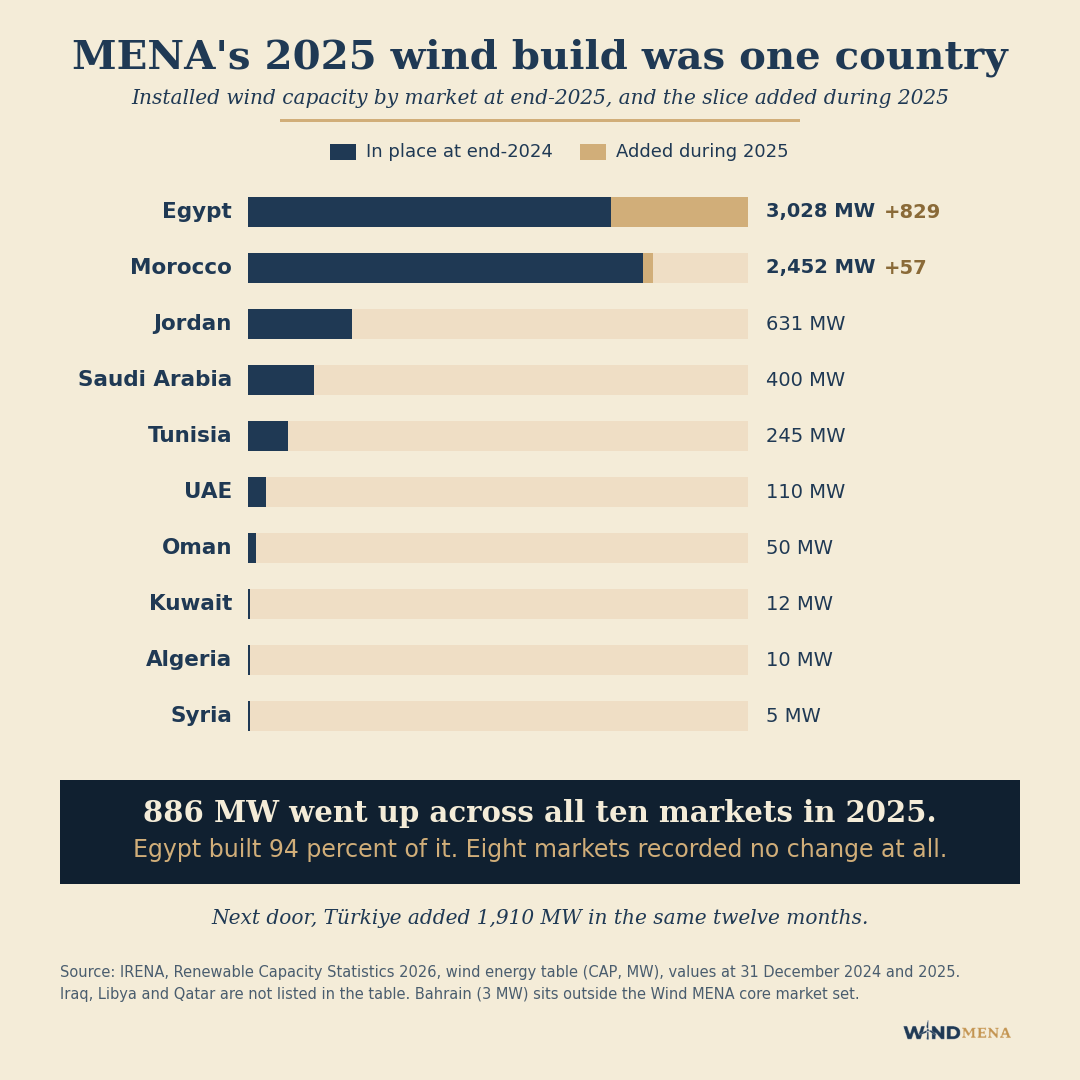
Note, 13 October 2026: IRENA and GWEC count Saudi wind differently. GWEC reports 1,512 MW of Saudi additions in 2025 and 2,324 MW installed at year end; IRENA's table, used here, shows no change. We report IRENA's figures as published.
886 megawatts. That was MENA’s entire wind build in 2025, and Egypt put up 829 of them.
IRENA’s Renewable Capacity Statistics 2026 landed in March with the region’s year-end numbers. Ten MENA markets carry installed wind. Morocco added 57 MW. In IRENA’s table, the other eight, Jordan, Saudi Arabia, Tunisia, the UAE, Oman, Kuwait, Algeria and Syria, finished 2025 on exactly the capacity they started it with.
On IRENA’s count the regional fleet stands at 6,943 MW, and Egypt and Morocco hold 79 percent of it. IRENA still records Saudi Arabia at 400 MW, the size of Dumat Al Jandal, and Oman at 50 MW.
Set that against what the Gulf is currently procuring. Saudi Arabia has 2.2 GW of wind moving through NREP Round 7, five and a half times the fleet IRENA records for it.
Next door, IRENA records Türkiye adding 1,910 MW over the same twelve months, more than twice what all of MENA managed.
This looks to me like a sequencing problem. Egypt and Morocco built their fleets over two decades of steady, smaller rounds. The Gulf is standing up a fleet and the machinery that procures one in the same cycle, and right now the procurement half is running well ahead of the steel.
The chart that matters is next year’s. Which market puts up its first full gigawatt in a single year, and does it come from North Africa again?
The data
| Market | End-2024 MW | End-2025 MW | Added 2025 |
|---|---|---|---|
| Egypt | 2,199 | 3,028 | +829 |
| Morocco | 2,395 | 2,452 | +57 |
| Jordan | 631 | 631 | 0 |
| Saudi Arabia | 400 | 400 | 0 |
| Tunisia | 245 | 245 | 0 |
| UAE | 110 | 110 | 0 |
| Oman | 50 | 50 | 0 |
| Kuwait | 12 | 12 | 0 |
| Algeria | 10 | 10 | 0 |
| Syria | 5 | 5 | 0 |
| MENA core total | 6,057 | 6,943 | +886 |
| Türkiye (adjacent) | 12,871 | 14,781 | +1,910 |
Source: IRENA, Renewable Capacity Statistics 2026 (published March 2026), “Wind energy” table, header CAP (MW), printed pp. 14-15.
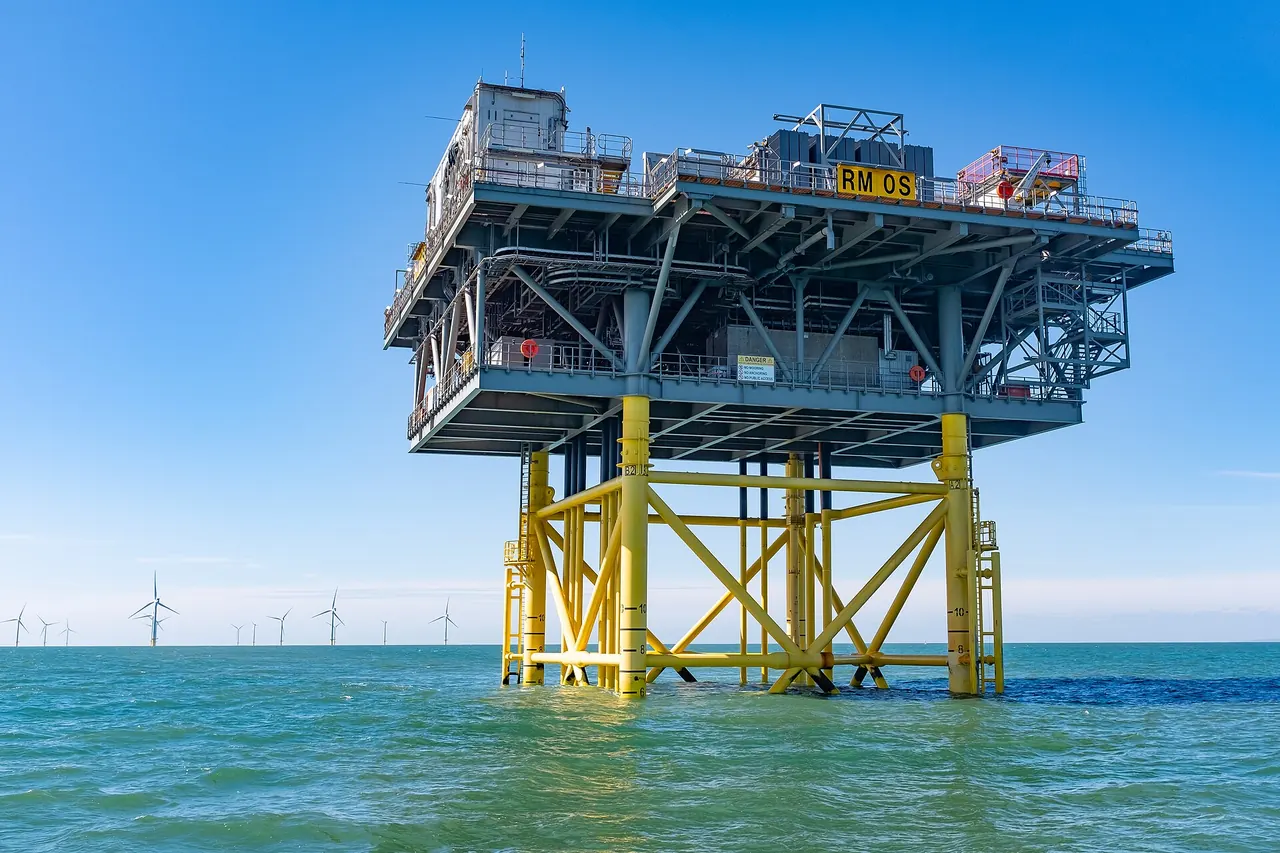
Oman's largest wind farm will sell all 234 MW to an oil field operator, not the national grid
Riyah 1 and 2 supply Petroleum Development Oman under long-term PPAs, with commercial operation due in December 2026. Nama PWP's three tendered wind IPPs have not yet been awarded. 1 min read
Oman’s largest wind farm will not send a single megawatt-hour to the national grid.
Riyah 1 and Riyah 2 are going up inside the southern part of Petroleum Development Oman’s Block 6 licence area, 18 turbines each, 234 MW combined. All 36 turbine sets reached the sites in May after 300,000 freight revenue tonnes moved through the Port of Duqm. OQ Alternative Energy holds 51 percent of the JV and TotalEnergies 49. Every megawatt-hour goes to PDO under long-term power purchase agreements. OQAE says commercial operation remains on track for December 2026.
Oman’s utility-scale wind procurement runs a slower clock. Nama PWP’s 2025 annual report, reported by Zawya Projects in May, lists three wind IPPs at Duqm (Ras Madrakah), Mahout and Sadah, tendered in the fourth quarter of 2025 and worth roughly 1,120 to 1,260 MW together. None has been awarded yet. Sadah is scheduled for commercial operation in Q4 2027, Mahout in Q1 2028. The one project already awarded in this cycle, 120 MW at Jaalan Bani Bu Ali to EDF power solutions, Al Khadra Partners and OQAE, connects in Q3 2027.
Line those dates up and an oil field gets its wind roughly three quarters before the current IPP round delivers its first megawatt.
My read is that the ordering is structural. An industrial offtaker controls the counterparty, the land, the connection point and the demand curve inside one fence, so the project skips the tender cycle, the evacuation lot and the tariff negotiation that pace grid-connected wind farms in the region. Oman is proving the shortcut at 234 MW.
Which MENA industrial operator signs the next behind-the-fence wind PPA, and does it beat its own national procurement round to commissioning again?
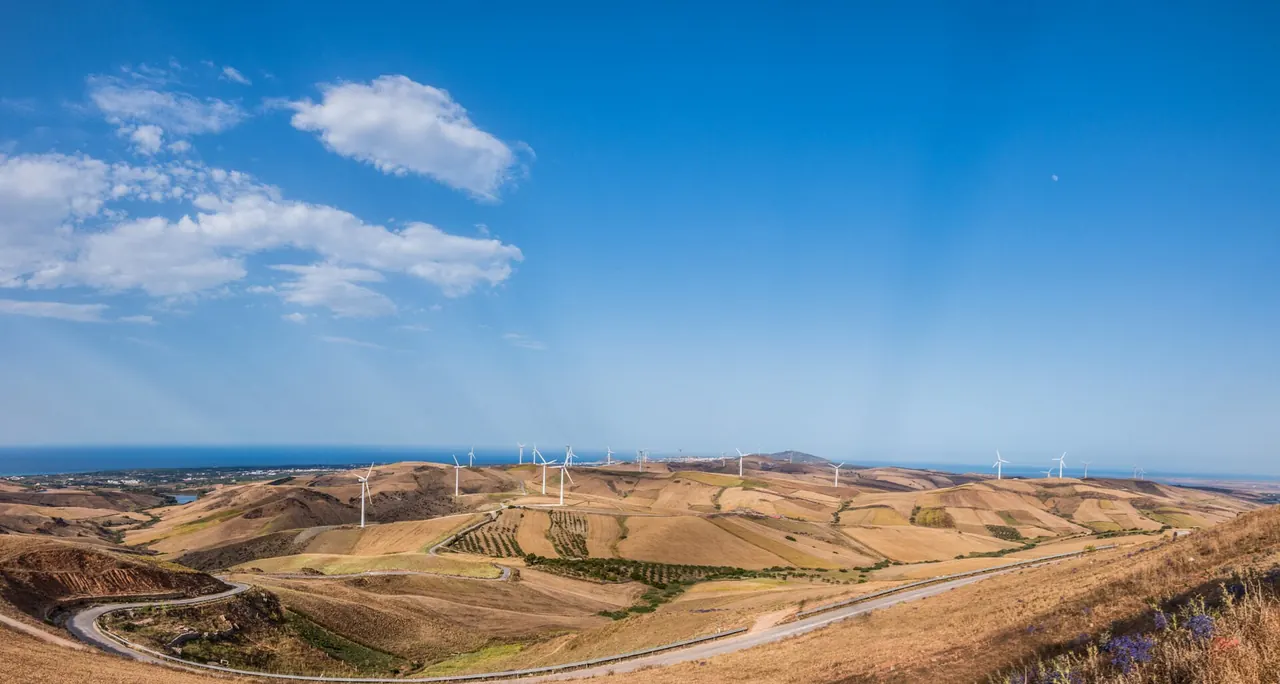
Two wind datasets put Middle East and Africa at 15.2 GW and 31.2 GW, and Türkiye is the gap
Windpower Intelligence counts 31.2 GW at end-2025 and GWEC counts 15.2 GW. Subtract Türkiye from the first and the two land within half a gigawatt. 1 min read
Two credible wind datasets put Middle East and Africa’s installed capacity at the end of 2025 at 15.2 GW and 31.2 GW. Both are right. The gap between them is one country.
Windpower Intelligence published its July global forecast on 16 July, projecting the MEA region to reach 69.1 GW of installed wind by end-2032, up from 31.2 GW at end-2025. Türkiye claims 27.5 GW of that 2032 total after adding just under 12 GW across the outlook, which implies just over 15.5 GW already in place there today. Egypt is forecast at 11.9 GW by end-2032, Morocco at 6.8 GW, South Africa above 10 GW. The forecast groups everything else in the region, the entire Gulf included, into a single “others” line of roughly 12.5 GW. Separately, GWEC’s Global Wind Energy Report 2026 counted 15.2 GW installed across Africa and the Middle East at end-2025 and forecasts 35 GW of new additions between 2026 and 2030, split 53% Middle East and 47% Africa. Subtract Türkiye from the Windpower Intelligence total and the two datasets land within half a gigawatt of each other.
Why it matters
On these numbers, Türkiye has built roughly as much wind capacity as the rest of Africa and the Middle East combined. Where an analyst files a single country doubles or halves the headline number for an entire region, and those headline numbers reach capital allocation committees long before the footnotes do.
What it means for MENA
Check the regional definition before quoting any regional total. For anyone sizing a turbine order book or a service territory here, that 12.5 GW “others” line is the number to watch, because the forecast names Türkiye, South Africa, Egypt and Morocco individually and Saudi Arabia is not among them. Saudi Arabia closed 2025 with 2,324 MW installed after adding 1,512 MW in a single year. One country’s build-out could redraw that entire line before 2032.
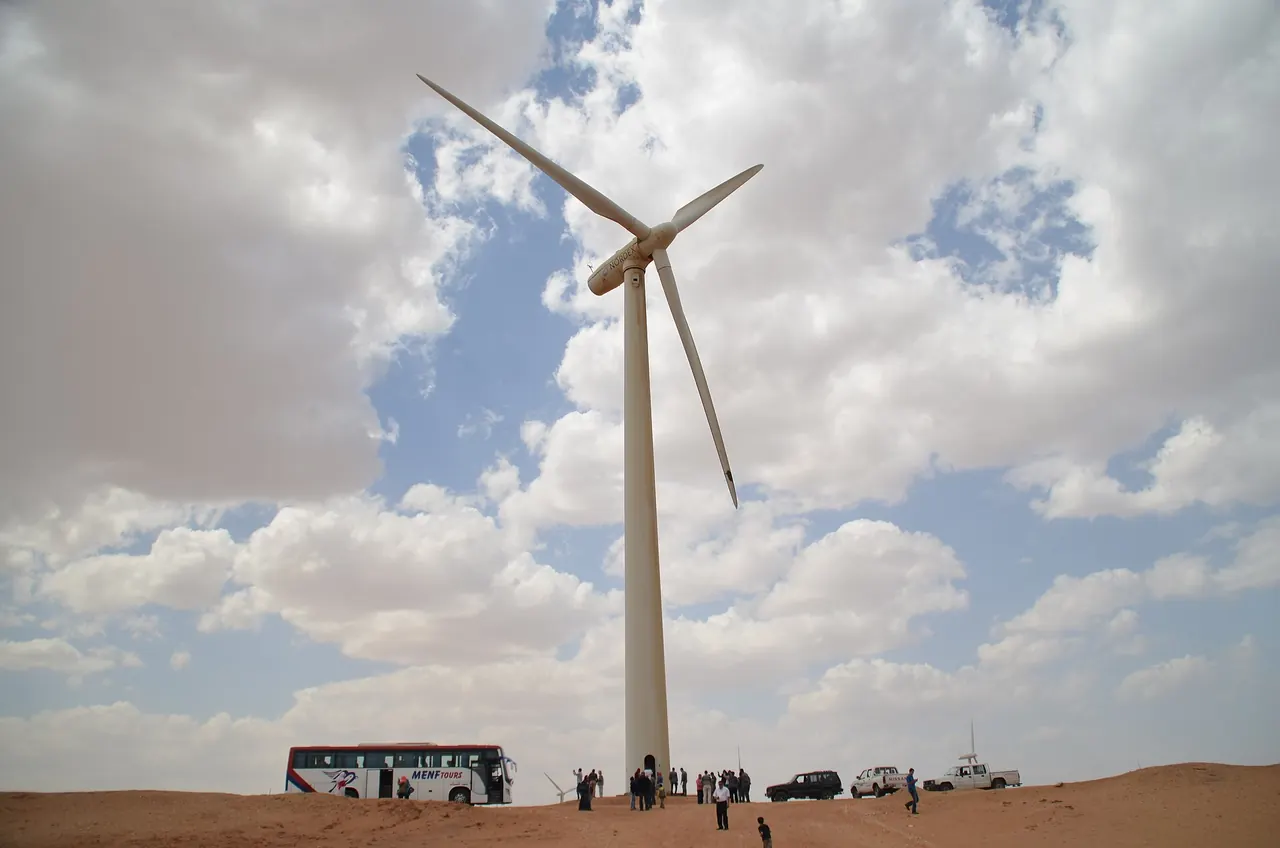
Egypt bills wind farm land at a minimum of 2% of the energy it generates
Cabinet Resolution 54 of 2023 sets NREA's usufruct charge for up to 25 years from commercial operation. Sites can be auctioned on the percentage itself. 1 min read
Egypt bills the land under a wind farm in electricity.
Cabinet Resolution 54 of 2023 sets the usufruct charge on NREA land at a minimum of two percent of the value of the energy the plant generates, paid annually in the same currency as the power purchase agreement, across a usufruct that runs up to twenty-five years from commercial operation. Run the arithmetic and the land bill for a 25-year wind project comes to roughly six months of its own output.
That percentage is not unusual by itself. American wind royalties typically clear between one and four percent of gross revenue, according to NYSERDA. What differs is the recipient. Under Egypt’s regime the cheque goes to NREA and the governorates.
Two clauses in that resolution deserve more attention than they get.
The first: NREA can auction a site and select the winner on the usufruct percentage itself. Land is a bid variable in Egypt. A developer can compete margin away on rent as readily as on tariff.
The second: investors must deliver met mast measurements to NREA quarterly, and if they do not complete the project, the data and studies become NREA property. Egypt banks the wind resource dataset whether or not the turbines ever turn.
The two percent is a floor, and it was negotiated. Before 2019, governorates were quoting five to seven percent. NREA talked them down.
I keep asking one question. As Egypt hands land to ACWA Power and Masdar for 10 GW wind projects each, and to the Scatec-Orascom consortium for 8 GW, does a two percent floor survive contact with the best sites?
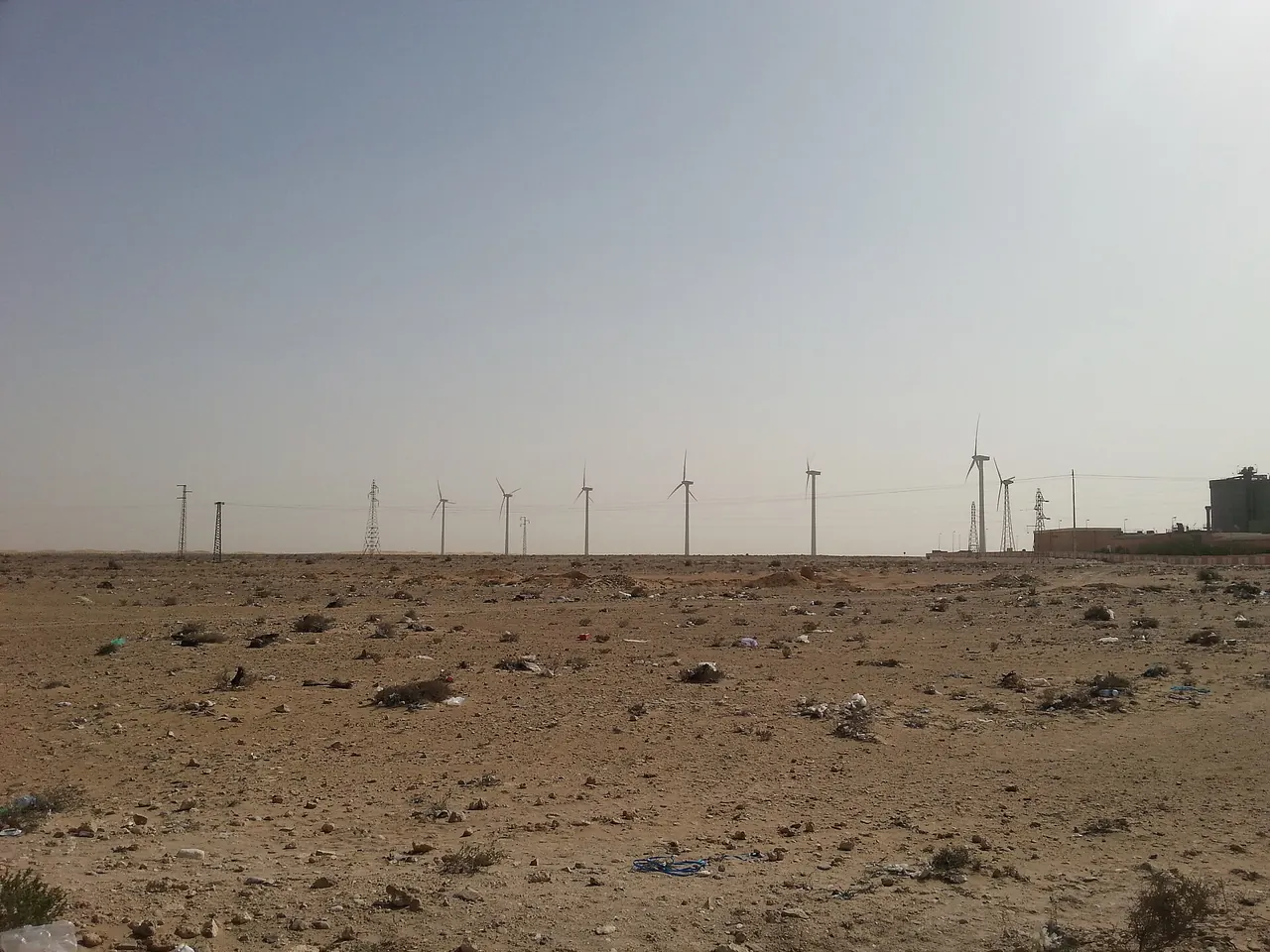
ACWA Power's 40 MW Khalladi expansion is Morocco building on what already works
ACWA Power has a permit to lift Khalladi in northern Morocco from 120 to 160 MW for about MAD 550 million, with completion expected within two years. 1 min read
One of MENA’s quieter wind moves this month measures 40 megawatts, and I think it may be the smartest one in the region.
ACWA Power has secured a permit to lift its Khalladi wind plant in northern Morocco from 120 to 160 megawatts, an investment of about MAD 550 million (roughly $60 million), expected to be completed within two years to help meet growing industrial demand. Khalladi has run since 2018. Expanding an operating site means the grid link, the wind data and the access roads already exist. My read is that these are among the cheapest megawatts Morocco can build right now.
The permit adds to a bigger Moroccan book for ACWA: AGBI, citing Asharq Business, puts its investments in the country at $3 billion, and the company also plans to enter desalination there. I read this as a playbook: expand what already works before reaching for the next greenfield. Small moves, stacked, can beat one big leap that stalls at financial close.
When the 2027 additions are tallied, will Morocco’s quiet compounding outpace the region’s gigawatt flagships?
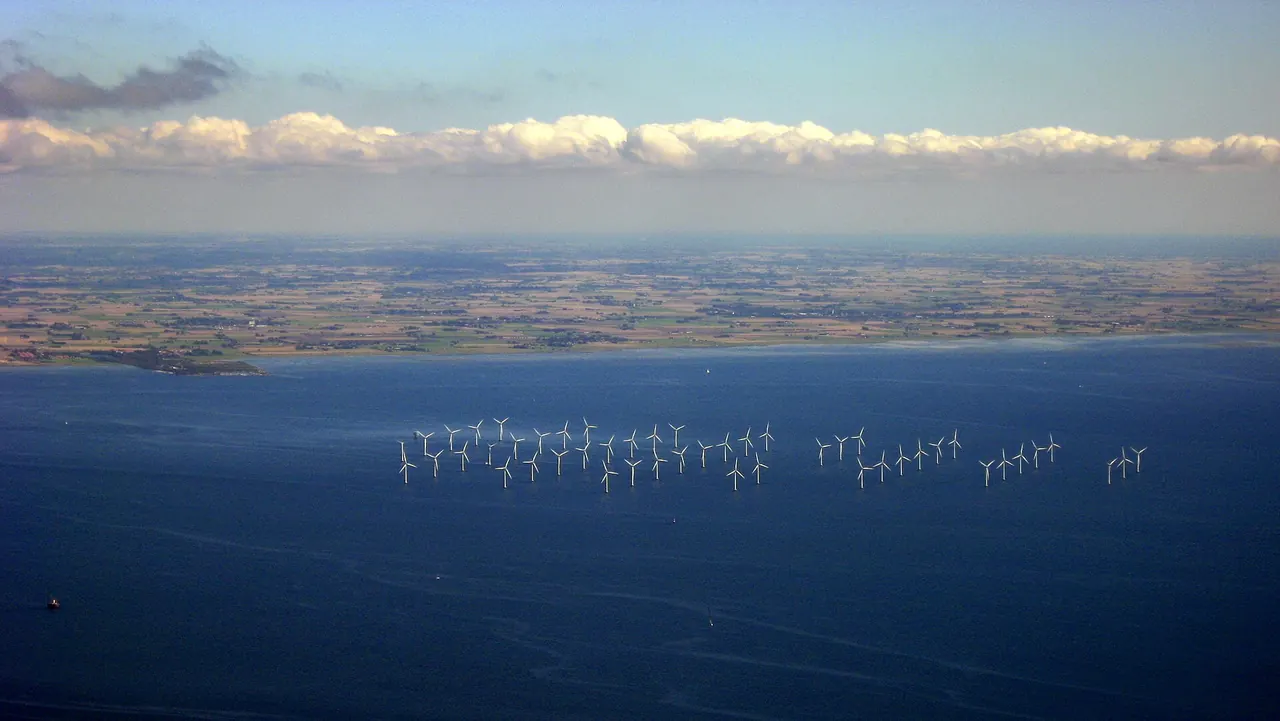
Türkiye's 7 to 11 cent offshore wind band sits over four times above Saudi Arabia's Al Ghat onshore price
Draft YEKA OWPP-2026 rules cover four sea areas, a 49-year operating right and 25 percent domestic content. Saudi Arabia's Al Ghat cleared onshore wind at 1.566 cents. 1 min read
Saudi Arabia’s Al Ghat, now feeding the Saudi grid, cleared onshore wind at 1.566 cents per kWh. The offshore price band in MENA’s neighbourhood opens at 7.
Türkiye’s draft rules for YEKA OWPP-2026, its first gigawatt-scale offshore wind auction, set a reverse-auction corridor of 7 to 11 US cents per kWh across four sea areas, from Saros Bay to the waters off Edremit. Public consultation closes August 17. We covered the announcement in June. The number deserves its own post.
Türkiye’s offshore floor sits more than four times above Al Ghat’s clearing price. The ceiling runs about seven times higher.
The spread prices a new frontier: 49-year operating rights at sea, a 25 percent domestic content requirement backed by 5 million dollars of penalty per missing percentage point, and, as I read it, a Turkish offshore supply chain that is still mostly to be built. TÜREB points to a World Bank scenario in which 7 GW of Turkish offshore by 2040 draws 16 billion dollars of investment and 110,000 jobs.
If offshore follows the path onshore took in the Gulf, this band is a starting point and auction rounds do the compressing. Every coastline weighing offshore, from Morocco’s Atlantic to the Gulf of Suez, now has a benchmark to beat.
Which coastline in the region posts the first sub-5-cent offshore bid?
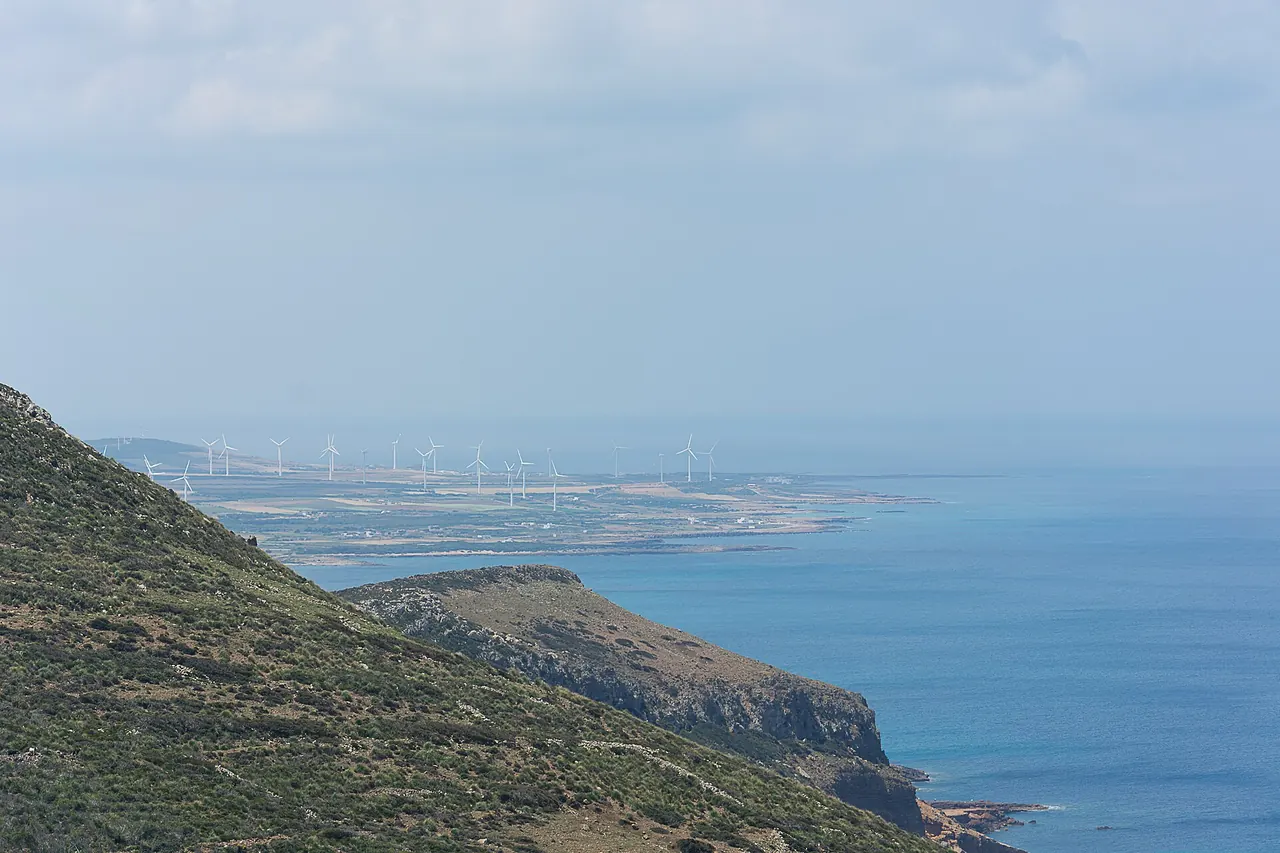
O-Green's Mustafa Al Hinai signed for 2.7 GW built to deliver nearly 770 MW around the clock
His contract with Nama PWP covers the Continuous Renewable Energy Project across Mahout and Duqm, with commercial operations targeted for summer 2028. 1 min read
On a Sunday in Muscat this May, two signatures turned 2.7 gigawatts of wind, solar and batteries into a promise of nearly 770 megawatts that never switch off.
The signature on the seller’s side belonged to Mustafa Mohammed Al Hinai, CEO of O-Green Energy, the platform Oman founded in 2025 through OQ Alternative Energy and Naqaa Sustainable Energy. The contract he signed with Nama Power and Water Procurement covers the Continuous Renewable Energy Project across Mahout and Duqm, which Oman News Agency calls one of the world’s largest hybrid continuous renewables projects, with commercial operations targeted for summer 2028.
Run the arithmetic. Roughly 3.5 megawatts get built for every megawatt guaranteed around the clock. My read is that this ratio, and the fact that a sovereign single buyer signed for it, says more about where MENA wind is heading than any headline gigawatt number.
Founded only last year, Al Hinai’s platform already reports 11 GW of generation and storage under development across 12 countries, with more than 3.3 GW secured. He calls the project “very much linked” to the Mawarid wind turbine factory under construction in Oman.
We think Oman just set the region’s benchmark: electricity sold as a product that shows up.
Which MENA buyer contracts firmness at this scale next?
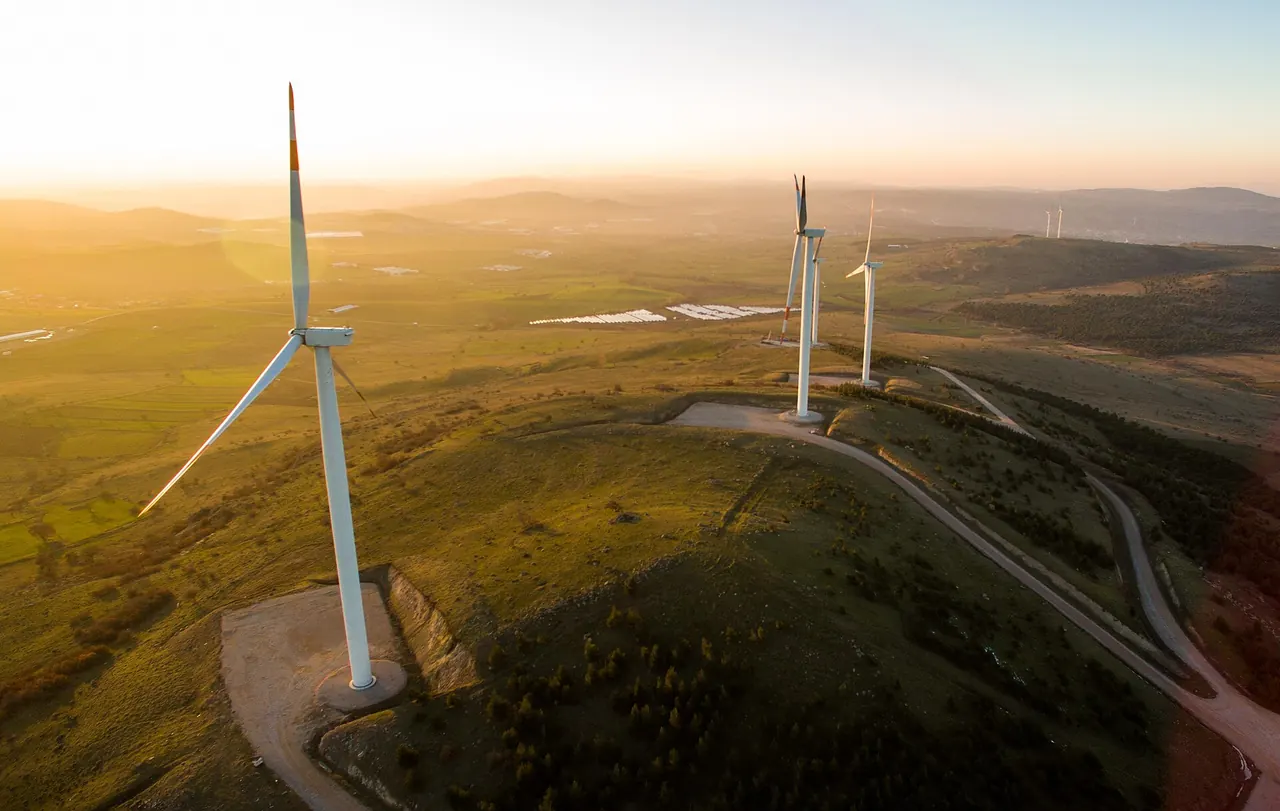
Türkiye opens YEKA-2026 with 1,500 MW of onshore wind across seven auctions
Energy Minister Alparslan Bayraktar launched the 2.4 GW tender on 13 July with a €0.055/kWh ceiling and a €0.035/kWh wind floor. Applications close 13 October. 1 min read
Türkiye just opened a 2.4 GW wind and solar tender, and wind takes the majority of the capacity.
Energy Minister Alparslan Bayraktar launched YEKA-2026 on July 13, allocating 1,500 MW to seven onshore wind auctions and 900 MW to fourteen solar auctions across designated Renewable Energy Resource Areas. The ceiling price sits at €0.055/kWh for both technologies; the wind floor is €0.035/kWh and the solar floor €0.0325/kWh. Winners hold a 72-month open-market window for wind (60 months for solar) before entering 20-year PPAs at auction pricing. Applications close October 13. Balıkesir gets the largest single wind allocation at 685 MW.
Why it matters
Türkiye has pledged at least 2 GW of YEKA competitions every year en route to 120 GW of wind and solar by 2035. I think a predictable annual tender cadence matters more to bidders than any single round.
What it means for MENA
Türkiye now runs a structured annual wind tender cycle next door to Saudi NREP, and Saudi bidders get a comparable procurement architecture in an adjacent market. My read is that a €0.035/kWh wind floor sharpens the pricing question heading into Saudi Round 7’s bid window.
Enerjisa Üretim lines up $180 million arranged by FMO, with $80 million from DEG, for 250 MW of Muğla wind
The syndicated package funds three Enercon-supplied wind farms in Muğla. DEG already financed nine Enerjisa YEKA-2 plants totalling 750 MW. 1 min read
Türkiye’s largest private electricity producer just lined up $180 million in DFI-arranged debt for 250 MW of new wind.
Enerjisa Üretim, in which E.ON is a shareholder, signed the contracts in a syndication arranged by Dutch development bank FMO, with Germany’s DEG providing $80 million of the $180 million total, DEG announced on July 13. Proceeds finance three wind projects in Muğla province in southern Türkiye with around 250 MW combined, all supplied by Germany’s Enercon. DEG puts their potential output at enough for roughly 189,000 households a year, avoiding around 221,000 tonnes of CO2. DEG has worked with Enerjisa since 2024 and, as part of a larger consortium, financed nine onshore wind plants totalling 750 MW under Türkiye’s YEKA-2 program. Enerjisa has around 4.6 GW installed.
Why it matters
Our read is that long-tenor DFI debt for private wind IPPs is still scarce in emerging markets, which makes a repeat customer relationship like this one worth more than the ticket size. DEG frames the loan around a German shareholder and German turbines.
What it means for MENA
We see a template here for MENA wind IPPs: tie the development finance ticket to the turbine supplier’s home-country lender, and come back to the same lender for the next tranche. Which MENA sponsor builds that relationship first?
Saudi Arabia's sub-2-cent wind tariff faces its first operating year before Round 7
Al-Ghat cleared at 1.566 cents per kWh and is now fully grid-connected, with Wa'ad Al Shamal synchronised behind it. Operating data from Q3 2026 arrives as Round 7 wind is bid. 1 min read
MENA wind’s next real price test arrives with the first operating year.
Saudi Al-Ghat’s 600 MW cleared at 1.566 cents per kWh under a 25-year SPPC PPA and is now fully grid-connected. Wa’ad Al Shamal’s 500 MW reached full grid synchronization on June 25, with both projects pending the 168-hour reliability run before commercial operation. The same Marubeni and Ajlan partnership is building Yanbu 700 MW behind them. NREP Round 7 wind bidding falls into that same window.
Those prices were set before either site had a year of operating data at hub height. From Q3 2026, that data starts arriving. Availability rates, curtailment behaviour, dust and thermal loss profiles all land at project meters over the next four quarters. I expect lenders and procurement offices to read those numbers before they underwrite the next tender.
That is the test. If Round 7 clears near current levels once the first operating year is public, I would read the sub-2-cent floor as a real market clearing price. If Round 7 clears wider, operating reality has repriced the market.
Which way does it go?
Oman's grid operator schedules over 2 GW of wind for connection between 2027 and 2030
OETC's Five-Year Annual Capability Statement 2026-2030 also lists 5.7 GW of solar and a 1 GW round-the-clock project, lifting renewables from about 7% to 30%. 1 min read
Oman’s grid operator just published the 5-year plan that pins wind to over 2 GW by 2030.
Oman Electricity Transmission Company (OETC) released its Five-Year Annual Capability Statement 2026-2030 this month. It schedules over 2 GW of wind, 5.7 GW of solar, and a 1 GW round-the-clock renewables project for grid connection between 2027 and 2030. Battery storage systems and cross-border transmission upgrades sit around the buildout. The plan lifts Oman’s renewables share from about 7% today to 30% by 2030. Reported by MEES on July 3 and Renewables Now on July 7.
My read: grid operator schedules are the last mile between announcement and commissioning. When OETC publishes hard connection dates, the tender rounds and PPA signings from Nama PWP finally have a path to the meter.
Oman’s wind fleet moves from about 120 MW today to over 2 GW inside four years, anchored on the Mahoot, Duqm, and Sadah wind IPPs. We read the statement as a working template for smaller markets whose grid operators are drafting their next capability statements.
Four parties now sign separate pieces of a single MENA wind farm
SPPC signs tariffs, MIGA the risk cover, DFIs the debt and Tahya Misr the financing, in deals from Saudi Arabia to Egypt. 1 min read
MENA wind’s counterparty stack has fragmented, and we read that as the pattern doing the heavy lifting in H1 2026.
Different parties are now signing different pieces of the same wind farm.
SPPC signs the tariff in Saudi Arabia, and it now tenders the storage that firms the wind as separate build-own-operate projects: 3 GW and 12 GWh in its second battery tranche.
MIGA signs the political risk cover. On June 22 it agreed a $193.3 million guarantee for ACWA Power’s 1.1 GW Suez wind project in Egypt.
Development finance institutions sign the debt. The same Suez project sits on a $703.6 million senior debt facility closed in January 2025 with EBRD, the African Development Bank, British International Investment and DEG.
Tahya Misr signs the financing. The May 4 agreement with the electricity and finance ministries hands financing and implementation of 4,750 MW of wind to the state-owned holding, with electricity priced in Egyptian pounds.
The older model had one utility signing a single-tranche PPA and one sponsor building the plant. On Suez, ACWA Power and HAU Energy hold the equity, EETC buys the power, four lenders hold the debt and MIGA covers the political risk. My read: each party now carries only the piece it is priced to carry.
The next test: which MENA procurement authority rewrites its wind rulebook to formalize this fragmentation, and which stays with the single-tranche model until it stops closing deals?
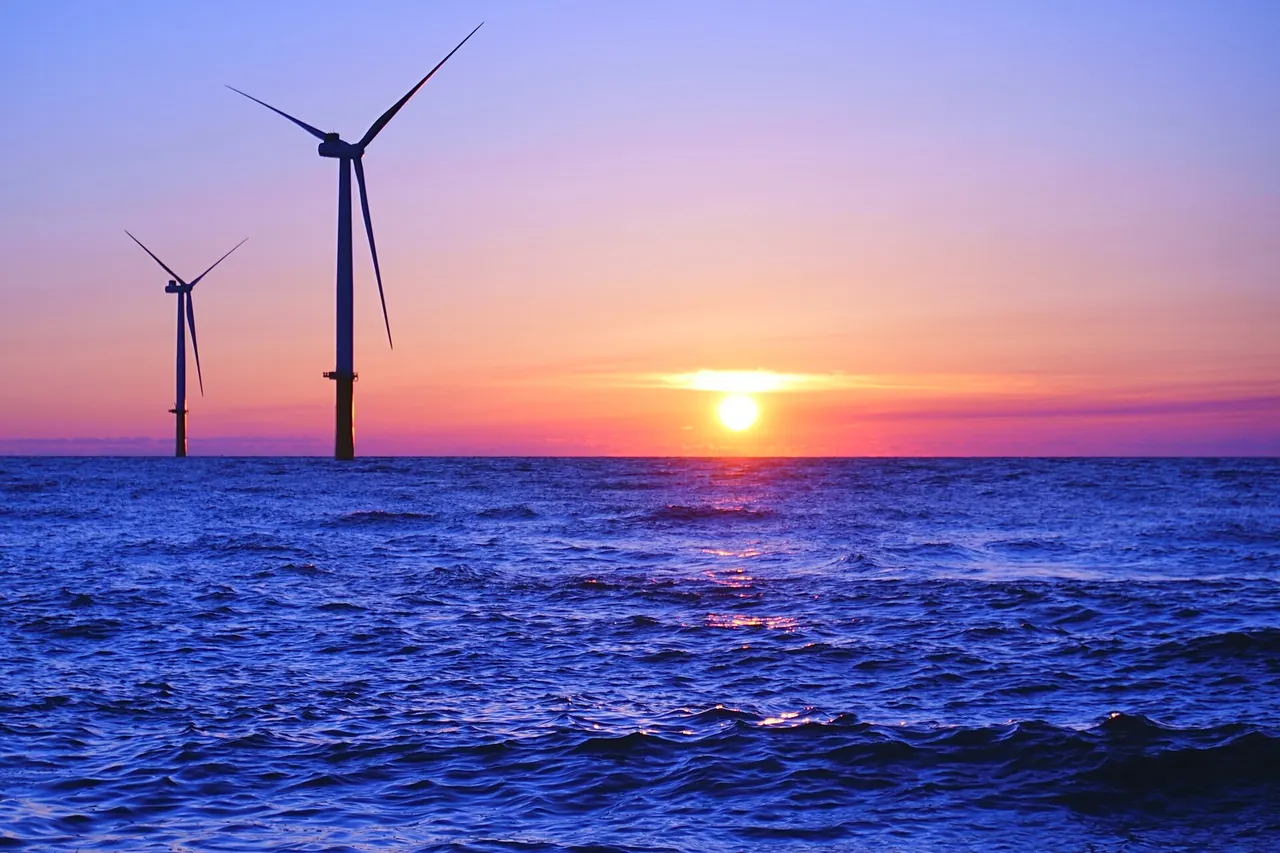
MENA wind logged a milestone at five layers of its value chain in eight days
A Sany factory MoU in Egypt, Türkiye's offshore auction draft, MIGA cover for ACWA Power's Suez project, Masdar's Zhambyl groundbreaking and two Saudi grid syncs. 1 min read
Eight days in late June gave MENA wind a milestone at five layers of its value chain.
Manufacturing. Sany signed an MoU with EETC and NREA on June 24 covering a 2 GW turbine factory in Egypt and a 2 GW Gulf of Suez wind farm, financed in Egyptian pounds. If it reaches final agreements, a Chinese OEM’s local factory comes with a 2 GW wind farm attached.
Procurement architecture. Türkiye published draft rules on June 22 for its first 1 GW offshore auction. Four candidate sea areas, a $0.07 to $0.11 per kWh price band, 49-year concession, 25 percent domestic content, public consultation to August 17. We know of no earlier auction in the wider region that puts a price band, bid bond and delivery clock against offshore wind.
Investability underwriting. MIGA agreed to provide $193.3 million in political risk cover for ACWA Power’s stake in the 1.1 GW Suez wind farm, layered onto a $704 million EBRD, AfDB, BII, and DEG senior debt facility.
Overseas sponsorship. Masdar broke ground on the 1 GW Zhambyl wind farm in Kazakhstan on June 29 with $1.4 billion committed and a 600 MWh BESS, plus a roadmap for the country’s first round-the-clock clean energy project for AI data centre baseload.
Physical delivery. Saudi Arabia grid-synced all 80 Al Ghat 7.7 MW turbines by June 10 and all 67 Waad Al Shamal 7.7 MW turbines by June 25. Both are Marubeni and Ajlan and Bros joint ventures under 25-year SPPC PPAs, and Al Ghat holds the world-record LCOE at $15.66 per MWh.
Five layers, eight days. Which one looks most fragile going into H2?
Masdar breaks ground on 1 GW, $1.4 billion Zhambyl wind farm in Kazakhstan
The project adds a 600 MWh battery and more than 400 km of new transmission. Masdar also signed a roadmap for Kazakhstan's first round-the-clock clean energy project. 1 min read
Masdar broke ground on its first Kazakh wind farm on Jun 29, a 1 GW project with a $1.4 billion price tag and a 600 MWh battery bolted on.
The site sits in Kazakhstan’s Zhambyl region, co-developed with Alpha Dhabi subsidiary W Solar, Qazaq Green Power (a Samruk-Kazyna Fund company), and the Kazakhstan Investment Development Fund. The build adds more than 400 km of new overhead transmission alongside the turbines and will power roughly 880,000 southern Kazakh homes once operational. In parallel, Masdar signed a roadmap agreement with Kazakhstan’s Ministry of AI and Digital Development for the country’s first Round-the-Clock clean energy project, with a proposed initial phase of up to 200 MW of baseload for data centres and AI infrastructure.
Why it matters
Zhambyl is Masdar’s first renewable energy development in Kazakhstan, and Masdar describes it as one of the largest integrated wind and battery storage projects in Central Asia. The RTC roadmap is a separate project, signed the same day with the AI ministry. My read is that data-centre baseload is starting to shape where the next class of gigascale clean power gets built.
What it means for MENA
Alpha Dhabi’s chief executive framed the deal as UAE capital and expertise going to markets where the energy transition is accelerating. We read it the same way: MENA capital continuing its shift from importer of wind technology to sponsor of large overseas wind projects.
Türkiye publishes draft rules for its first 1 GW offshore wind auction
YEKA OWPP-2026 sets a $0.07 to $0.11 per kWh price band, a 49-year operating right and 25 percent domestic content. Consultation runs to August 17. 1 min read
Türkiye just published the draft rules for its first gigawatt-scale offshore wind auction.
The Energy Ministry’s YEKA OWPP-2026 specification puts a 1 GW project up for bid across four candidate sea areas: Saros Bay, Gökçeada, Bozcaada, and waters off Edremit. The reverse auction sets a $0.07 to $0.11 per kWh price band, awards a 49-year operating right, and requires 25 percent domestic content backed by $5 million penalties per percentage-point shortfall. Bidders post $50 million at application and $250 million on contract signing. Early commissioning within seven years earns a $0.12 per kWh tariff for the first phase. Public consultation runs to August 17, 2026. TÜREB cites a World Bank scenario in which 7 GW of Türkiye offshore by 2040 would mean $16 billion of investment and 110,000 jobs.
Why it matters
We know of no earlier auction in the wider region that puts a price band, bid bond, and seven-year delivery clock against offshore wind. The 25 percent domestic content rule attaches a manufacturing requirement to the megawatts.
What it means for MENA
Every MENA developer with offshore ambition now has a procurement template within driving distance. My expectation is that the first MENA offshore tender will be benchmarked against the price band, bond structure, and local-content rules Türkiye just put on paper.
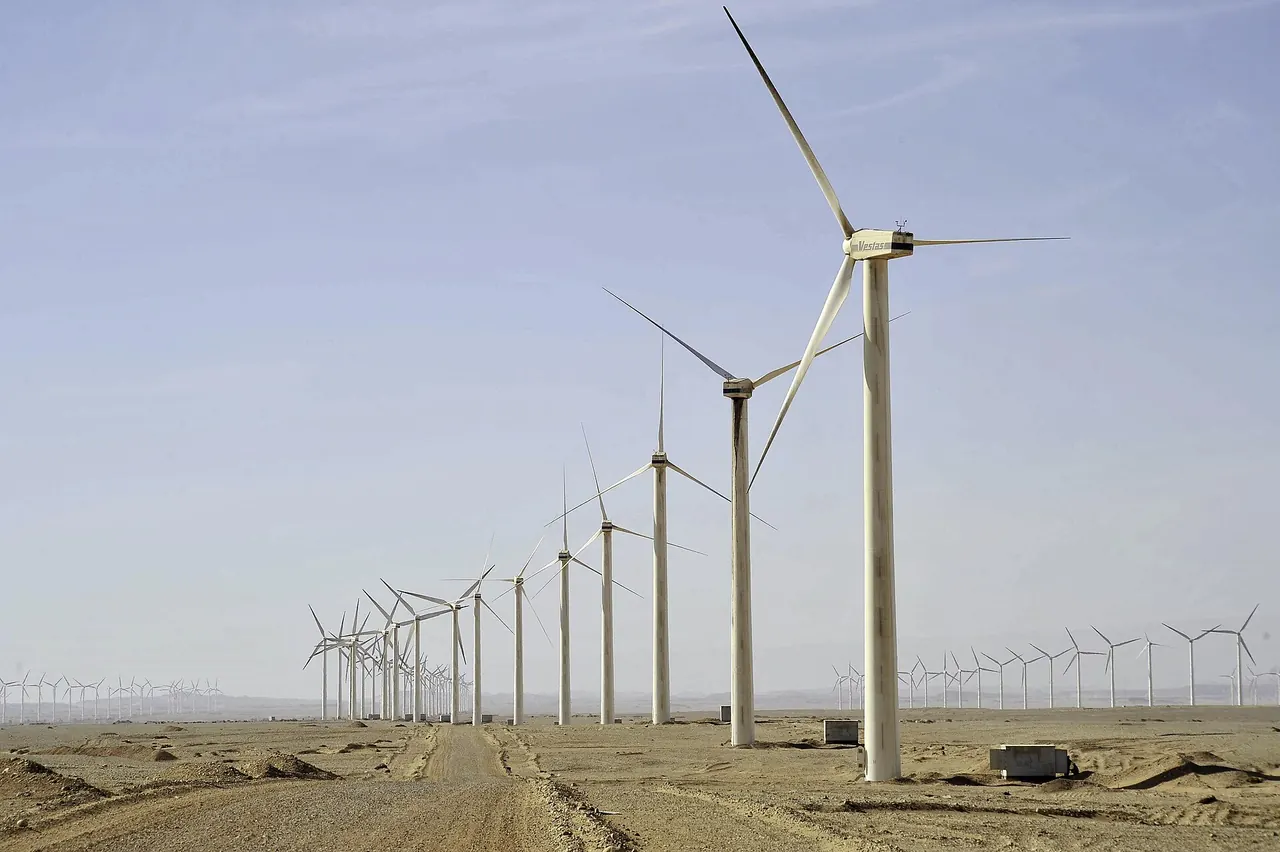
MIGA backs ACWA Power's 1.1 GW Suez wind farm in Egypt with a $193.3 million guarantee
The cover layers onto a $703.6 million senior debt facility closed in January 2025. Full commercial operation is targeted for Q2 2027. 1 min read
MIGA just put $193.3 million of political-risk cover behind Egypt’s 1.1 GW Suez wind farm.
The World Bank Group’s Multilateral Investment Guarantee Agency has agreed to provide USD 193.3 million in guarantees to ACWA Power to cover its investment in the project. The wind farm sits at Ras Gharib on the Gulf of Suez, split across two 550 MW plots, with 138 Envision Energy 8 MW turbines on order. ACWA Power holds 70 percent alongside HAU Energy, selling output to EETC under a 25-year build-own-operate power purchase agreement. Full commercial operations are targeted for Q2 2027. MIGA cover layers onto a $703.6 million senior debt facility closed in January 2025 with EBRD, the African Development Bank, British International Investment, and DEG.
Why it matters
We read political-risk cover at this scale as what pulls pension and insurance capital into emerging-market renewables. The 1.1 GW project now carries a MIGA guarantee on top of a senior debt facility from four development lenders.
What it means for MENA
My read: Egypt’s wind procurement pace is being underwritten by guarantees and development-finance debt as much as by turbine technology. The Suez stack is the clearest example so far.
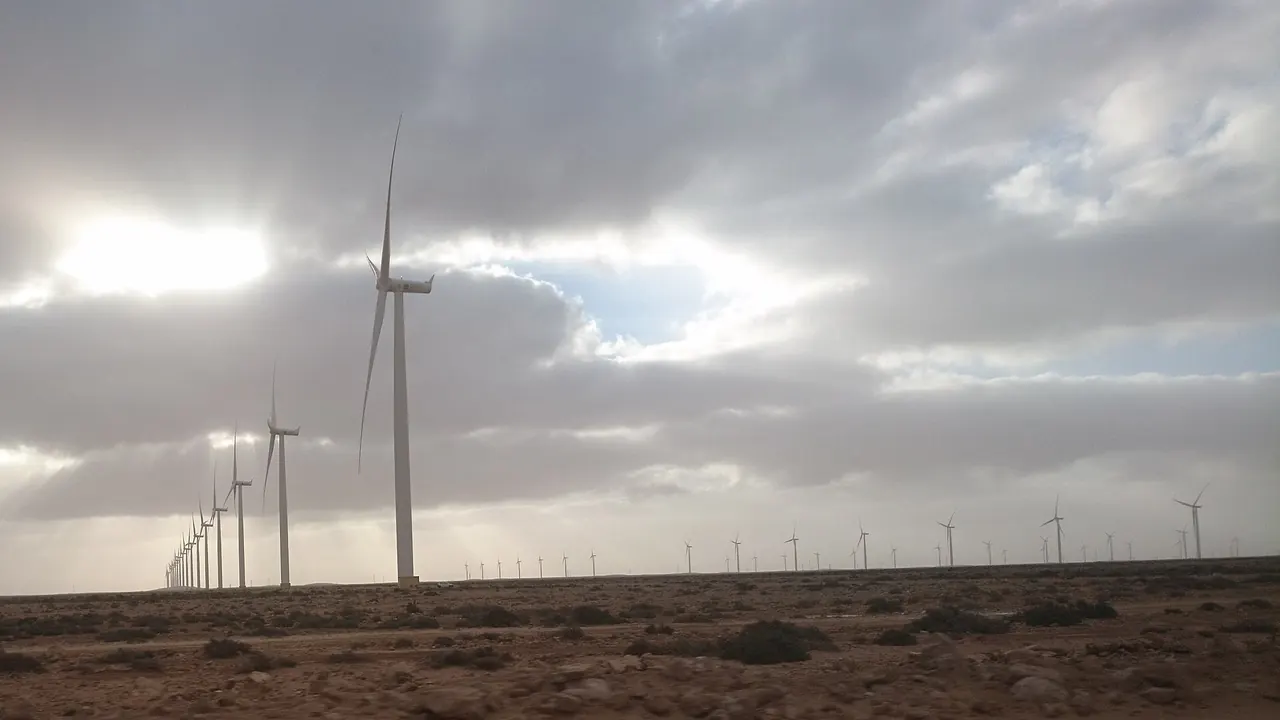
Acwa Power wins approval to expand Morocco's Khalladi wind farm from 120 MW to 160 MW
The 40 MW extension is estimated to cost MAD 550 million ($60 million), with completion targeted inside two years. 1 min read
Acwa Power just won approval to add 40 MW to Morocco’s Khalladi wind farm, lifting installed capacity from 120 MW to 160 MW.
The Saudi-listed developer secured a new permit at an estimated cost of MAD 550 million ($60 million), with completion targeted inside two years. Khalladi began operations in the north of the country in 2018. Acwa Power’s broader Moroccan footprint includes a first-wave green hydrogen selection in March and planned entry into seawater desalination. Acwa’s total Moroccan investments stand at around $3 billion, according to the Asharq Business report AGBI cites.
Why it matters
A brownfield extension builds on an existing grid connection and eight years of measured wind data. We read it as the cheaper route to add wind in markets where transmission is the binding constraint.
What it means for MENA
We read Khalladi as a sign that operating MENA wind assets are becoming an asset class in their own right.
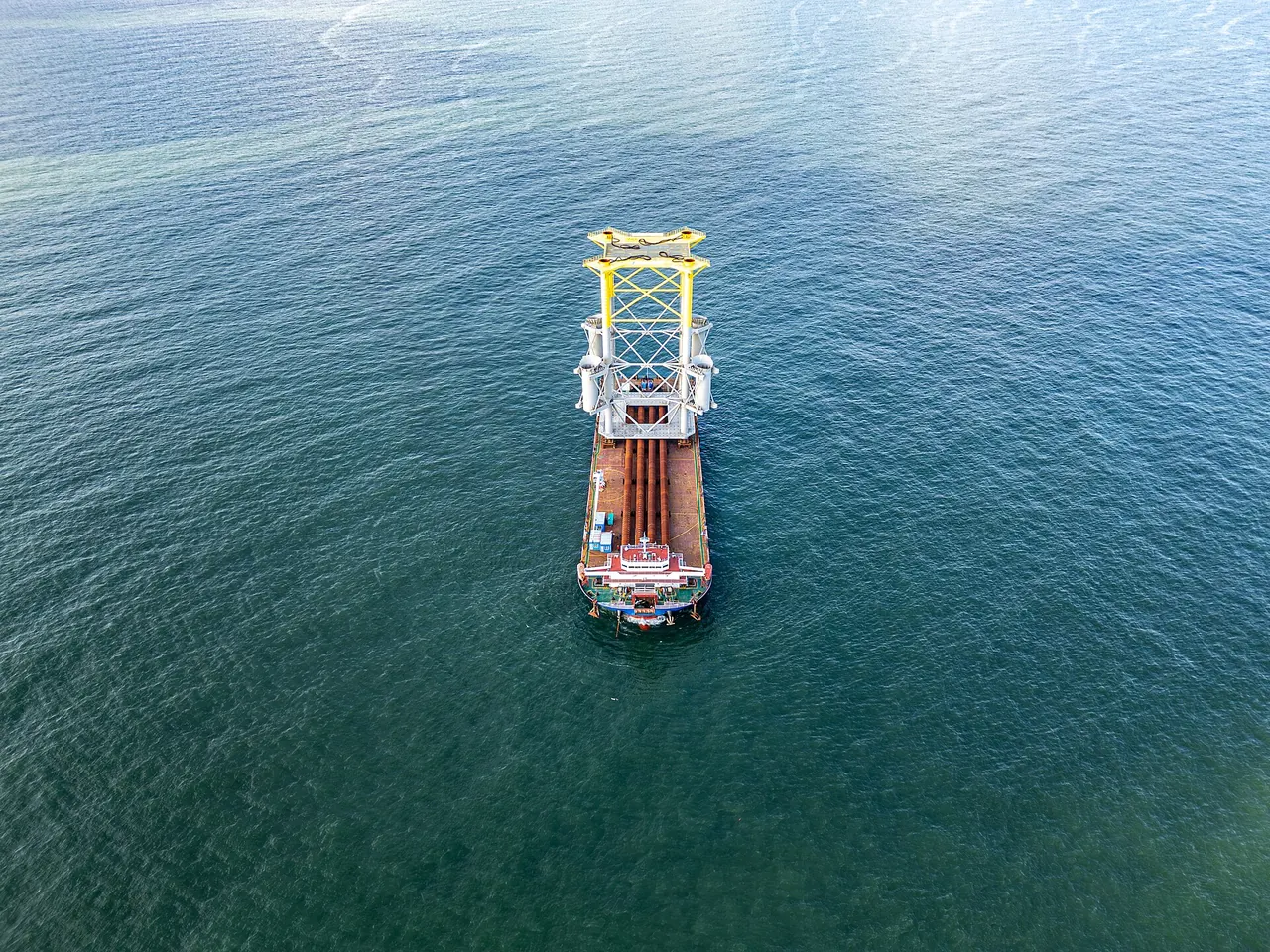
Egypt signs MoU with Sany for a 2 GW turbine factory and a 2,000 MW Gulf of Suez wind farm
EETC, NREA and SANY Renewable Energy signed with Prime Minister Mostafa Madbouly present. The wind farm is to be financed in Egyptian pounds. 1 min read
Egypt just signed an MoU with Sany for a turbine factory, and added a 2 GW wind farm on top.
Prime Minister Mostafa Madbouly witnessed yesterday’s signing between EETC, NREA, and SANY Renewable Energy at the Cabinet headquarters in the New Administrative Capital. SANY will build Egypt’s first wind turbine manufacturing plant with 2 GW annual production capacity, due within two years of final agreements. The same agreement covers a 2,000 MW wind farm in the North Gulf of Suez, financed in Egyptian pounds, targeting national grid connection within 23 months of execution. Minister of Electricity Mahmoud Esmat framed the deal as a step toward implementing renewable energy projects in local currency. Counterparties signed: Li Qiang for SANY, Mona Rizk for EETC, Ehab Ismail for NREA.
Why it matters
In our reading, it is unusual for a turbine factory and a wind farm to share one MoU on day one. If the MoU becomes final agreements, Egypt gets a 2 GW wind farm attached to a Chinese OEM’s local factory, structured around domestic-currency financing instead of dollar project finance.
What it means for MENA
We read the Egyptian-pound financing as the line to watch. If it survives into final agreements, MENA gets a template for wind projects that do not depend on dollar project finance.
Saudi Arabia's 600 MW Al-Ghat wind farm reaches full grid connection on all 80 turbines
EPC contractor SEPCOIII confirmed final installation on June 2 and full grid synchronization within eight days. Output is projected at 4.2 TWh a year. 1 min read
Saudi Arabia’s 600 MW Al-Ghat wind farm just energized all 80 turbines.
EPC contractor SEPCOIII confirmed final installation on June 2 and full grid synchronization within eight days. The site is between Al Ghat and Az Zulfi in Riyadh Province, runs 80 domestically supplied 7.7 MW turbines and is projected to generate 4.2 TWh per year, enough for around 300,000 households. Marubeni and Ajlan & Bros co-developed under a 25-year SPPC PPA priced at $0.01566/kWh.
Why it matters
We read Al-Ghat as one site that lands three of MENA wind’s 2026 ambitions together: a 7.7 MW turbine class, a sub-2-cent tariff, and domestically supplied turbines.
What it means for MENA
Saudi wind is moving from procurement headlines to grid-connected capacity. Each project that reaches full synchronization gives the next round of bidders a real build schedule to price against.
Korra Energi consortium wins $58 million of Egypt's Gulf of Suez wind transmission lines
Korra Energi and HIDELECO won Lots 1 and 3 of a transmission project linking Gulf of Suez wind farms to Egypt's national grid. 1 min read
Egypt just awarded two lots of the transmission project that will let Gulf of Suez wind reach the national grid.
Korra Energi, in consortium with High Dam Electrical and Industrial Projects (HIDELECO), won Lots 1 and 3 of the EETC scheme on June 12, with a combined value above EGP 3 billion ($58 million). Lot 1 covers about 45 km and Lot 3 about 52 km, both 500 kV ultra-high-voltage overhead lines running to the Hawamdia substation in Giza Governorate. The full scheme spans roughly 350 km in eight lots, with total investment between EGP 12 billion and EGP 14 billion ($231 million to $269 million). When complete, it will allow the grid to absorb more than 2 GW of new Gulf of Suez wind.
Why it matters
Wind projects without evacuation capacity are stranded assets. The award lands six weeks after EETC opened the global tender on April 30. We read that as Egypt executing the transmission build alongside the wind build rather than after it.
What it means for MENA
The Gulf of Suez belt already holds Zafarana, Gabal El Zeit, Ras Ghareb, West Bakr, and Red Sea Wind Energy, with ACWA Power’s 1.1 GW Suez project, Ras Shokeir 900 MW, AMEA Amunet 500 MW, Scatec Shadwan 900 MW, and Infinity Ras Ghareb 200 MW under construction or in development. The Tahya Misr 4,750 MW protocol announced May 4 sits on top of that. None of it generates a megawatt-hour without the wires.
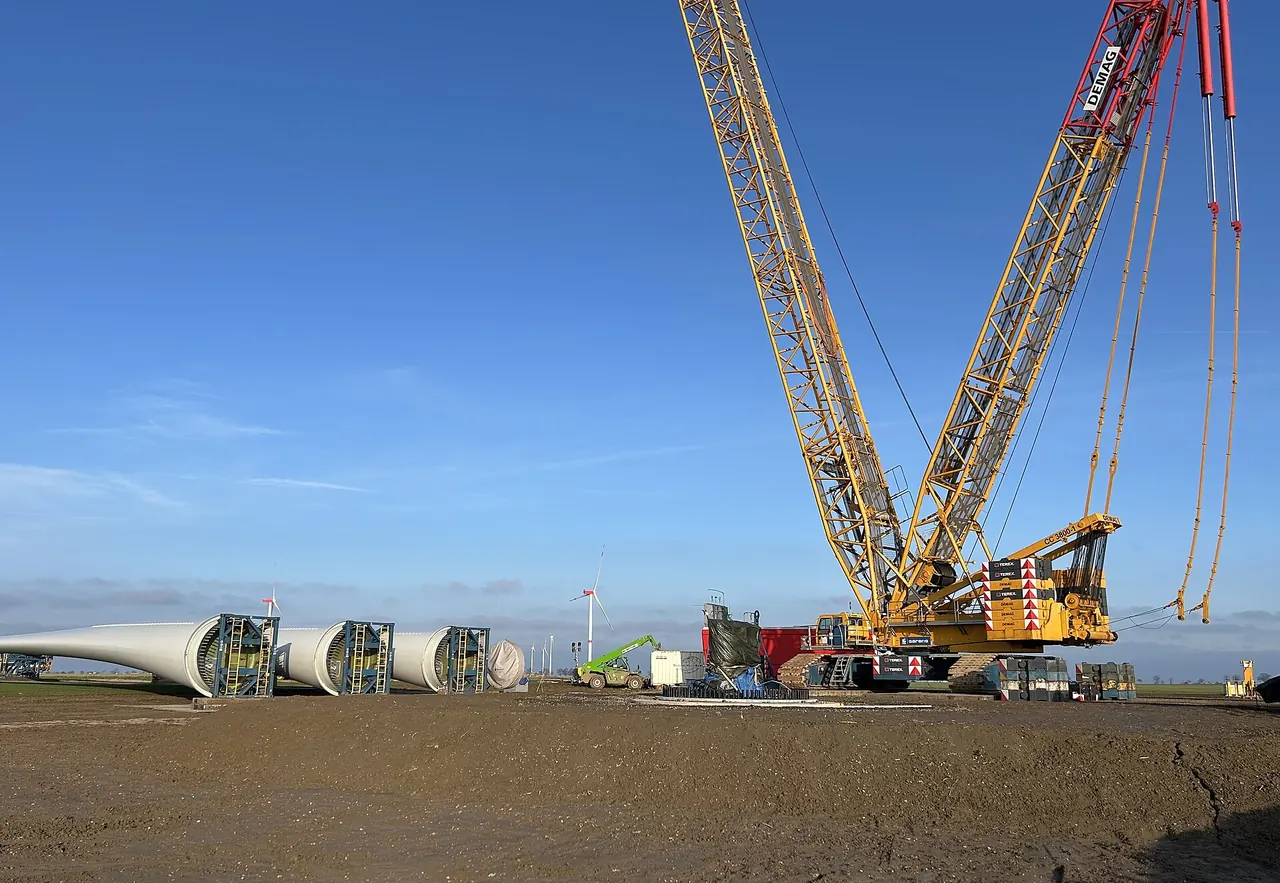
Three MENA wind deals in 60 days bundle sites, technologies and supply chains into single awards
Egypt's 4,750 MW Tahya Misr protocol, Oman's 2.7 GW O-Green contract and Sany's Egypt factory each package several pieces at once. 1 min read
MENA wind procurement just bundled itself.
Three of the big wind-related deals signed in MENA over the past 60 days share one feature: each one packages multiple sites, multiple technologies, or manufacturing and generation into a single deal.
Egypt’s Tahya Misr 4,750 MW wind protocol signed May 4 covers four wind belt sites (Gulf of Suez, Ras Shokeir, Galala, Zafarana), with Tahya Misr leading financing and implementation and a two-year delivery window.
Oman’s O-Green Energy 2.7 GW round-the-clock contract, announced May 18, bundles wind, solar, and battery storage across Mahout and Duqm into one PPA.
China’s Sany $300M Egypt factory deal announced this week packages turbine manufacturing with a planned 1 GW Gulf of Suez wind project.
My read: each deal is built to lock in more than one piece of the value chain at once, and each prices the platform rather than the project.
The implication I draw for developers: winning in MENA in 2026 means winning a position inside a multi-year pipeline.
Which MENA market signs the first single-signature deal that bundles wind, solar, storage, transmission, AND manufacturing?
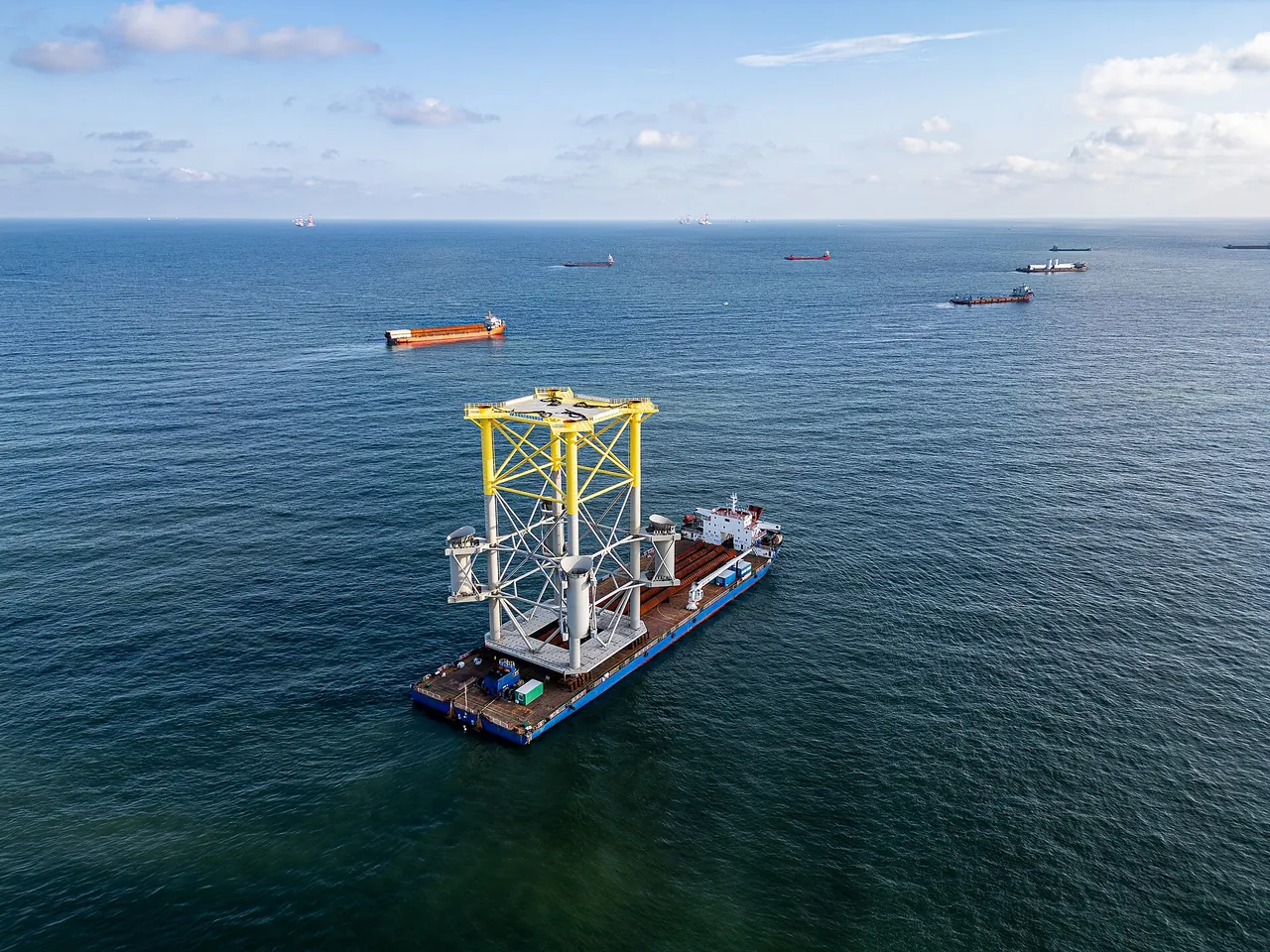
Sany Group will invest more than 300 million dollars in Egypt's first wind turbine factory
The plant in the Suez Canal Economic Zone is tied first to a planned 1,000 MW wind project in the northern Gulf of Suez. 1 min read
Sany plans to put more than 300 million dollars into Egypt’s first wind turbine factory.
China’s Sany Group will invest more than $300 million to build a wind turbine and components plant in the Suez Canal Economic Zone, according to Asharq, as reported by WAYA on June 1. First-phase output is tied to a planned 1,000 MW wind project in the northern Gulf of Suez. Some major components keep arriving from China until local production lines are fully operational. Egypt’s imports of complete wind turbines and major turbine components exceeded $235 million in 2024.
My read: turbines and their major components carry most of a wind project’s equipment value, and producing them inside Egypt keeps more of that margin in the country.
Egypt is positioning the Suez Canal Economic Zone as a gateway to African and Arab markets, so the plant could export as well as supply Egypt’s own target of more than 42% clean electricity by 2030.
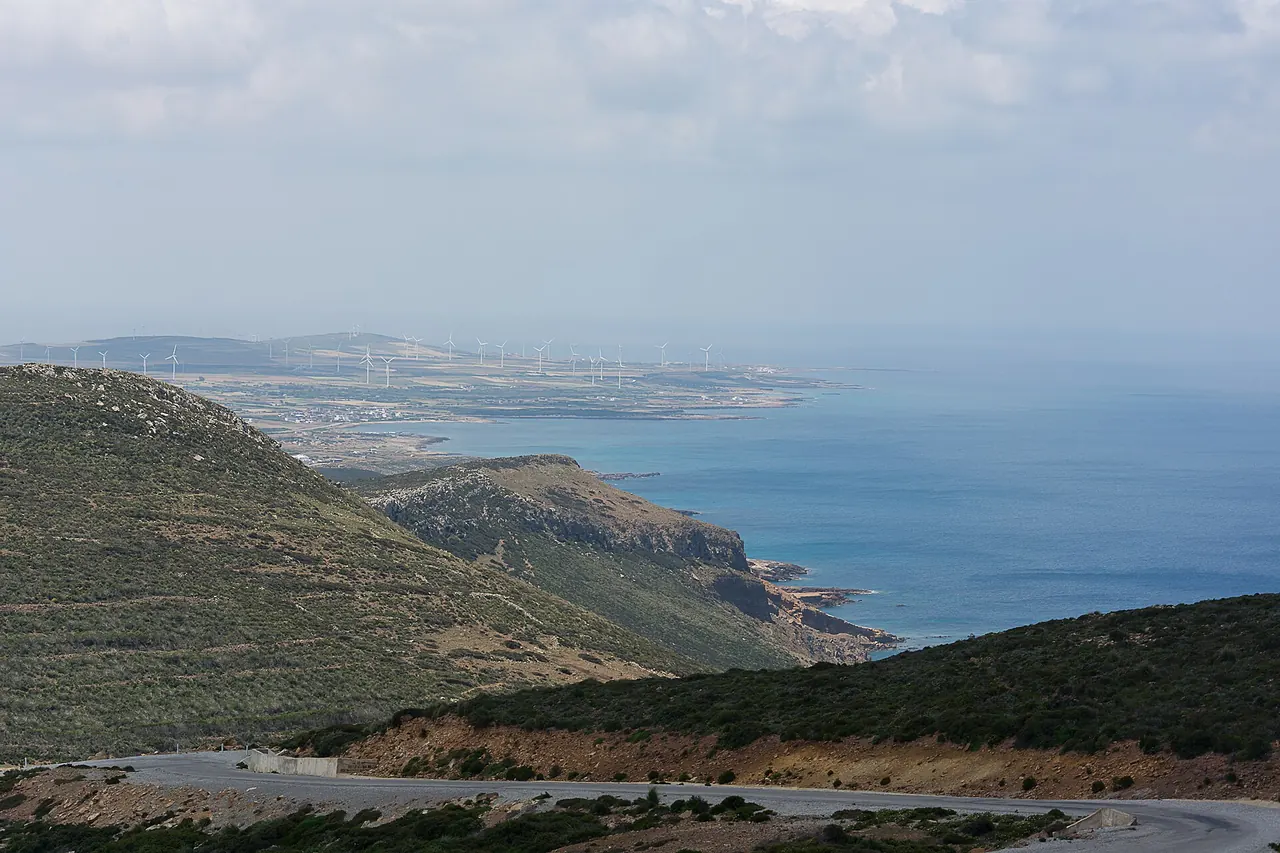
O-Green plans a 58 MW Duqm wind pilot with six 9.6 MW turbines, the Middle East's largest
The pilot is expected to generate around 190 GWh a year to decarbonise the wind turbine plant O-Green is building in the same economic zone. 1 min read
Oman just put the Middle East’s biggest single wind turbines on a project sheet.
State-backed clean energy platform O-Green is developing a 58 MW pilot wind farm at the Duqm Special Economic Zone, comprising six 9.6 MW wind turbine generators, the largest individual turbines of their kind in the Middle East. Formally known as the Duqm North and South Wind Project, the pilot is expected to generate around 190 GWh of electricity per year, used to decarbonise the wind turbine manufacturing plant O-Green is building in the same SEZ. The pilot sits inside an 11 GW solar and wind plus 4.5 GWh storage pipeline spanning Oman, the GCC, Africa, and Europe, of which 3.3 GW of generation and 2.4 GWh of storage are already secured. O-Green is the joint venture between OQ Alternative Energy and state-owned Naqaa Sustainable Energy that recently signed a PPA with Nama PWP for a 2.7 GW round-the-clock renewables project in Duqm and Mahout.
Why it matters
No turbine in the Middle East is currently larger than 9.6 MW, according to the Oman Daily Observer report. Oman is starting its wind story at that class, on a pilot built to feed its own factory.
What it means for MENA
The pilot is meant to help decarbonise the turbine factory next door, which will build multi-megawatt turbines on technology licensed from Shanghai Electric. That puts a wind farm and the turbine plant it powers inside the same economic zone. We read that pairing as the template other MENA localisation plans will be measured against.
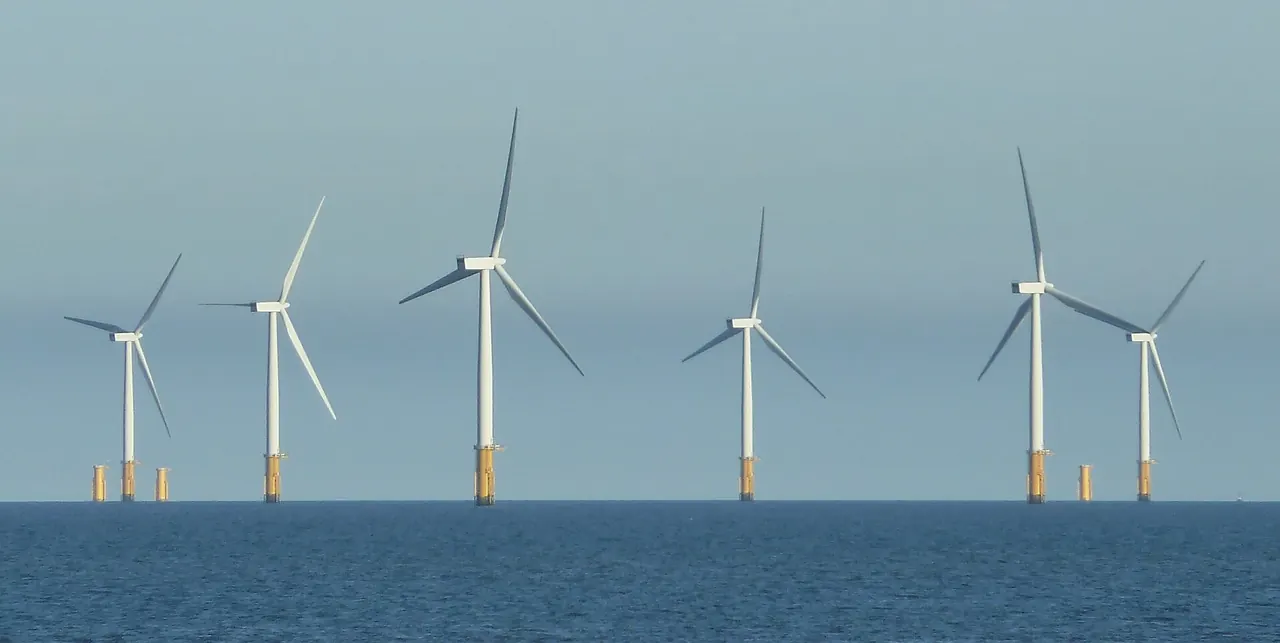
IEA says Gulf war repairs could curb overseas energy investment, the capital behind stakes like Masdar's in Dogger Bank
Analysts put the repair bill, including Iran, as high as 58 billion dollars. GCC investors sent a net 271 billion dollars abroad in 2025, per BNP Paribas. 1 min read
The IEA has warned that the Iran war repair bill could slow the Gulf capital flowing into energy projects abroad.
The IEA’s World Energy Investment Report 2026, covered by AGBI on May 30, says Gulf states could scale back overseas energy investments to help fund tens of billions of dollars in repairs to infrastructure damaged during the Iran war. Analysts quoted by AGBI say the amount, including repairs in Iran, could reach $58 billion. The IEA writes that the repair costs “could reduce outward capital flows, which have been a growing source of financing for infrastructure and energy projects in other regions.” AGBI lists Masdar’s 49 percent stake in the £11 billion Dogger Bank UK wind development among the Gulf’s international energy holdings. BNP Paribas estimates GCC investors sent a net $271 billion abroad in 2025; Gulf sovereign wealth funds manage around $6 trillion per Deloitte.
Why it matters
In our read, the IEA is putting the Gulf’s overseas energy tickets and its post-war domestic repair list on the same balance sheet, and Gulf-backed wind abroad sits on that ledger.
What it means for MENA
Gulf sponsors have been writing large offshore wind equity tickets abroad while domestic pipelines grow at home. The IEA framing puts those two strands in tension. Watch whether Gulf sovereigns continue to write nine-figure offshore wind equity tickets through H2 2026 or whether the rotation tilts firmly home.
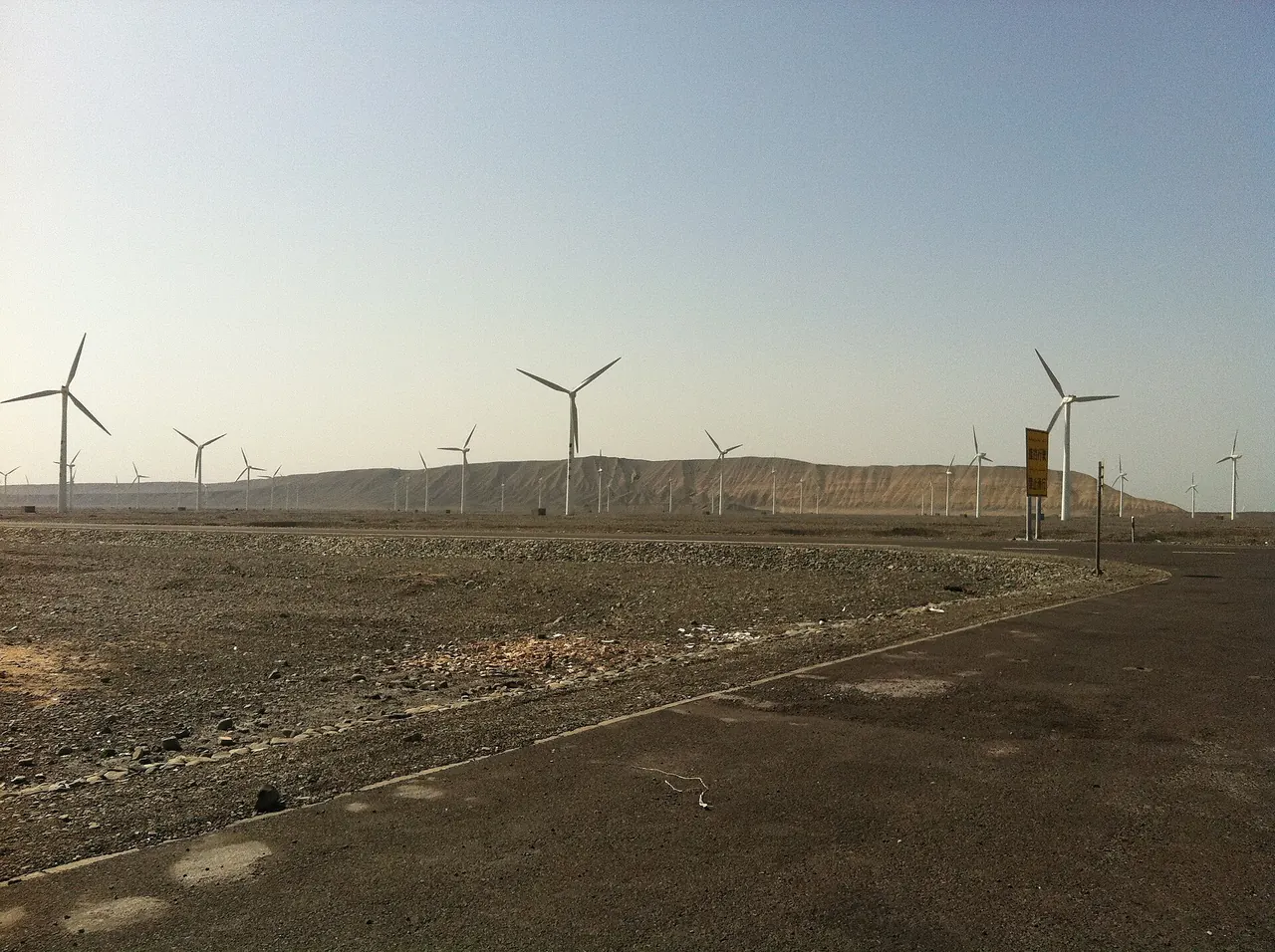
MENA's next gigawatt-scale wind PPA may come from a hyperscaler rather than a utility
IRENA's firm-cost benchmark, Masdar's 1 GW round-the-clock project and the Egypt-Saudi HVDC link line up with buyers that need power around the clock. 1 min read
The next gigawatt-scale wind PPA signed in MENA may not be signed by a utility.
The pieces are lining up. IRENA’s May 6 firm LCOE report estimated firm wind plus storage at roughly $59 to $94 per MWh across the markets it sampled in 2025 and named AI and data centres among the users firm renewables are well positioned to serve. In Abu Dhabi, Masdar and EWEC are developing what Masdar calls the world’s first gigascale integrated renewable project: 5.2 GW of solar plus 19 GWh of BESS delivering 1 GW of continuous baseload. The Egypt-Saudi HVDC link has completed final testing, Al Arabiya reported citing an unnamed source, with a first 1,500 MW phase and 3,000 MW once complete. In principle, wind generated in Egypt’s Gulf of Suez could then feed Saudi load.
My read is that a MENA hyperscaler wind PPA will get signed. What I cannot call yet is when, in which market, and with which counterparty.
Which lands first: Saudi Arabia, UAE, or Egypt? And does the buyer turn out to be Microsoft, Google, AWS, or a Gulf-native operator like G42 or Humain?
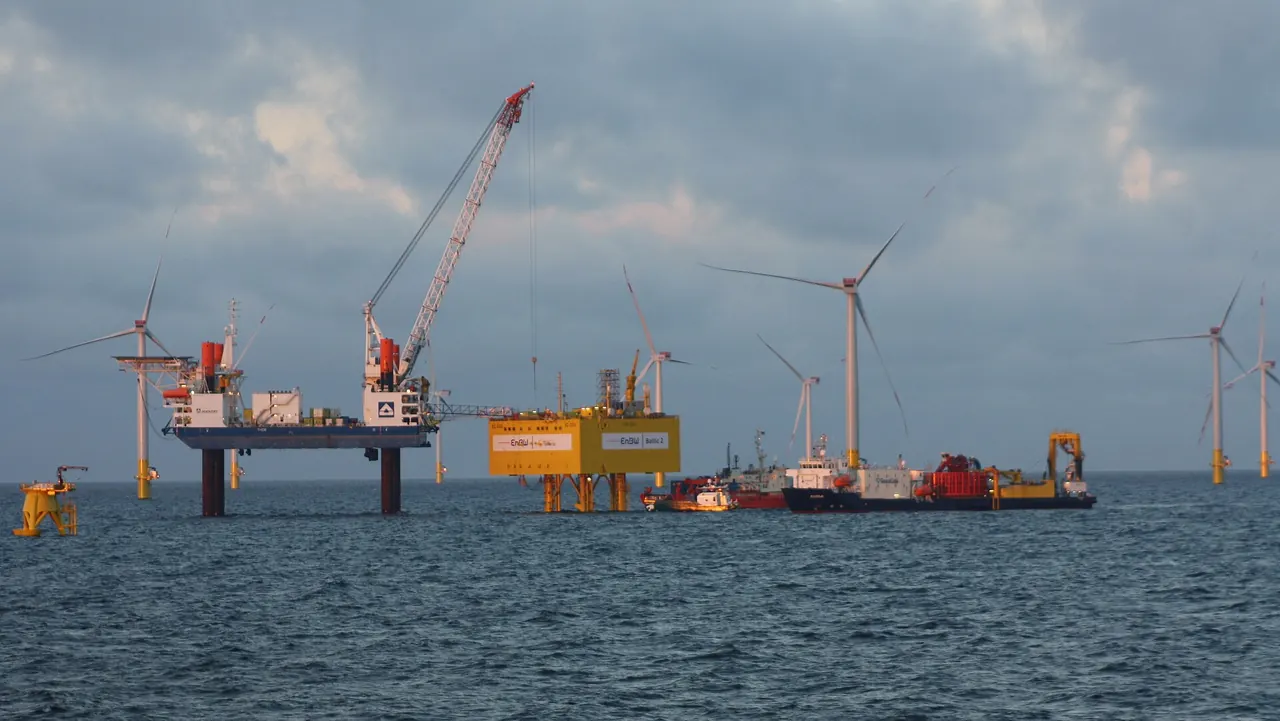
Nordex starts production at a 1,200-blade-a-year plant in Türkiye's Izmir Free Trade Zone
The Menemen plant makes blades for the N163 and N175 platforms, with initial output for YEKA-4 and YEKA-5 and surplus reserved for European projects. 1 min read
Türkiye just turned on a 1,200-blade-per-year wind factory designed to fill YEKA tenders at home and ship surplus to Europe.
The Nordex Group on May 22 started production at its new rotor blade plant in Menemen, in the Izmir Free Trade Zone, covering 130,000 sqm of land with a 90,000 sqm production hall. At full capacity, four shifts will turn out up to 1,200 rotor blades per year and employ around 1,200 people. The plant is built around blades for the Nordex N163 and N175, the company’s latest onshore turbine platforms designed for medium to strong wind conditions. Initial output is earmarked for YEKA-4 and YEKA-5 wind farms inside Türkiye, with surplus capacity reserved for European projects. Nordex has been in Türkiye since 2009 and has held market leadership since 2017 with about 34 percent share.
Why it matters
My read: a blade plant sized for domestic YEKA rounds, with an export tail into Europe, is how a functioning wind manufacturing hub comes together. Domestic tenders fill the first years. Exports carry the plant through the slow ones.
What it means for MENA
For MENA governments running their own wind localisation plans, we see Menemen as the closest live benchmark for what a finished wind manufacturing hub looks like, including an export tail into Europe. For procurement teams in Riyadh, Cairo and Muscat, that export tail is the part worth studying. My read is that its unit economics decide whether a MENA wind factory survives the first slow tender year.
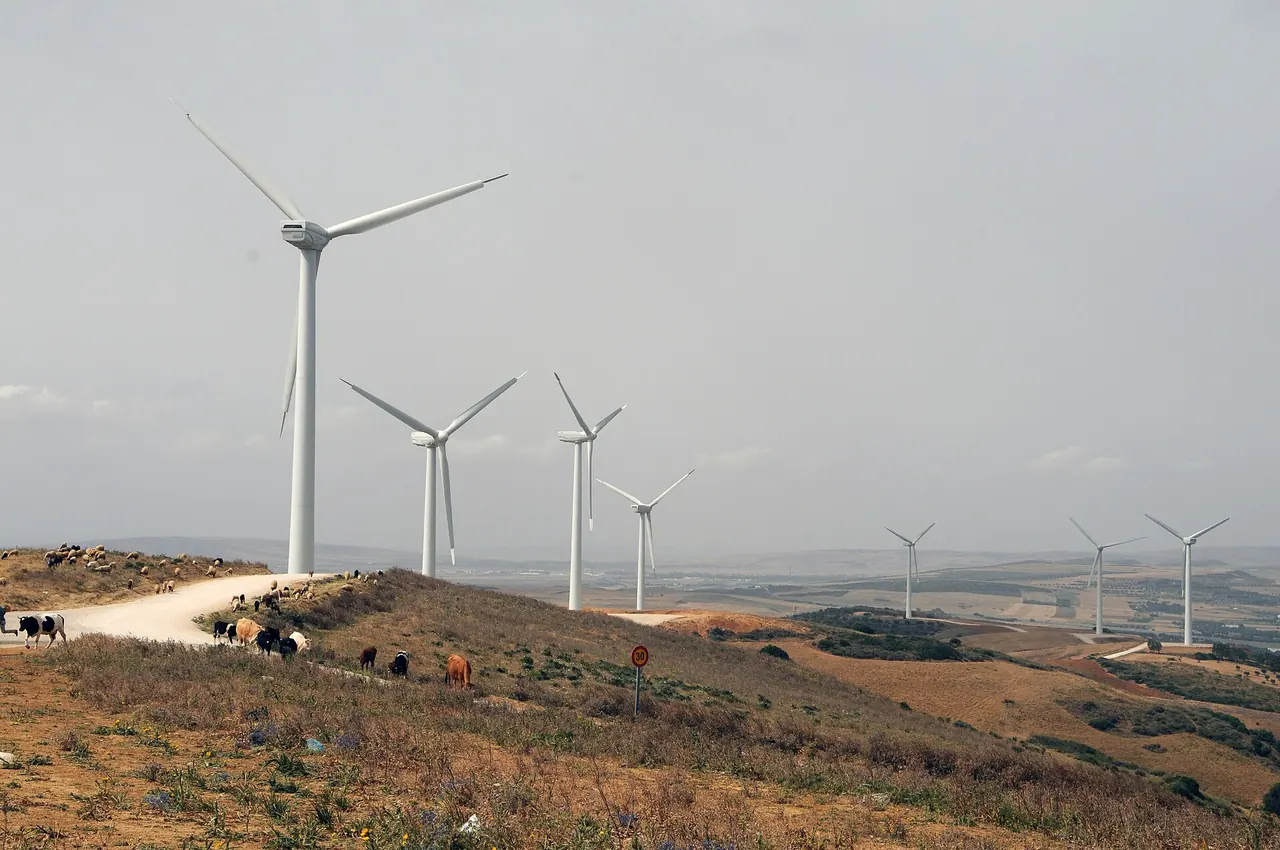
Saudi Arabia added 1,512 MW of wind in 2025, up 287 percent, as regional additions hit 2.6 GW
Saudi Arabia accounted for 57.8 percent of Africa-Middle East additions. Morocco added 261 MW, while Morocco and Egypt both still hold larger installed bases. 1 min read
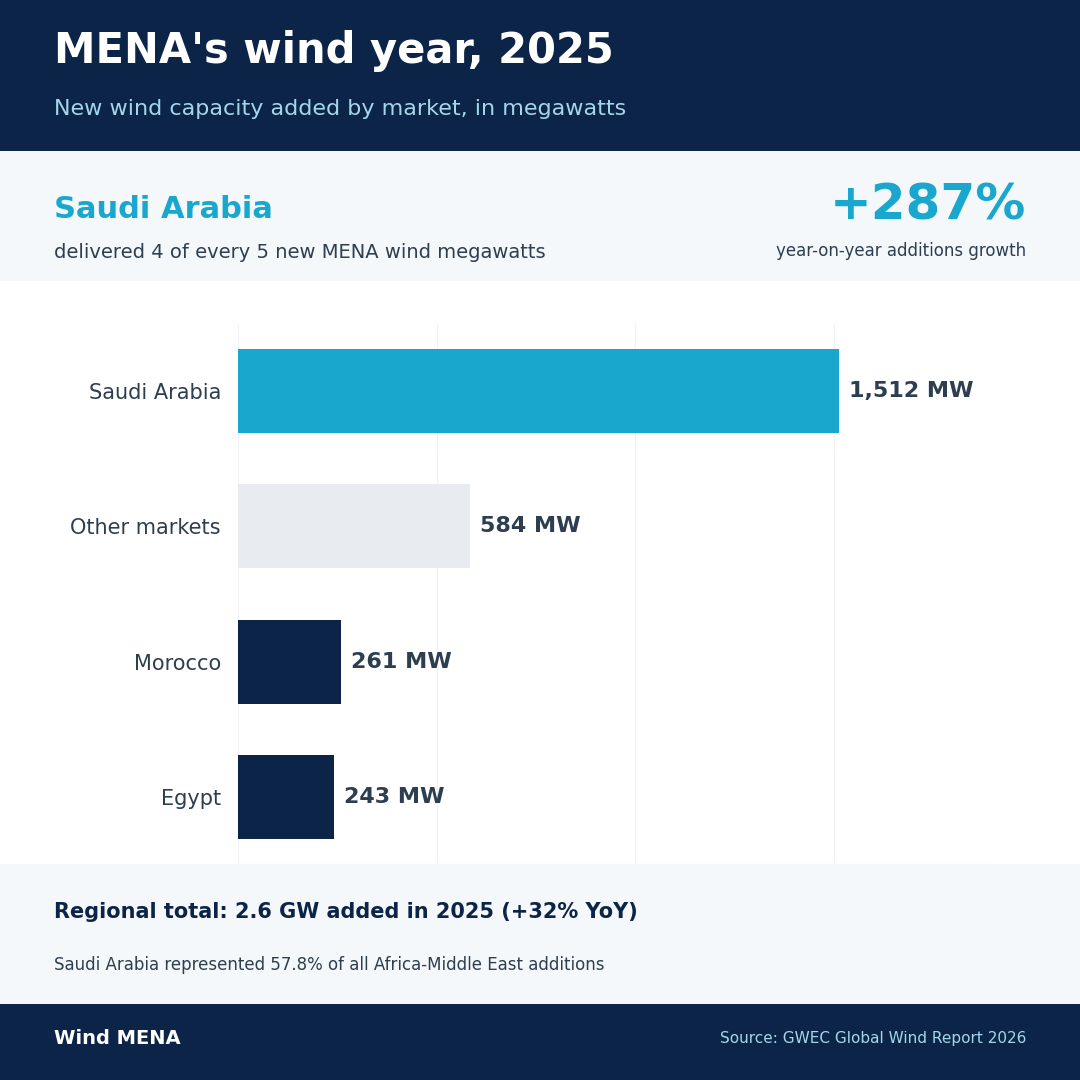
Correction, 13 October 2026: Saudi Arabia's share of 2025 regional wind additions was 57.8 percent, not four in five.
The numbers are in for 2025. One country drove almost three in every five new wind megawatts across Africa and the Middle East.
Saudi Arabia added 1,512 MW of new wind capacity in 2025, up 287% from the year before, and accounted for 57.8% of all Africa-Middle East additions that hit the grid. The regional total reached 2.6 GW added, a 32% jump on 2024.
Morocco added 261 MW. My read is that the GCC, led by Saudi NREP, has become the volume engine. North Africa is still the larger installed base, with Egypt at 3.1 GW cumulative and Morocco at 2.6 GW cumulative, but we think the next wave is shifting east.
GWEC’s regional forecast is 35 GW of new wind across Africa and the Middle East between 2026 and 2030. GWEC expects the Middle East to take 53% of that.
Which MENA market do you expect to lead the 2026 additions table?
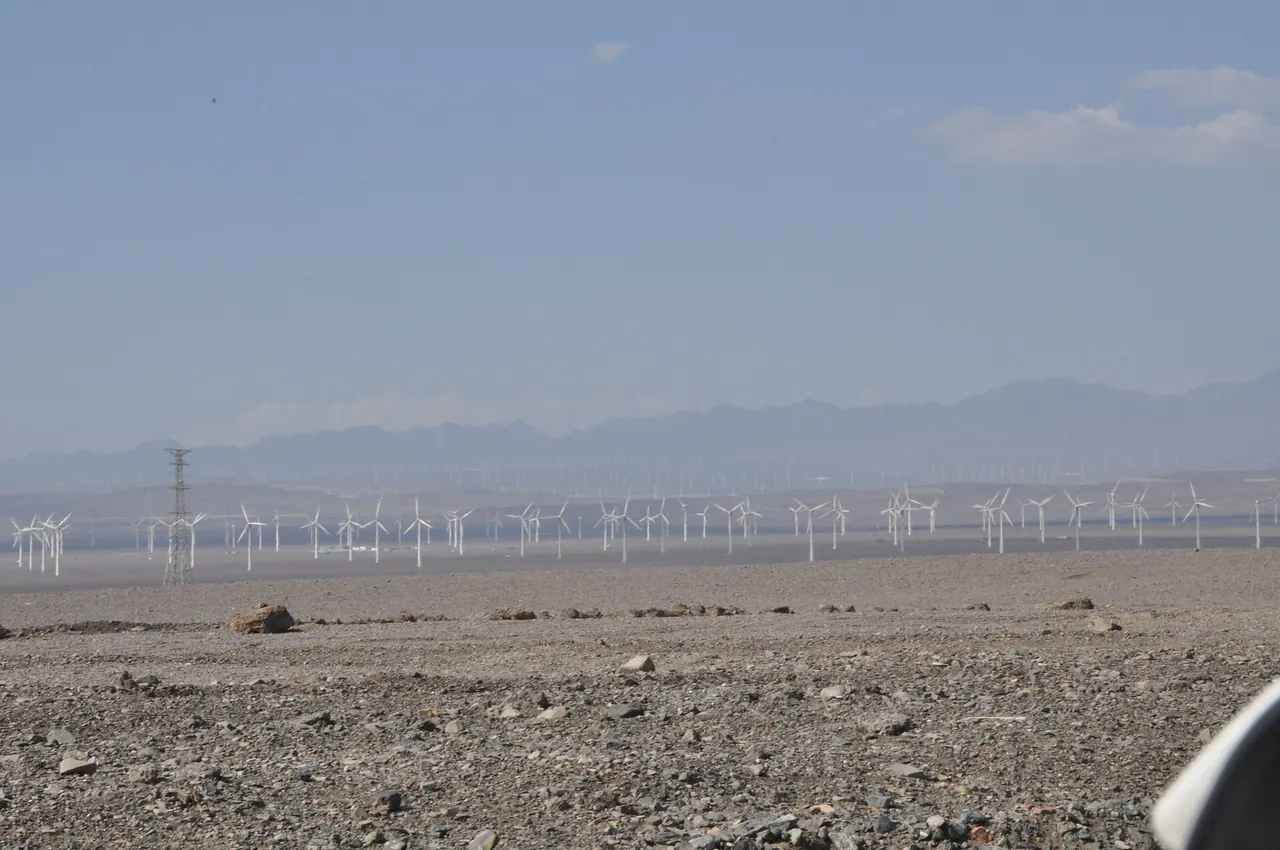
The 3,000 MW Egypt-Saudi HVDC link will let MENA wind cross a border at gigawatt scale
The first 1,500 MW phase is scheduled before the end of Q2 2026. Türkiye is planning 14,700 km of HVDC lines of its own. 1 min read
Within five weeks, wind generated in MENA could be flowing across a national border at gigawatt scale.
Egypt and Saudi Arabia are scheduled to bring the first 1,500 MW phase of their 3,000 MW interconnection online before the end of Q2 2026. Converter stations at East Medina and Tabuk on the Saudi side and Badr City on the Egyptian side are joined by 1,350 km of overhead lines, built under 1.8 billion dollars of contracts awarded in 2021.
In our view, that single piece of infrastructure changes what wind is for. Once energised, the link will let wind generated in Egypt and Saudi Arabia serve summer peak load on either side of the Red Sea.
This is not a one-off. Türkiye’s grid plan of roughly 30 billion dollars includes 14,700 km of new HVDC lines. ACWA Power secured $226 million of debt for its 300 MW Bash II wind farm in Uzbekistan earlier this month, another sign that MENA wind capital already moves across borders.
We think the cost story for MENA wind is settled, and that interconnection is the story of the next 18 months. Which MENA wind farm sells its first MWh across a national border?
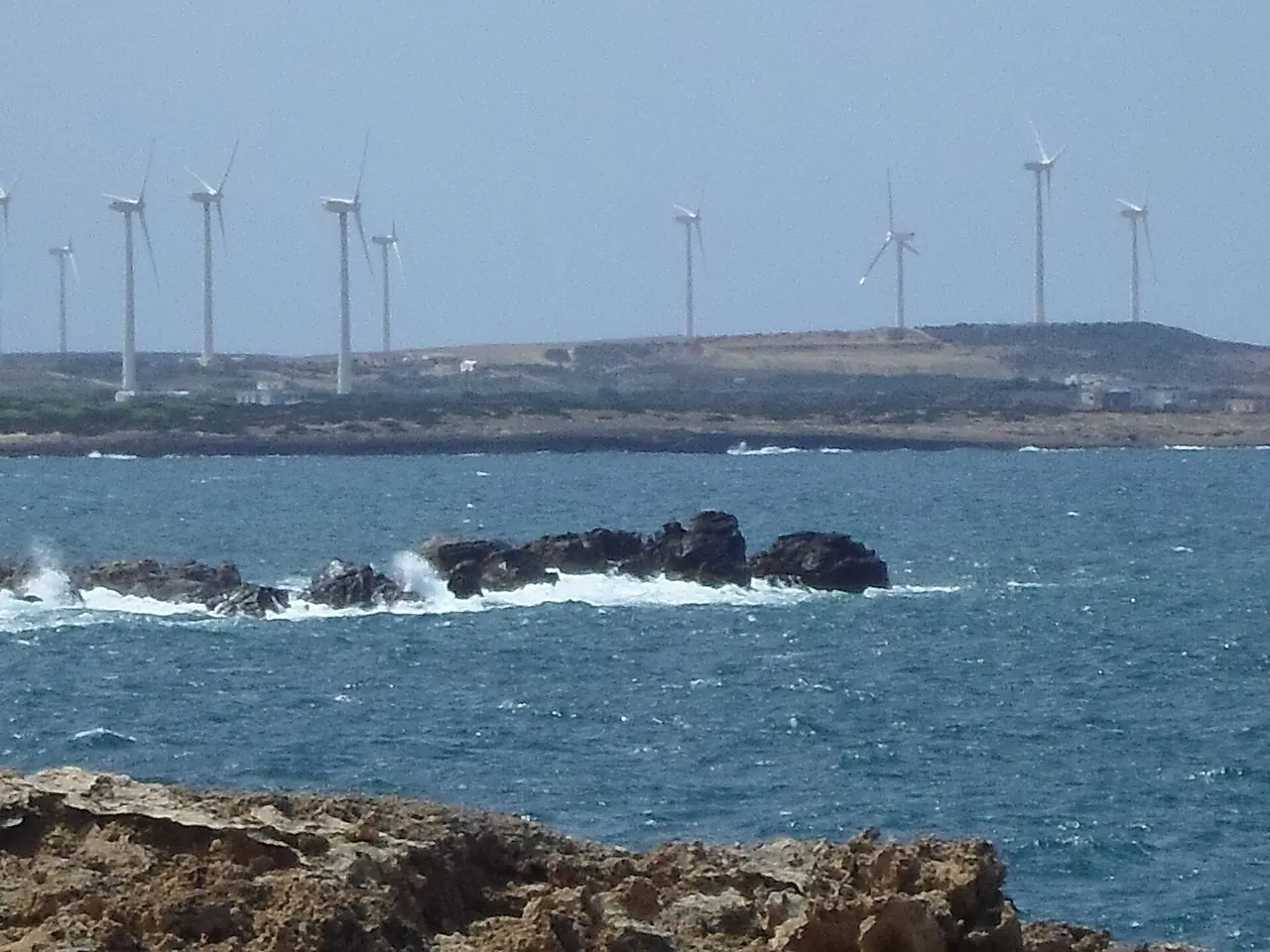
Oman's 2.7 GW O-Green award shows the state moving into MENA wind equity
Oman awarded the first of two planned round-the-clock renewables plants to state-backed O-Green Energy in the same week Egypt's president reviewed a 7,000 MW pipeline. 2 min read
A wind, solar and storage contract in Oman, part of a 2.7 GW hybrid development, went to a state-backed Omani company this month.
In mid-May, Oman’s single buyer, Nama Power and Water Procurement, awarded the power purchase agreement for the round-the-clock scheme to O-Green Energy. Energy minister Salim Al Aufi called it the first of two planned round-the-clock plants.
The same week, in Cairo, President El-Sisi sat down with his prime minister and electricity minister for a project-by-project review of Egypt’s 7,000 MW renewable and storage pipeline, including the 900 MW Ras Shokeir wind farm, confirmed for grid connection in 2027.
Two countries, one week, the same signal as I read it. Beyond policymaker and offtaker, the state is increasingly the developer and the financier for MENA wind.
For a decade the familiar regional model was simple. A government set a target and ran a tender. A developer, often European or Gulf, took the equity. Development finance institutions and commercial banks took the debt.
That model still works and still runs. A second model now sits alongside it. Oman’s O-Green is a state-backed company holding the contract directly. Egypt’s 4,750 MW Tahya Misr wind and storage program is led by a state holding company that arranges its own financing and prices power in Egyptian pounds. The UAE built the original template years ago with Masdar, today a 65 GW portfolio owned by the state.
Why does the ownership question matter as much as the megawatts? Currency is one reason. In my view a state developer pricing in local currency shields a project from dollar exposure. Speed is another: when the sponsor and the offtaker answer to the same government, I expect financial close and grid connection to stop competing for attention. And value. The returns on a 25-year asset stay inside the country that built it.
The risks are just as real. Concentrating wind equity on sovereign and state-enterprise balance sheets concentrates the downside there too. International capital does not leave, but its role shifts from sponsor to lender, and I think less operating expertise travels with money that only lends.
The headline number for MENA wind in 2026 will be gigawatts tendered and gigawatts financed. The more telling number is harder to see: how much of that capacity the region now owns outright.
Which country still relying entirely on foreign sponsors will be the next to follow Oman and Egypt?
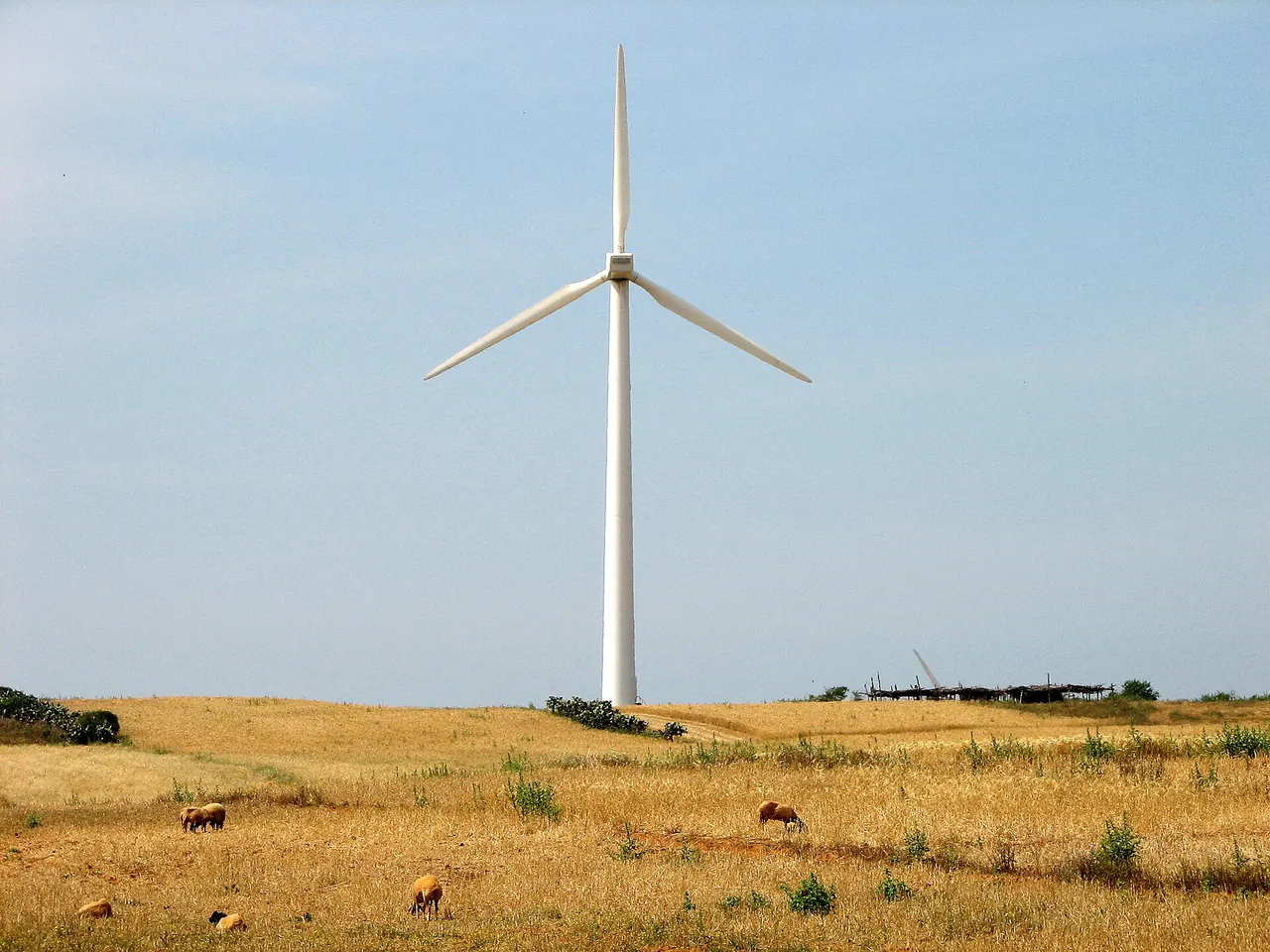
MENA is moving wind procurement from megawatts to round-the-clock firm output
Oman has signed a 2.7 GW round-the-clock hybrid and plans a 1,000 MW round-the-clock tender, and these contracts pay wind for the hours solar leaves empty. 1 min read
MENA is starting to buy wind by the hour as well as by the megawatt.
Three recent moves point the same way. Oman’s Nama Power and Water Procurement has awarded O-Green Energy a 2.7 GW wind, solar and storage contract, the first of two planned round-the-clock plants, and plans to tender a 1,000 MW round-the-clock project at a capacity factor above 70 percent this year. Saudi Arabia is tendering battery storage in tranches, 3 GW and 12 GWh in the second alone, which we read as the firming layer its wind fleet will need. In the UAE, Masdar and EWEC are developing a gigascale solar and battery project designed to deliver 1 GW of baseload around the clock. The common thread is procurement that pays for firm output.
My read is that wind is what holds the hybrid contracts together. A round-the-clock plant has to deliver after sunset and through the evening demand peak, which is exactly when solar output falls away. A solar-only firm contract crosses those hours on batteries alone. A wind-paired contract does not.
In our reading, that re-prices what a wind project is worth. Under a standard power purchase agreement, a developer is paid for energy whenever the wind happens to blow. Under a round-the-clock contract, wind is paid for filling the hours solar leaves empty, and a strong night or summer wind profile becomes a commercial asset.
If 2025 was the year MENA proved wind could be cheap, will 2026 be the year it proves wind can be firm?
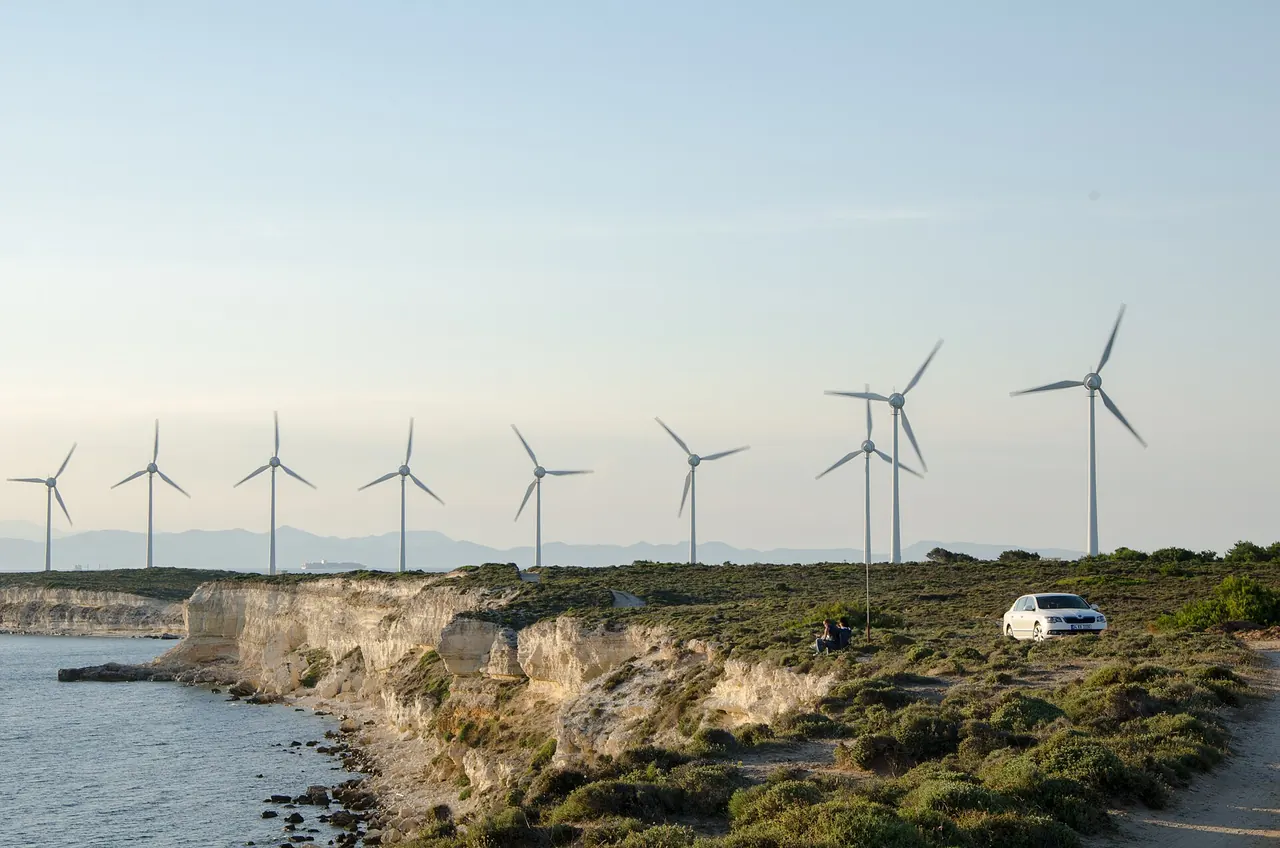
Oman signs a 2.7 GW round-the-clock wind, solar and storage PPA with O-Green Energy
Nama Power and Water Procurement awarded the hybrid project across the Mahout and Duqm areas. The energy minister called it the first of two planned round-the-clock plants. 1 min read
Oman just signed its first round-the-clock renewable energy contract, for a 2.7 GW hybrid development.
Nama Power and Water Procurement awarded the power purchase agreement to state-backed O-Green Energy for a hybrid wind, solar, and battery storage project spanning the Mahout and Duqm areas on Oman’s coast. Minister of Energy and Metals Salim Al Aufi confirmed the signing at the Oman Petroleum and Energy Show on Monday, calling it the first of two planned round-the-clock plants. The project is meant to cut Oman’s reliance on gas-fired generation while supporting industrial growth in Duqm.
Why it matters
Pairing wind and solar with batteries lets the project produce electricity continuously, which is what lets it displace gas-fired generation. Renewables made up 9.5 percent of Oman’s electricity production at the end of 2025, up from about 2 percent in 2021, according to the Authority for Public Services Regulation. Minister Al Aufi’s “first of two” puts a second round-the-clock plant in the queue.
What it means for MENA
We read a signed gigawatt-scale wind, solar and storage hybrid PPA as a strong signal that the region is moving from intermittent renewables toward dispatchable clean supply. For wind developers, my read is that the product being bought is shifting from megawatts to hours.
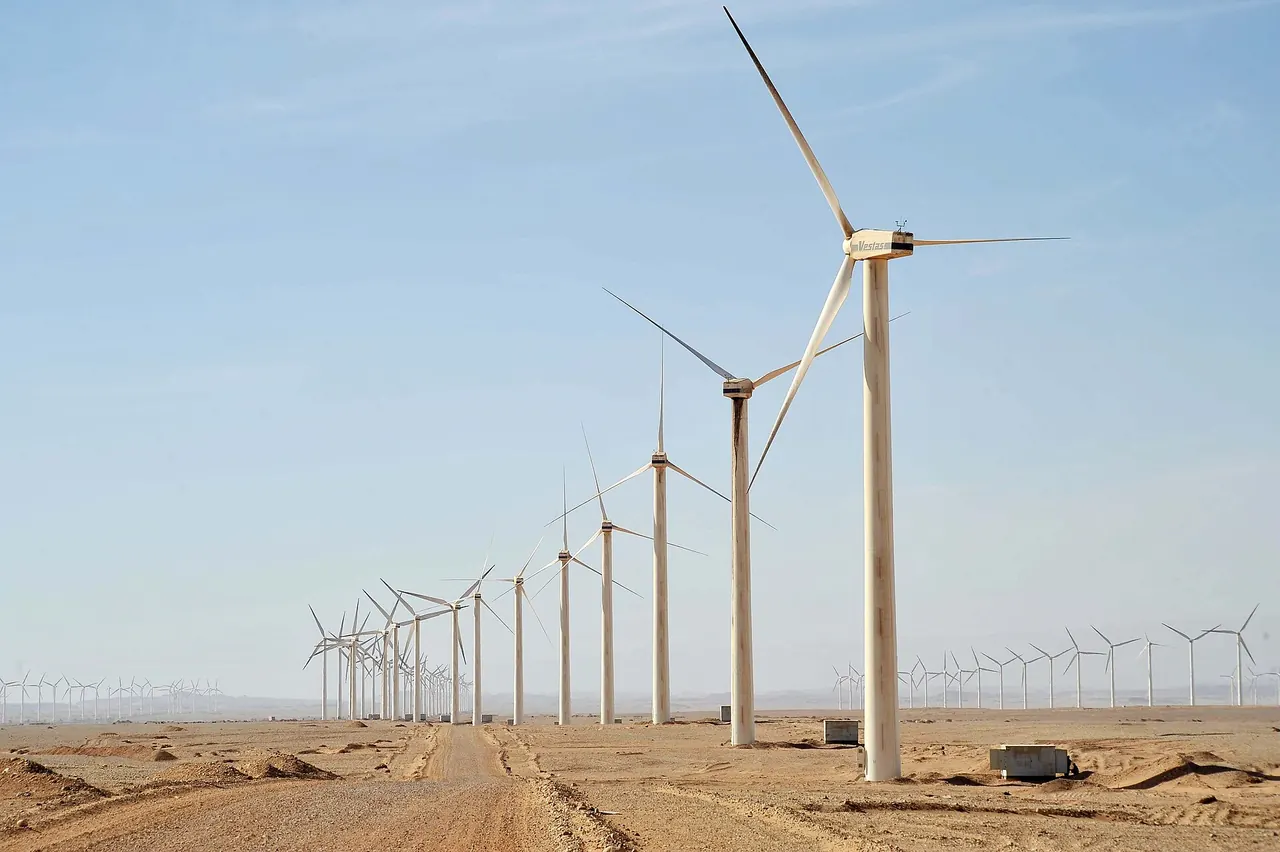
Egypt's president reviews a 7,000 MW renewables pipeline and confirms 900 MW Ras Shokeir for 2027
El-Sisi met the prime minister and electricity minister on 18 May. The review also covered Obelisk solar Phase 2, 1,700 MW Minya solar and 4,000 MW of battery storage. 1 min read
Egypt’s 7,000 MW renewable pipeline just landed on the President’s desk for a project-by-project review.
President Abdel-Fattah El-Sisi met with Prime Minister Mostafa Madbouly and Minister of Electricity and Renewable Energy Mahmoud Esmat on May 18 to walk through Egypt’s combined solar, wind, and energy storage pipeline of more than 7,000 MW. The 900 MW Ras Shokeir wind farm was confirmed for grid connection in 2027. Phase 2 of the 500 MW Obelisk solar plant in Nag Hammadi is scheduled to connect to the national grid later this month. The 1,700 MW Minya solar project was also reviewed, alongside plans for 4,000 MW of connected and standalone battery storage at sites in Minya, Alexandria, and Qena.
Why it matters
Specific BESS site assignments and a near-term grid-connection date for Obelisk Phase 2, reviewed at presidential level, read to us as the buildout shifting from announcement to monthly execution tracking.
What it means for MENA
Egypt is reviewing wind, solar and a multi-site BESS roll-out on the same timetable. The 2027 grid date for Ras Shokeir puts a 900 MW Egyptian wind farm in MENA’s near-term wind queue, and we will track whether it holds.
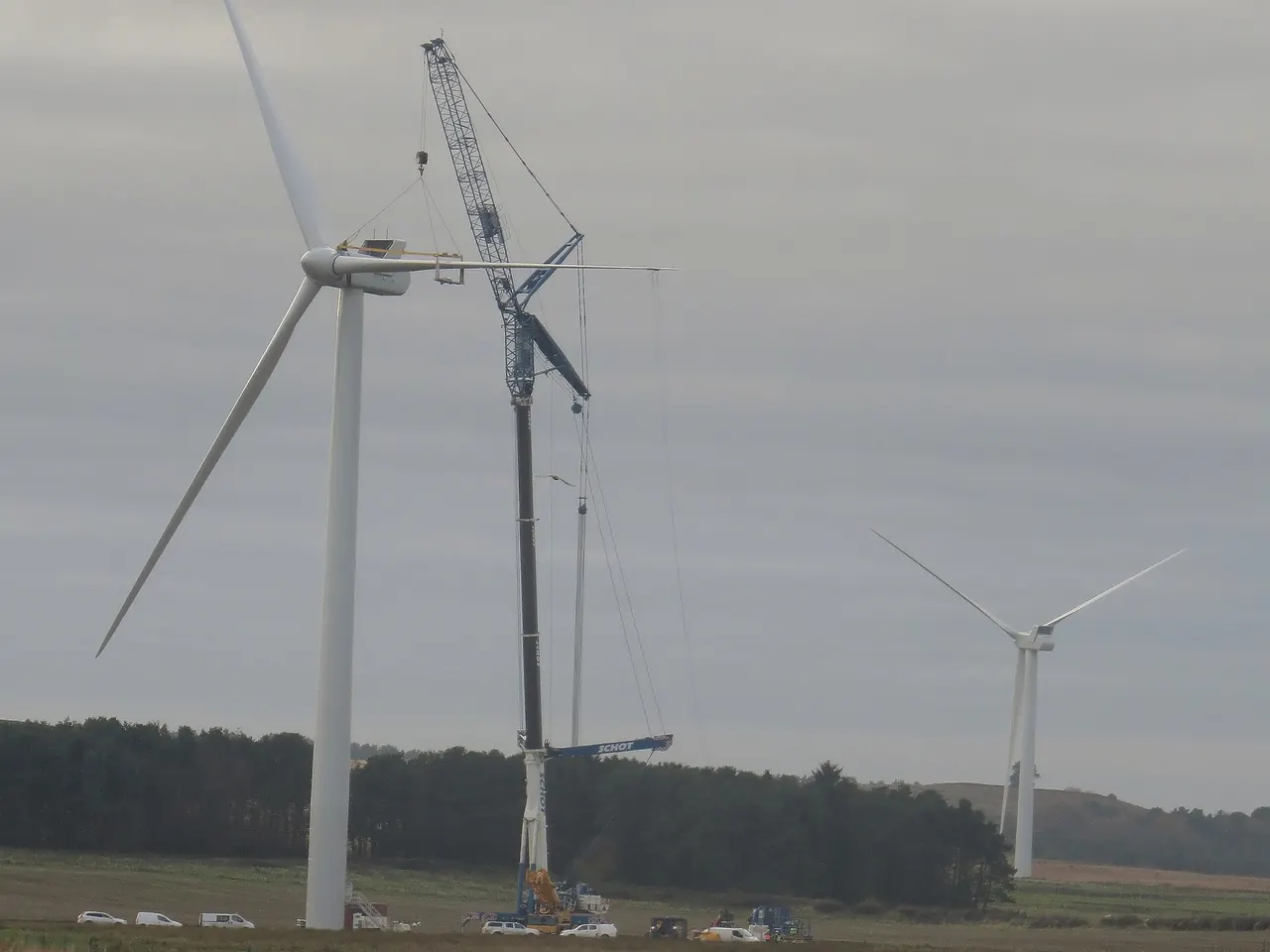
Tower and turbine plants in three countries are turning MENA wind into an industrial policy story
Al Yamamah Steel's Yanbu towers, Mawarid Turbine's Duqm plant and Egypt's talks with Sany Group point to a supply chain race. 1 min read
MENA wind is becoming an industrial policy story.
In our reading, five months ago MENA wind was still mostly about how cheap the electrons could be priced. Today the conversation is shifting to who manufactures the towers, who casts the blades, and where the factory sits.
Three signals make the case.
Al Yamamah Steel signed an SAR 126 million contract with EPC contractor SEPCO3 to supply steel wind towers for the 700 MW Yanbu wind farm.
Mawarid Turbine signed in January for a wind turbine manufacturing and assembly plant in Duqm SEZ. Phase 1 valued at about RO70 million, covering turbine components and blades, with 800 to 1,000 MW expected annual production capacity.
Egypt’s Ministry resumed talks with Sany Group on May 4 to build its first wind turbine factory in country, tied to a 2,000 MW project pipeline. We read it as the same playbook copied across three wind markets.
We consider cost competitiveness settled. The next contest is whether the next gigawatts get built with imported steel and Chinese turbines, or whether each country starts shipping components out of its own ports.
Prediction: Before end of 2027, the first wind tower exported from MENA will leave Yanbu or Duqm bound for an East African or Central Asian project. The MENA wind story stops being about cost and starts being about supply chains.
Which country gets to the export milestone first?
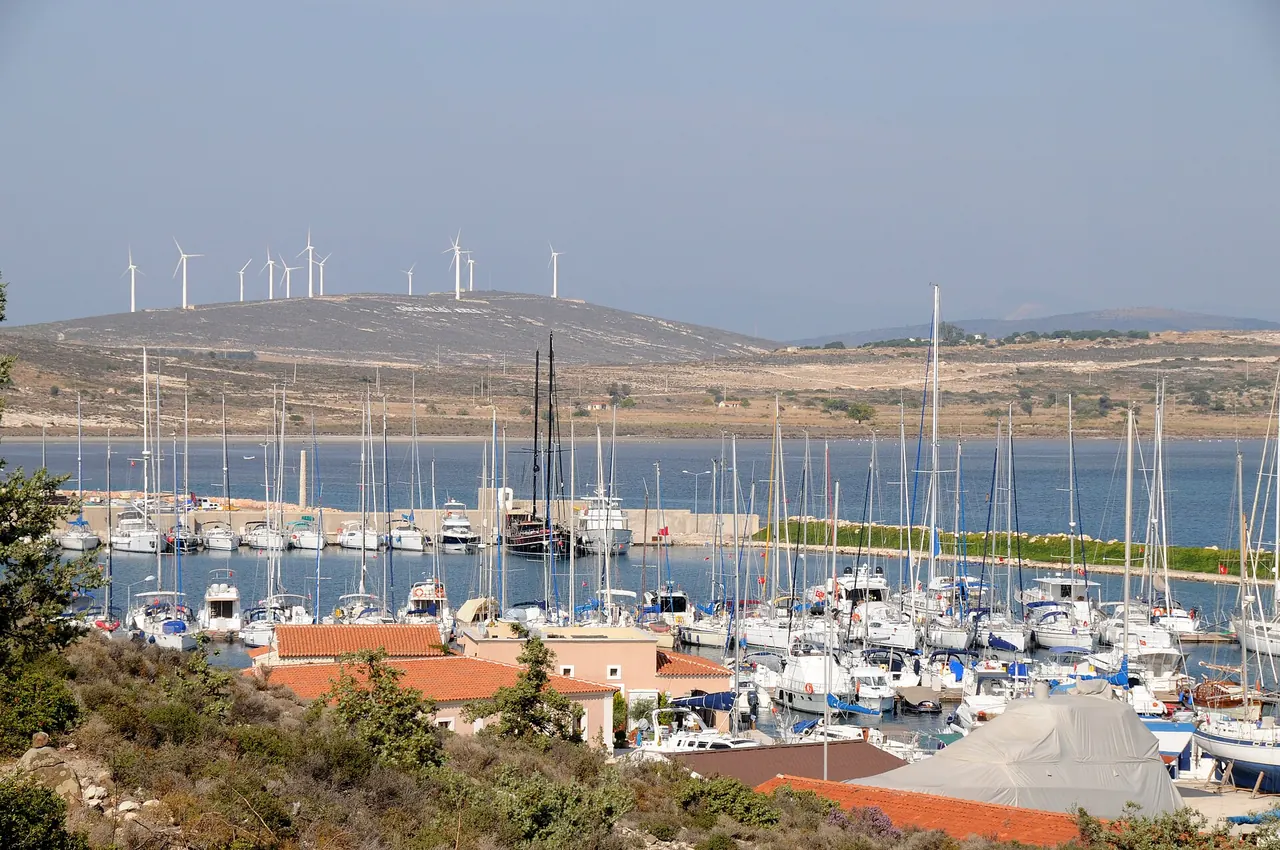
Oman plans three wind IPP tenders and a 1,000 MW round-the-clock renewables project in 2026
Nama PWP's 2025 annual report lists Duqm III at 300 MW, Al Jazir at 100 MW and Shaleem at 100 MW, all scheduled for commercial operation in Q2 2029. 1 min read
Oman’s 2026 procurement plan has three wind IPP tenders and a gigawatt-scale round-the-clock renewables project.
Nama PWP confirmed in its 2025 annual report (covered by Zawya on May 14) that it will issue Request for Qualification tenders this year for three new wind IPPs: Duqm III at 300 MW, Al Jazir at 100 MW, and Shaleem at 100 MW, all scheduled for commercial operation in Q2 2029. Alongside the wind round, Nama PWP will tender a 1,000 MW round-the-clock renewables project combining solar PV, wind, and battery storage at an annual capacity factor above 70 percent, with award targeted in 2026. The plan also covers a 280 MW solar IPP dedicated to decarbonising the Marsa LNG project and four further solar IPPs in a 2,500 MW programme.
Why it matters
My read is that a 70 percent capacity factor from integrated solar, wind and storage starts to compete with gas-fired baseload on reliability. That is the bar Oman is setting for this tender.
What it means for MENA
We read this as Oman moving its wind procurement into the firm-power category, buying renewables by the hours they deliver as well as by the megawatts installed.
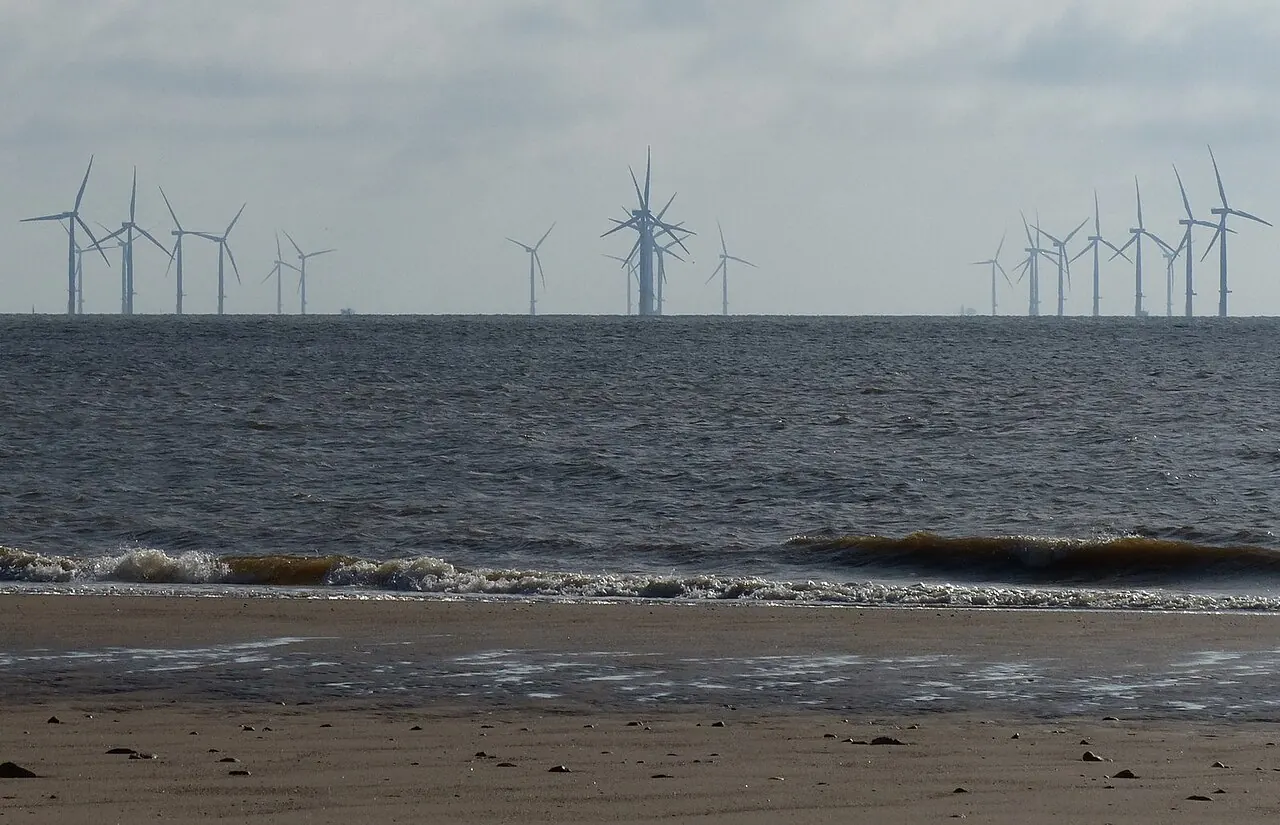
Masdar and RWE win UK consent for the 3 GW Dogger Bank South offshore wind project
Masdar holds 49 percent and RWE 51 percent. When the partners signed in 2023, the first 800 MW was planned for 2029, with full commissioning by the end of 2031. 1 min read
Abu Dhabi just secured planning approval for a project its partners position as one of the world’s largest offshore wind farms, 100 km off the English coast.
Masdar and Germany’s RWE today received the development consent order for the 3 GW Dogger Bank South project, signed by Lord Whitehead on behalf of UK Energy Secretary Ed Miliband. The project is split across DBS East and DBS West, each at 1.5 GW, with each site spanning 500 square kilometres roughly 100 km off the north-east coast of England. Masdar holds a 49 percent stake and RWE 51 percent, part of an £11 billion joint investment in UK renewables. The partners agreed to work together on Dogger Bank South at COP28 in December 2023, when the first 800 MW was planned to come online in 2029, with full commissioning by end of 2031. The two projects already secured UK Contracts for Difference in January 2026.
Why it matters
The consent comes a month after Masdar and ScottishPower installed the UK’s largest wind turbine. We read Abu Dhabi as becoming an anchor equity partner in the UK’s offshore wind buildout.
What it means for MENA
My read is that the same capital stack (Gulf sovereign equity alongside a European partner, with project finance) becomes the reference model for the region’s next large wind tenders.
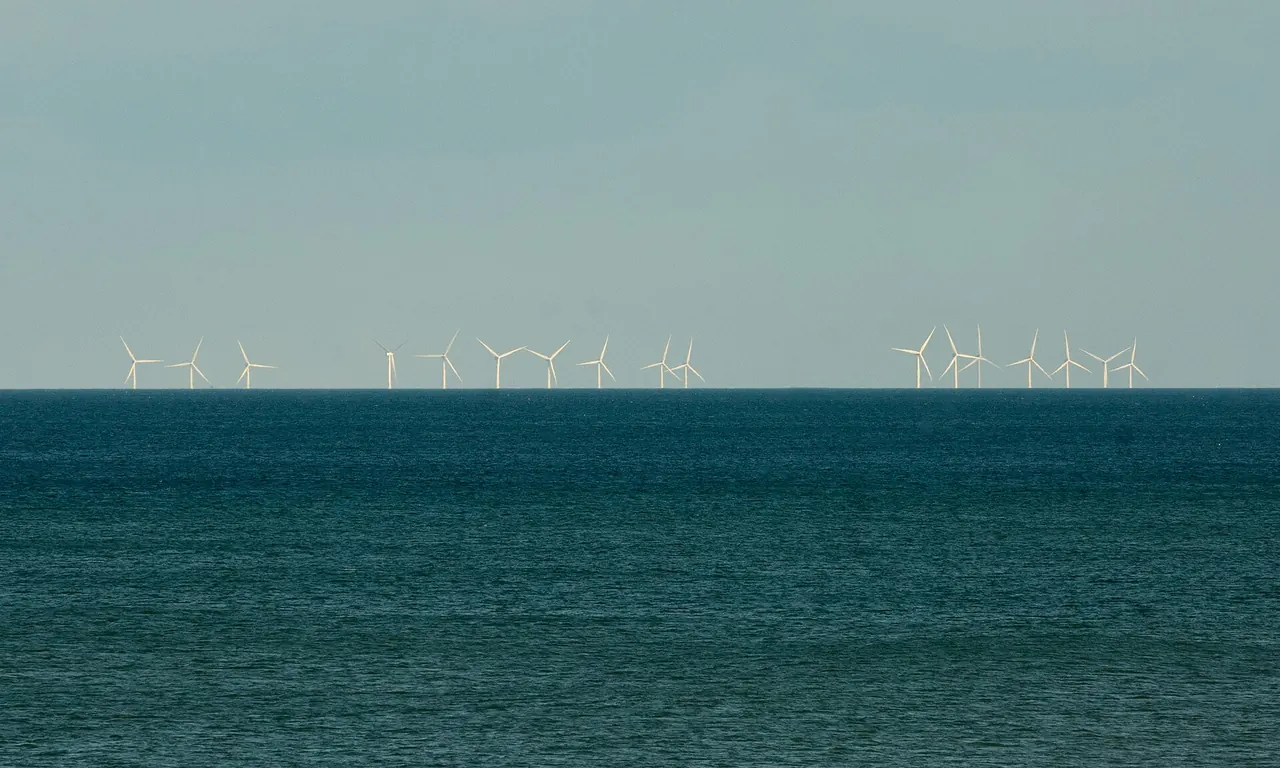
Türkiye declares 2026 the year of wind with 1,500 MW for YEKA auctions and a 5 GW offshore target
Energy Minister Alparslan Bayraktar named four offshore zones and a grid plan of roughly 30 billion dollars, including 14,700 km of HVDC lines. 2 min read
A 125 GW power system has declared an entire calendar year the year of wind.
Türkiye’s Energy Minister Alparslan Bayraktar dubbed 2026 the year of wind at the Turkish Wind Energy Congress in Ankara on Tuesday. The headline numbers include 1,500 MW of fresh capacity earmarked for upcoming YEKA renewable auctions, a 5 GW offshore wind target by 2035, and four newly designated offshore zones at Saros Gulf, Gökçeada, Bozcaada and Edremit. Wind already supplies 10.9 percent of Türkiye’s 393 billion kilowatt hours of generation, with installed wind capacity now sitting above 15 GW, up from 20 MW in 2005. To support the buildout, Ankara plans roughly 30 billion dollars of grid investment, including 14,700 km of HVDC lines, 15,000 km of new AC transmission and 40 new converter stations.
What to look for
The signal I would watch is the localisation rate. Bayraktar reports about 60 percent domestic content on wind turbines, and over 70 percent on towers, generators and blades. The renewable ecosystem has grown from 27 producers in 2014 to roughly 500 domestic manufacturers, supporting close to 50,000 green jobs. Combine that with COP31, which Türkiye co-hosts with Australia in Antalya this November, and we read this as an industrial policy story more than an installation tally. Bayraktar gave no timeline for the first offshore YEKA tender beyond the completion of permitting; TÜREB’s Ibrahim Erden expects it late this year or early next. Its procurement design will shape how offshore wind in Türkiye’s northwest actually scales.
What it means for MENA
My read is that MENA tenders over the next few years will run inside a window where Turkish suppliers, with 60 to 70 percent localisation, can bid blades, towers and generators into the region. The grid plan matters too. Bayraktar said Türkiye is working to raise interconnection capacity with its neighbours to position itself as a regional energy trading hub, and I think that makes it a future trading partner for the eastern Mediterranean.
A country that builds most of its own turbine components and upgrades its own grid is a different kind of competitor, and a different kind of partner. Which piece of the model would do the most for your country: the manufacturing localisation, the offshore tender design or the cross border grid build?
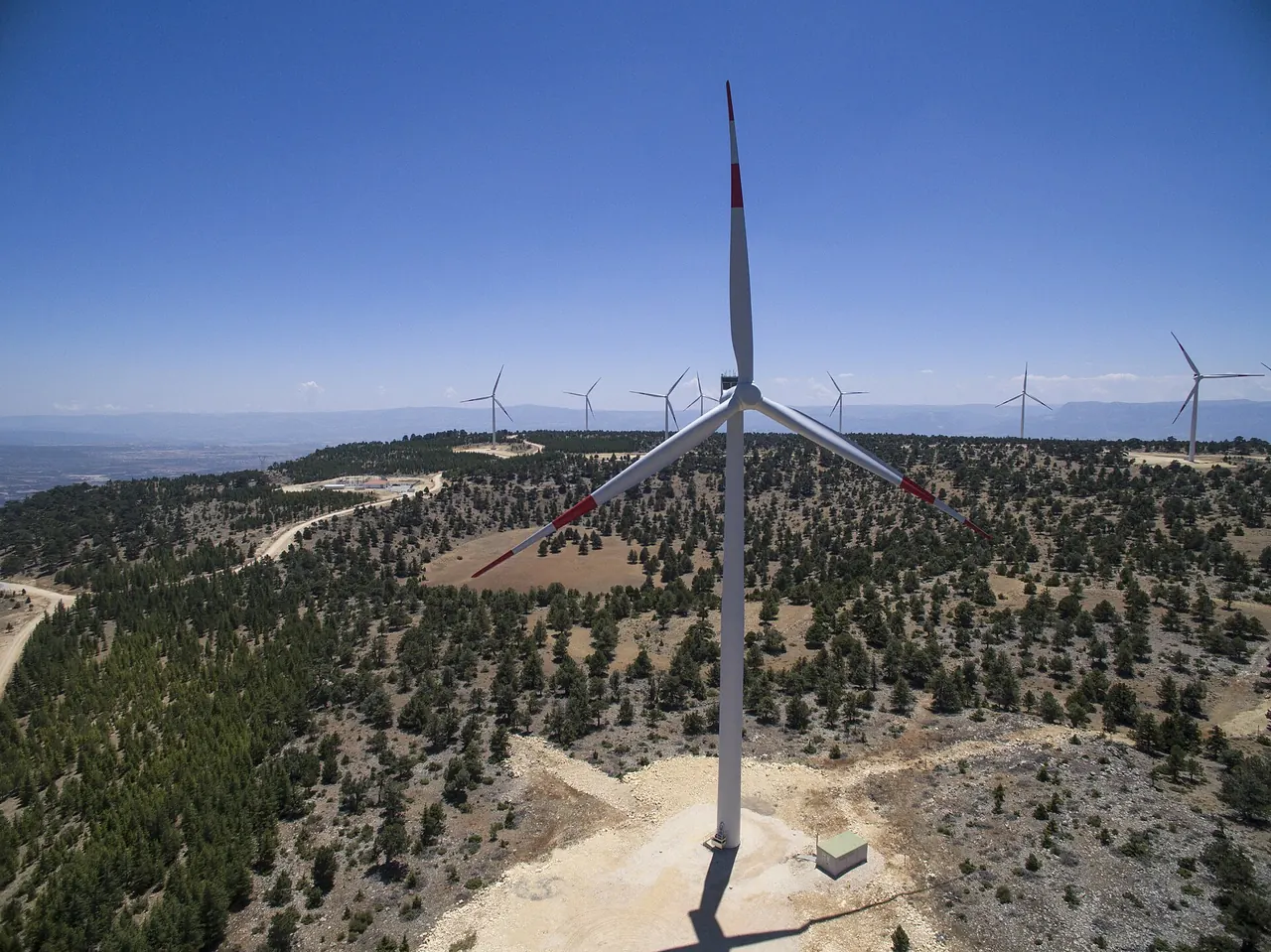
ACWA Power signs USD 226 million of debt for the 300 MW Bash II wind farm in Uzbekistan
ADB, AIIB and Standard Chartered provide a package covering more than two thirds of project cost. The farm in southwestern Uzbekistan targets commercial operation in H2 2027. 1 min read
A Saudi developer just lined up $226 million of multilateral and bank debt to put 300 megawatts of wind into Uzbekistan, and that direction of travel is the real story.
ACWA Power secured the funding for the Bash II wind farm from the Asian Development Bank, the Asian Infrastructure Investment Bank and Standard Chartered, the company said in a statement reported by AGBI on May 8. The package covers more than two thirds of project cost. The farm is in southwestern Uzbekistan, and commercial operations are scheduled for the second half of 2027, with a 25 year power purchase agreement with the state-owned National Electric Grid of Uzbekistan. Once running, Bash II will supply more than 336,000 households and avoid about 475,000 tonnes of carbon dioxide a year.
What to look for
I see two signals worth tracking. First, ACWA Power is arranging multilateral wind finance outside the Gulf as a project sponsor, which in our read says the Saudi renewable model is mature enough to travel. Second, a senior debt mix of ADB, AIIB and a global bank suggests to us that emerging-market wind can be financed through repeatable structures rather than one off sovereign deals.
What it means for MENA
For years, the question was whether MENA could attract European and Asian capital to build wind at home. The new question is whether MENA capital can underwrite wind elsewhere. ACWA Power’s Uzbek financing is one answer. The company is 44 percent owned by Saudi Arabia’s Public Investment Fund and reports 110 projects in operation, construction or advanced development. We read MENA wind as now both a destination for capital and a source of it.
If you finance, supply, or partner in this market, watch where Riyadh and Abu Dhabi deploy next. Where would you place the next ACWA Power flag: North Africa, deeper into Asia, or further afield?
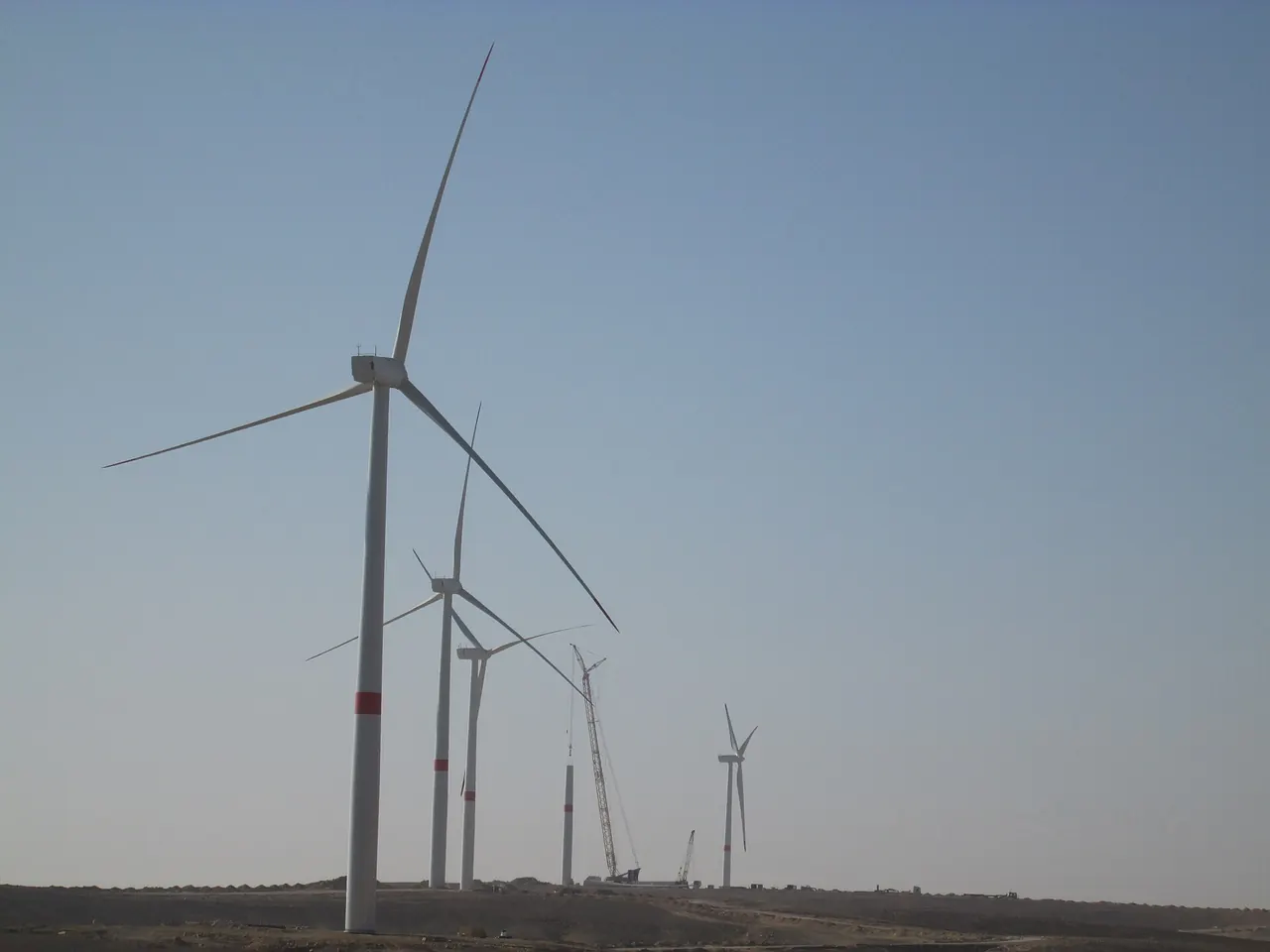
Egypt's electricity minister reviews 1,500 MW of Alcazar Energy wind projects
Mahmoud Esmat met Alcazar founder Daniel Calderon on 7 May on a 500 MW project at Zaafarana and a 1,000 MW farm in south Hurghada, delivered in two phases. 1 min read
Egypt spent this week reviewing how fast 1,500 megawatts of wind can hit the grid.
On May 7, Egypt’s Minister of Electricity and Renewable Energy Mahmoud Esmat sat down with Daniel Calderon, founder of UAE-based Alcazar Energy, to walk through progress on two onshore wind builds. The first is a 500 MW project at Zaafarana. The second is a 1,000 MW farm in south Hurghada, being delivered in two phases. The conversation zeroed in on timetables, grid connection dates, and the executive procedures needed to keep both projects on schedule.
What to look for
This is the kind of meeting that rarely makes global headlines but moves real megawatts. The minister stressed adherence to the implementation timetable and continuous monitoring. We read that as a shift from announcing wind targets to clearing the bottlenecks that slow them down. Watch for financial close milestones on the south Hurghada phases, and for Zaafarana’s first turbine deliveries.
What it means for MENA
A minister reviewing a UAE developer’s 1,500 MW against grid connection dates is a different conversation from a signing ceremony. My read is that Cairo now treats wind as a hard currency hedge rather than a slow moving climate option. For the wider region, the formula on show here is Gulf capital paired with Egyptian state follow-up on timetables.
If you are tendering, financing, or supplying into this market, the Alcazar pipeline deserves a close read. Who will be the next IPP to put 1,500 megawatts on the minister’s desk?
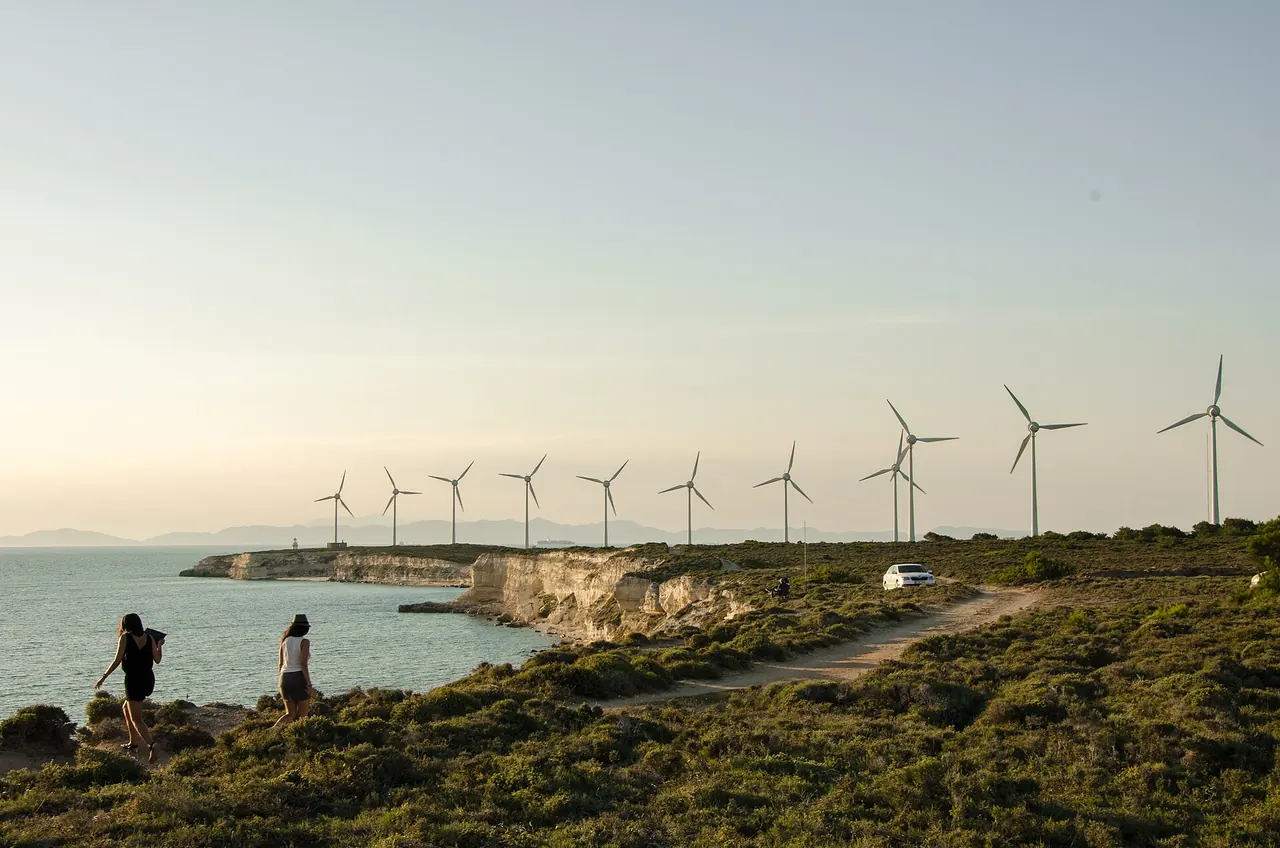
IRENA puts firm wind plus battery power at USD 59 to 94 per MWh in 2025, below new gas
IRENA's new firm cost benchmark sees hybrid wind and battery costs falling to USD 49 to 75 per MWh by 2030. New gas globally tops USD 100. 1 min read
Wind plus storage just came in under new gas on IRENA’s round-the-clock cost test.
IRENA’s new May 2026 report, “24/7 renewables: The economics of firm solar and wind,” benchmarks firm levelised cost of electricity, the round the clock measure. It puts firm wind plus storage at around $59 per MWh in Inner Mongolia and $88 to $94 per MWh across Brazil, Germany and Australia in 2025, falling to roughly $49 to $75 per MWh across those markets by 2030. New coal in China sits at $70 to $85. New gas globally tops $100. Since 2010, installed costs are down 87 percent for solar PV and 55 percent for onshore wind, and battery costs are down 93 percent. For solar plus battery, IRENA projects firm costs falling roughly 30 percent by 2030 and 40 percent by 2035.
What to look for
The first commercial scale firm wind PPAs hitting investment grade. AI and hyperscale data centers shopping for 24/7 clean supply, a buyer group IRENA names directly. Storage durations stretching from four hours toward eight and beyond. We expect the spread between firm renewables and new gas to keep widening, even before carbon prices show up on the bill.
What it means for MENA
The example IRENA cites is already in the region. The UAE’s Al Dhafra complex pairs solar PV with battery storage and delivers a firm 1 GW of clean electricity at around $70 per MWh. IRENA also notes that combining wind with solar cuts storage needs and overall system cost, which is where MENA’s best wind corridors come in.
Over the next 18 months we will be watching which MENA utility signs the region’s first firm wind plus storage PPA. Our bet is that whoever moves first will set the price reference for the rest of the region.
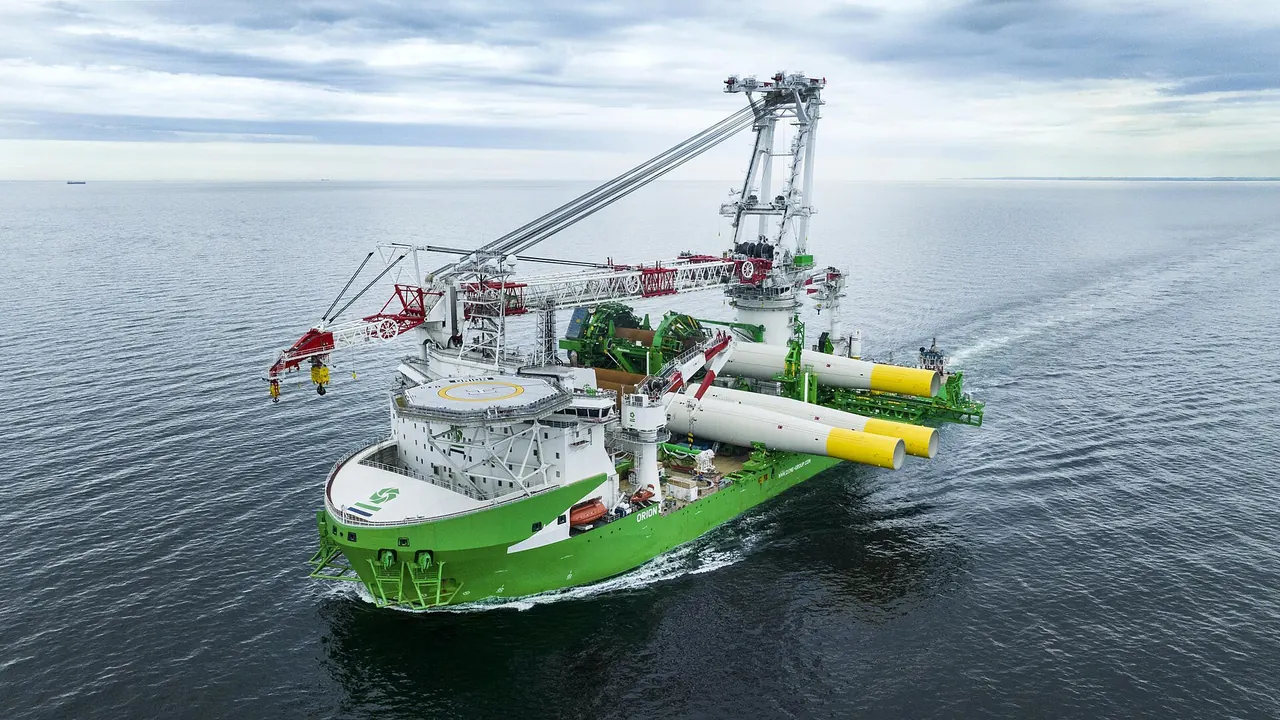
Egypt resumes talks with Sany on its first wind turbine factory, tied to a 2,000 MW pipeline
Electricity Minister Mahmoud Esmat met Sany in Cairo to advance plans first pitched in January 2026. 1 min read
Egypt wants its wind turbines built on Egyptian soil.
The country’s Minister of Electricity and Renewable Energy, Mahmoud Esmat, met China’s Sany Group in Cairo on Monday to advance plans for Egypt’s first wind turbine manufacturing plant. Sany made its initial pitch back in January 2026. According to the ministry statement, the latest meeting covered the steps Sany has taken to set up the factory, transferring and localising the company’s technology, and implementing 2,000 MW of wind projects. There was no mention of cost or location. Egypt has already signed agreements with foreign companies to produce solar panels and storage batteries.
What to look for
The factory itself is the headline, but the structure of the deal is where the real story lives. We see a localisation model as a step up from a straight equipment supply contract. If the 2,000 MW of projects is firmed up, the factory would have a domestic order book before construction begins, which is usually the missing ingredient in early stage manufacturing plays. Watch for the financing structure, the equity split, the export clause, and whether Egyptian steel and tower suppliers get built into the value chain. Watch also for the site, which the ministry statement did not name.
What it means for MENA
AGBI reports that Egypt hopes to become a regional centre for the export of renewable energy products. A wind turbine plant would add a third line to the solar panel and battery deals already signed. Our view is that localised manufacturing trims project costs, shortens lead times, and keeps a larger share of the energy spend inside MENA economies.
The next twelve months will show whether this talk turns into a signed investment. Which matters more to you, the factory or the 2,000 MW attached to it?
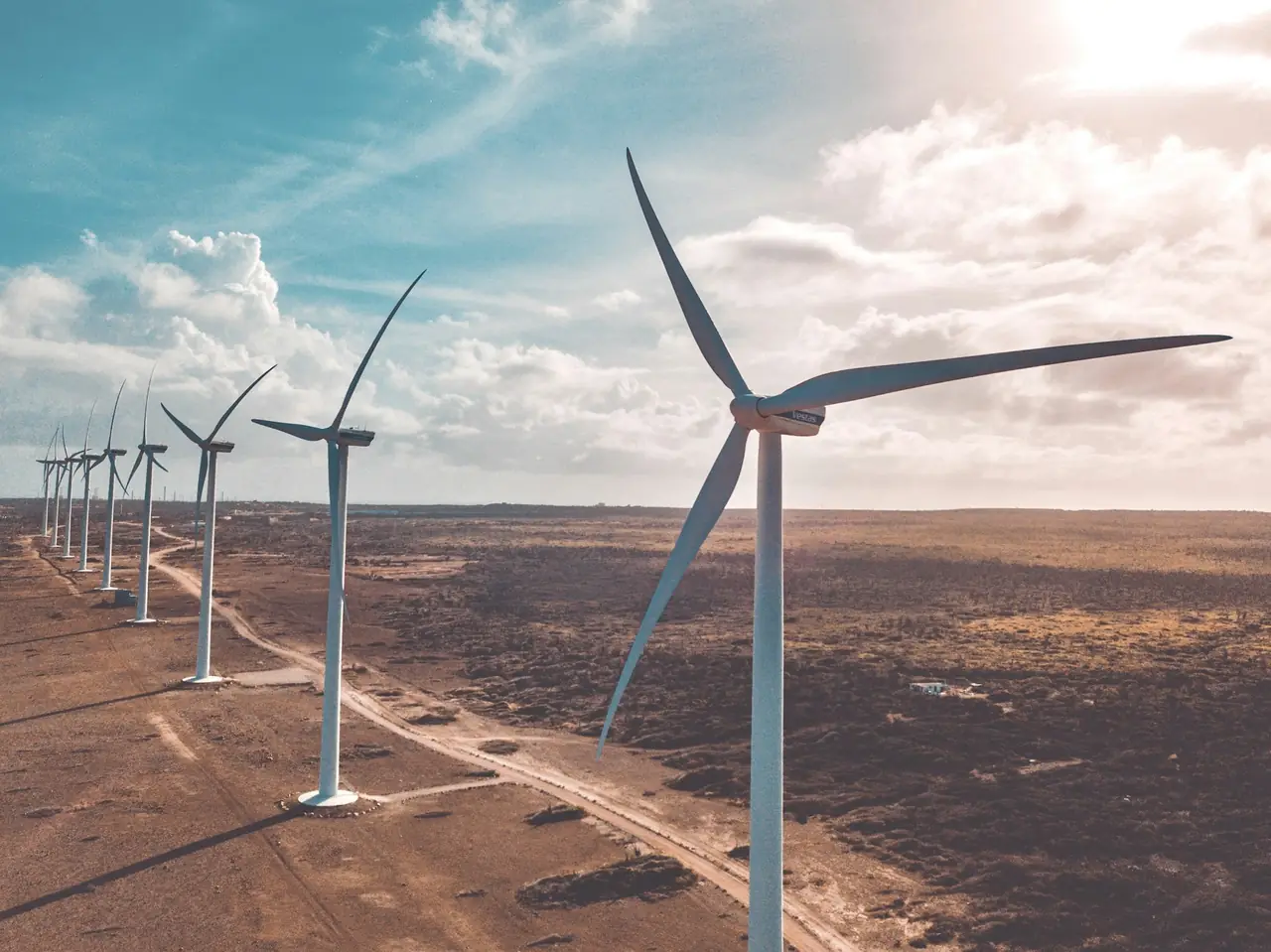
Morocco's ONEE sets out a 3,500 MW storage roadmap to 2030
The plan pairs storage with 4,500 MW of flexible gas capacity and 6,000 km of new very high voltage lines, inside a programme of more than MAD 180 billion to 2030. 1 min read
Morocco is putting around 18 billion dollars behind storage, flexible gas and transmission by 2030.
At an end of April gathering in Marrakech, the National Office of Electricity and Drinking Water (ONEE) laid out a plan to keep its rapidly rising renewable share, currently around 47 percent of the electricity mix, on the grid without destabilising it. The headline number is more than 3,500 MW of storage capacity by 2030. Alongside it come 4,500 MW of flexible gas-fired capacity that can start quickly when renewable output drops, and 6,000 km of new very high voltage lines to carry power from remote production sites to the main consumption centres. The whole package belongs to an investment programme of more than MAD 180 billion, around 18 billion dollars, by 2030.
What to look for
The plan sets targets but no tender calendar, so ONEE’s procurement schedule is the tell. I will be watching for the first storage tender: its size, its sites and its bidder list. The 4,500 MW of gas is the other half of the story. Morocco is firming its renewables with fuel as well as batteries, and my read is that the split between the two will decide how much of the flexibility bill wind developers end up carrying.
What it means for MENA
We read this as a strong signal that the next wave of MENA wind investment will be priced as wind plus storage. The cheapest wind hours only matter if the grid can hold them until the load needs them, and Morocco is now budgeting for that at national scale.
If you are mapping MENA wind opportunities for the next twenty four months, draw the storage layer first and the wind layer on top. Where do you see the firming bottleneck biting hardest, Algeria, Tunisia, or further east?
Egypt-Saudi HVDC link completes final testing, with the first 1,500 MW due before the end of Q2
The 1,350 km link runs from East Medina and Tabuk to Badr City east of Cairo and reaches 3,000 MW once both phases are operational. The project is priced at USD 1.8 billion. 2 min read
What happens when Egypt and Saudi Arabia get a power highway between them?
The final stages of technical testing on the Egypt to Saudi Arabia electricity interconnection have been completed, Al Arabiya reported, citing an unidentified source, and Cairo is reportedly planning to bring the first 1,500 MW phase online before the end of the second quarter of 2026, ahead of summer peak demand. In February, President Abdel Fattah El-Sisi stressed the importance of having that first phase running for the summer peak. Converter stations at East Medina and Tabuk in Saudi Arabia and Badr City in Egypt are joined by 1,350 kilometres of overhead lines. Capacity doubles to 3,000 MW once the project is complete. Egypt and Saudi Arabia awarded 1.8 billion dollars in contracts for it in 2021.
What to look for
The technology choice carries a lot of weight here. HVDC moves bulk power across long distances with low losses, which is what variable wind generation needs to travel from where it blows to where it is used. If Egyptian and Saudi demand and wind output peak at different hours, each grid can shave its peaks using the other country’s surplus. Watch for the confirmed energisation date and for the first published flow data across the link.
What it means for MENA
Wind power in this region has been a national story until now. Once this line energises, we think it starts to become a regional resource. Asset owners on both sides could price firm power that crosses borders, which would improve bankability for new wind farms and cut curtailment risk during low demand windows. A working Egypt to Saudi line would give other MENA countries a template for renewable integration at scale, and in our reading it moves the conversation from generation alone toward generation plus transmission as the binding constraint.
We see the summer of 2026 as the first test of MENA wind as a cross border product. Which regional link should come next?
Egypt signs for 4,750 MW of wind and 4,000 MWh of storage, and targets 45% renewables by 2028
Tahya Misr Holding Company will lead financing and implementation, with electricity priced in Egyptian pounds and a two-year delivery window. The wind farms sit along the Gulf of Suez corridor. 2 min read
Egypt just pulled its 2030 renewables target two years forward and lined up almost 5 gigawatts of wind to make it happen.
On May 4, Cairo signed a fresh cooperation agreement between Tahya Misr Holding Company, the Ministry of Electricity, and the Ministry of Finance to develop 4,750 MW of new wind capacity paired with 4,000 MWh of battery storage. The wind farms are slated for the Gulf of Suez, Ras Shukeir, Galala, and Zafarana, while batteries will be deployed south of Cairo, in Damanhur, and at Wadi El Natrun. Tahya Misr is taking on financing and implementation, with electricity priced in Egyptian pounds and a two year delivery window. The headline number sits behind it all, 45% renewables by 2028, replacing the old 42% by 2030 target.
What to look for
The financing route is the part we would watch most closely. In our read, a state-owned holding company financing wind with electricity priced in local currency takes hard currency risk off the table for the projects. The four wind sites all sit along the Gulf of Suez coast. The storage layer is built into the plan rather than bolted on later, with 4 GWh of batteries sited south of Cairo, in Damanhur and at Wadi El Natrun, and we read that as Egypt treating wind plus storage as one system. The two year build target is aggressive, which puts immediate pressure on turbine OEMs, civil contractors and the national electricity transmission company that has to connect it all.
What it means for MENA
We read this as a reset of regional ambition. Cairo is telling the rest of the region that 2030 was too patient a deadline. Pulling the share up by three percentage points and the date back by two years raises the bar for what other MENA governments can credibly target. The local currency pricing matters too. Our read of the deeper signal: state holding companies stepping into wind project delivery, with hard currency lenders following on rather than leading.
If Tahya Misr delivers inside two years, Egypt will have shown the region that wind ambition can be financed domestically and built fast. Who else in MENA is ready to bring their 2030 target forward to 2028?
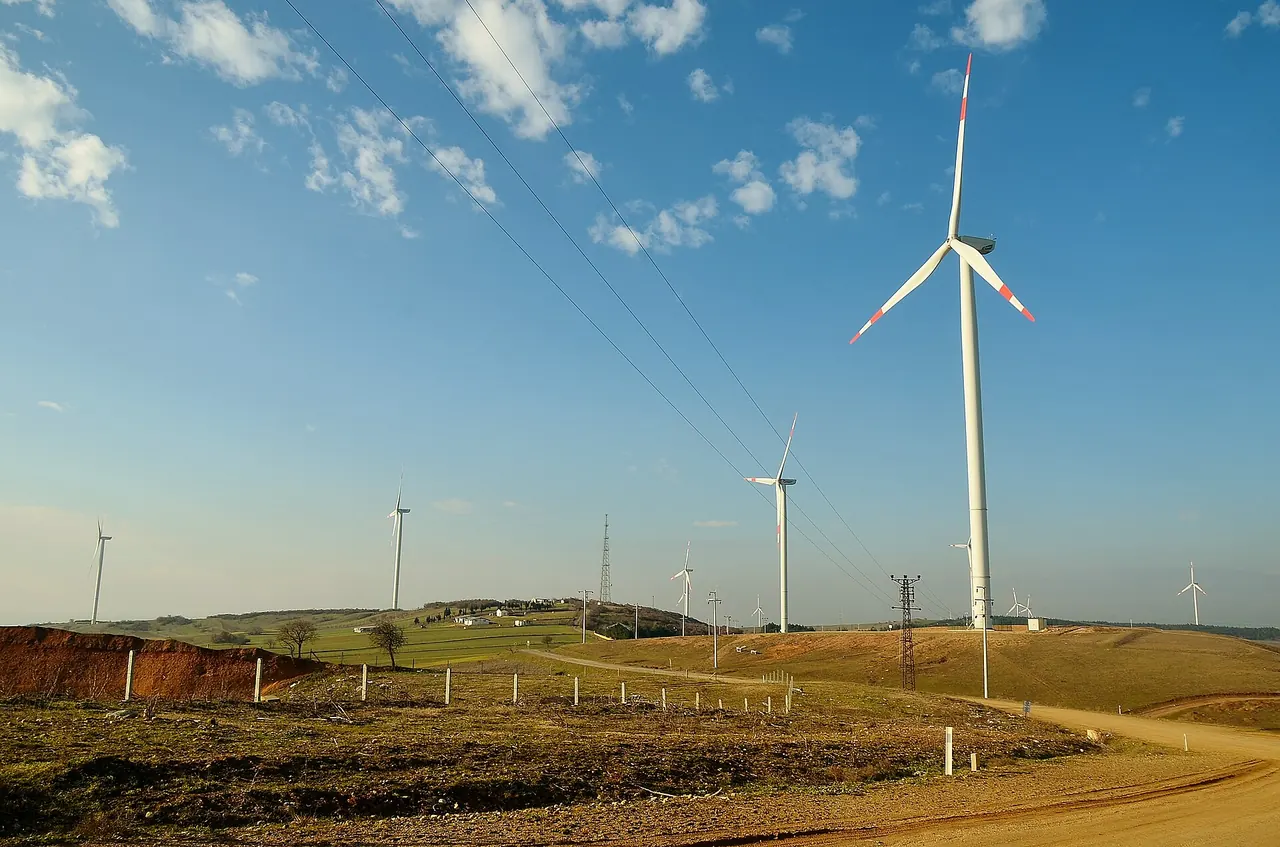
Saudi Arabia's 3 GW, 12 GWh battery storage tender closes qualification on 5 May
SPPC's six build-own-operate projects are each sized at 500 MW and 2 GWh. The tranche follows a first wave of 2 GW and 8 GWh. 1 min read
My pick for this week’s MENA wind story has nothing to do with a turbine.
The Saudi Power Procurement Company is closing the qualification window tomorrow, May 5, on a tender for six new battery storage projects totaling 3 GW and 12 GWh. The six sites are Samha in Qassim, Al-Leeth, Khulis and Ashyrah in Makkah, Al-Henakiyah in Madinah, and Sadawi in the Eastern Province, each sized at 500 MW and 2 GWh with four hour duration, all delivered build own operate. This is the second tranche after the 2 GW and 8 GWh first wave, and it counts toward Saudi Arabia’s 48 GWh battery storage target for 2030.
What to look for
We read this tender as the firming layer Saudi wind will need as more capacity connects. Watch which consortia qualify, and watch the LCOS numbers when bid prices land.
What it means for MENA
My view is that storage decides how much new wind the region can absorb without curtailment. By tendering 12 GWh in one shot, on top of 8 GWh in the first wave, Saudi Arabia is giving the rest of the region a working model of wind firming at scale.
SPPC’s qualification deadline falls at 14:00 on May 5.
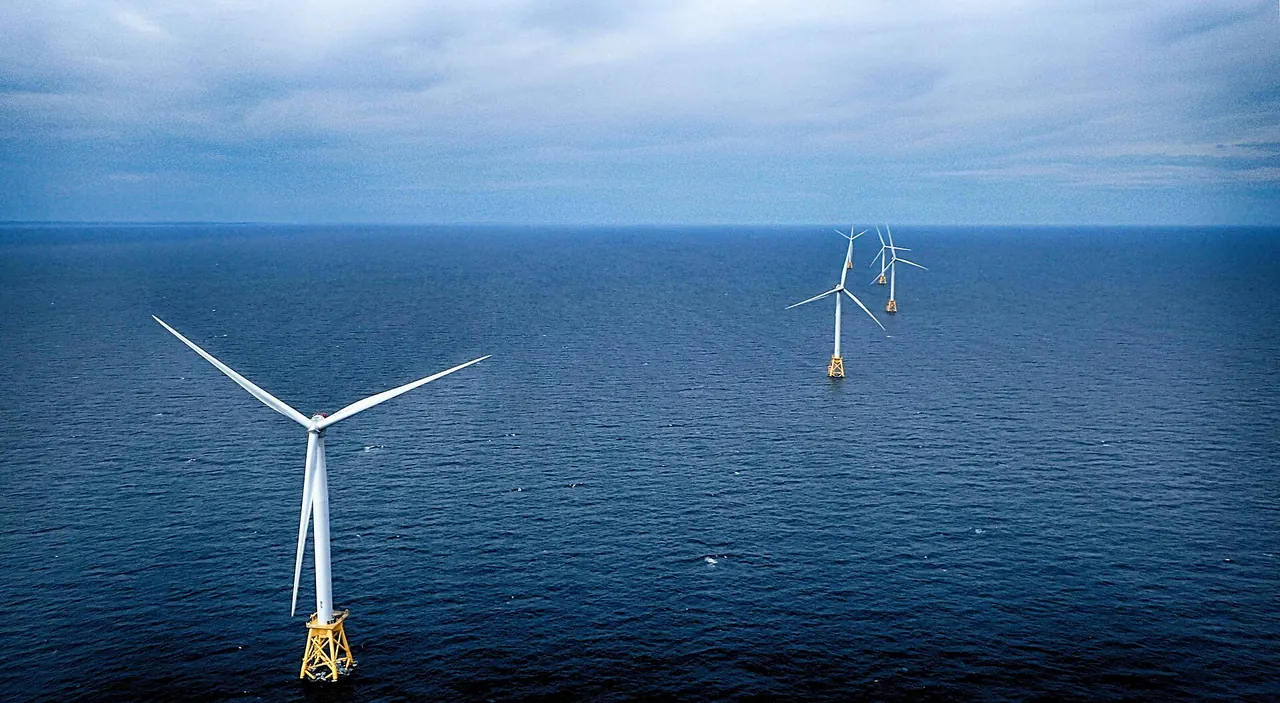
Turkey added 300 MW of wind in Q1 2026 and TÜREB projects 2.5 GW for the full year
TÜREB puts Q1 wind investment at about USD 350 million, after more than USD 2 billion and 2 GW in 2025. TÜREB's head expects Ankara's first offshore wind tenders by year end. 1 min read
Turkey just added 300 megawatts of wind in three months.
According to Ibrahim Erden, head of the Turkish Wind Energy Association (TÜREB), Turkey’s Q1 2026 wind investments hit roughly $350 million, building on a 2025 year that already pulled in over $2 billion for more than 2 GW of new capacity. Erden projects 2026 additions at 2.5 GW, implying total investment of $2.5 billion. Erden projects annual wind installations climbing to 4 to 5 GW by 2028 and 2029. Solar tells a parallel story, scaling from about 40 MW in 2014 to over 25 GW by January 2026, and in January Erden said he expected Ankara to issue its first offshore wind tenders by year end.
What to look for
Watch whether the first offshore tenders actually arrive this year, and watch for ripple effects on wind component supply chains. We read investment at this scale as Turkey positioning itself as a manufacturing and export hub for wind into MENA, the Caspian, and southern Europe.
What it means for MENA
Turkey’s trajectory sets a clean benchmark for the region’s emerging wind markets. If Turkey reaches 4 to 5 GW annually by 2029, I think it will show that a market next door to MENA can absorb large-scale wind buildouts year after year. My expectation is that Turkish supply chains, EPC firms and project finance structures will cross into MENA wind projects more often through 2027.
Which MENA wind market are you watching most closely right now?
Masdar and ScottishPower install the first 14 MW turbine at East Anglia THREE, with 115 metre blades
It is the UK's largest wind turbine. The 95-turbine, GBP 4 billion farm off Suffolk will power about 1.3 million homes when it comes online later this year. 1 min read
Masdar just helped raise the UK’s largest wind turbine, with blades longer than a Premier League football pitch.
The Abu Dhabi renewables company, working alongside ScottishPower (an Iberdrola subsidiary), installed the first 14 MW turbine at the £4 billion East Anglia THREE offshore wind farm off the Suffolk coast, The National reported on April 21. Each blade measures 115 metres. All 285 blades for the 95 turbine project are being made at Siemens Gamesa’s factory in Hull. The full farm will power roughly 1.3 million British homes when it comes online later this year.
What to look for
We read this as MENA capital moving up the offshore wind value chain, where projects are larger and more complex. Watch whether Masdar brings the same playbook home as the region tests whether offshore platforms can compete with onshore wind on cost. My view is that the supply chain relationships and project finance built abroad will shape what MENA can build at home.
What it means for MENA
An Emirati firm now co-owns a farm its partners call one of the world’s largest, and has just helped install the UK’s largest turbine on it. My read is that the expertise gained at East Anglia THREE will flow back into the Gulf and North Africa and shorten the learning curve when the region tenders its own offshore projects. MENA is now a source of wind capital as well as a destination for it.
Egypt plans a global tender for a 390 km, 500 kV line to carry Gulf of Suez wind
The line is valued at EGP 12 billion, around USD 226 million, with completion scheduled for mid-2027. The plan targets projects by Scatec and Orascom Construction in particular. 1 min read
Egypt is preparing to tender the wires to move its Gulf of Suez wind.
Cairo plans a global tender for a 390 km, 500 kV transmission line connecting wind energy facilities in the Gulf of Suez to the national grid. Asharq Business, citing unidentified sources, puts the project at EGP 12 billion, around 226 million dollars, with completion planned for mid 2027. AGBI, which reported the plan on April 30, says it will be one of the largest lines in the country. The aim is to integrate renewable projects, especially those of Scatec and Orascom Construction. Orascom, ENGIE and Aeolus announced plans in March for a 900 MW onshore wind farm near Ras Shokeir on the western coast of the Gulf of Suez. Scatec said in January it would build a 1.7 GW solar plant with 4 GWh of battery storage in Minya.
What to look for
I read this as a transmission story dressed up as a wind story. Track how quickly the tender package gets published, which international EPC contractors line up, and how the financing is structured after the 8 billion dollar outflow Moody’s says Egypt suffered because of the regional conflict. Cairo said earlier in April that it expects renewables to reach 42 percent of its generation mix by 2030, and this line is part of how it gets there.
What it means for MENA
My read is that grid build out is becoming the quiet bottleneck that decides which countries hit their wind targets. Countries that treat wires as climate infrastructure of equal weight to turbines should keep adding gigawatts through 2030. Countries that only run generation auctions risk curtailment, and investor confidence with it.
The next chapter of MENA wind will be written as much by the EPC firms stringing the lines as by the developers raising the towers. If you are tracking this transition, follow the wires.
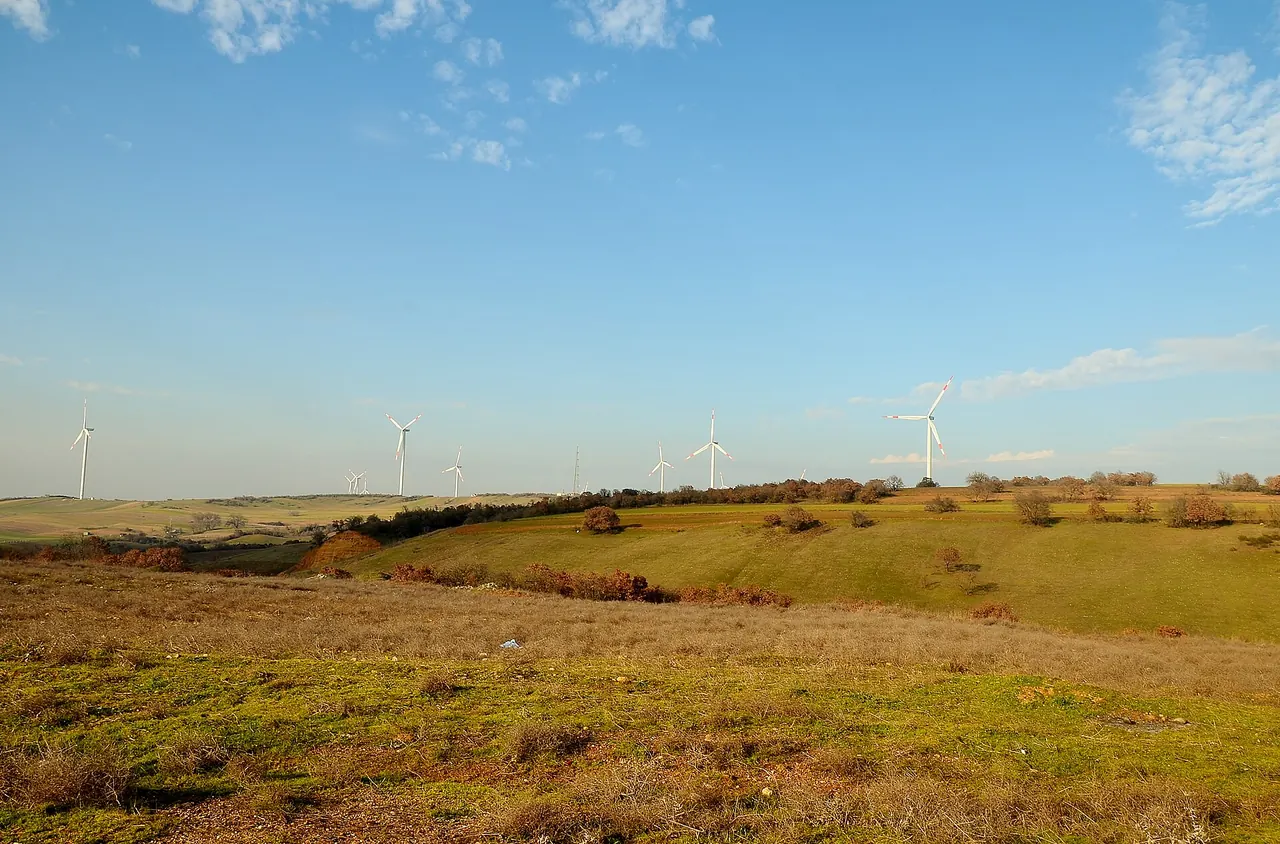
Saudi Arabia added a record 1,512 MW of wind in 2025, 57.8% of all Africa Middle East additions
GWEC's Africa Middle East report puts regional additions at 2.6 GW in 2025 and cumulative capacity at 15.2 GW. Saudi Arabia's installed base rose to 2,324 MW from 812 MW. 1 min read
Saudi Arabia almost quadrupled its annual wind additions in a single year, and on its own accounted for almost three in five new megawatts across Africa and the Middle East.
GWEC’s new Africa Middle East regional report, released April 28, says the Kingdom commissioned 1,512 MW of new onshore wind in 2025, a 287.7 percent leap year on year. That haul alone accounts for 57.8 percent of the region’s new wind capacity. Region wide, additions hit 2.6 GW in 2025, up 32 percent from 2024, while cumulative installed wind in Africa and the Middle East climbed to 15.2 GW. South Africa remains the largest single market at 4,037 MW, with Egypt second at 3,097 MW, Morocco fourth at 2,629 MW, and Saudi Arabia at a cumulative 2,324 MW from just 812 MW the year before.
What to look for
GWEC projects another 35 GW of new wind capacity across Africa and the Middle East between 2026 and 2030, with the Middle East taking the larger 53 percent share. If every project under construction, the 5.3 GW already awarded through Saudi NREP auctions, and the manufacturing pipeline in Saudi Arabia and Oman lands as planned, the Middle East alone could add over 18 GW by 2030. The pace setters I would track are NREP Round 7 awards, Yanbu and Al Ghat moving through commissioning, and the West Sohag tender in Egypt.
What it means for MENA
Egypt and Morocco still hold the larger installed bases. On these numbers, my read is that the center of gravity for new build has moved to the Gulf, and North African procurement teams now have a Saudi volume benchmark to answer.
I think the next 18 months of auctions and commissionings will decide which countries lead the region through 2030.
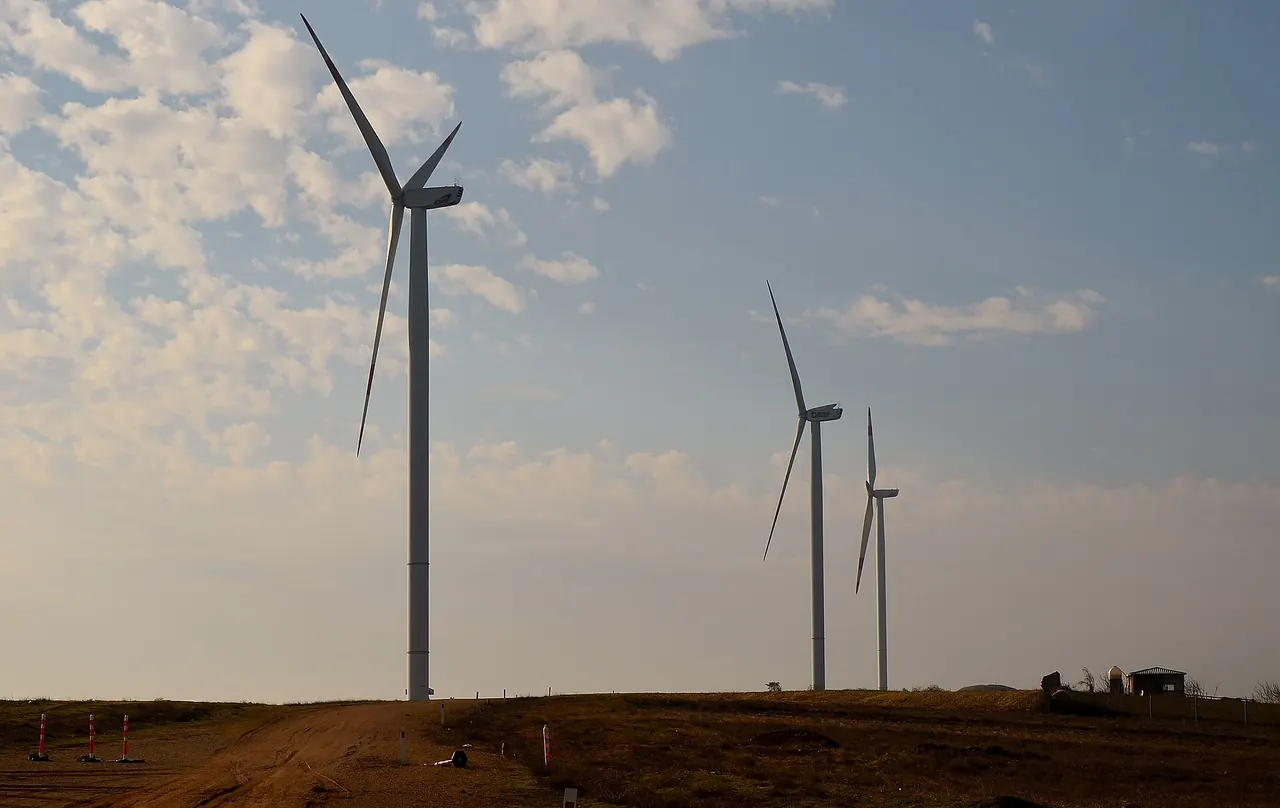
Sembcorp lifts its Oman portfolio to 1.1 GW, including the 125 MW Dhofar II wind project
Dhofar II, developed with OQ Alternative Energy, has a 20-year PPA with Nama PWP and targets commercial operation in Q3 2027. 1 min read
Sembcorp just placed its first wind bet in the Middle East, and Oman is the host.
Singapore based Sembcorp Industries has lifted its Oman energy portfolio to 1.1 gigawatts, including the 125 megawatt Dhofar II Wind Project. Developed in partnership with OQ Alternative Energy, the wind farm carries a 20 year power purchase agreement with Nama PWP and is slated for commercial operation in the third quarter of 2027. Sembcorp also locked in a 10 year power and water purchase agreement for the 465 megawatt Salalah Independent Water and Power Plant, plus a stake in the 588 megawatt peak Manah II Solar IPP built with China’s Jinko Power. Globally, the Singaporean utility now operates 28.5 gigawatts of energy assets, with 20.4 gigawatts already in renewables.
What to look for
The most interesting detail here is the geography of the capital stack. Sembcorp is Singaporean, OQ is Omani, Manah II’s solar partner is Chinese, and the Salalah extension keeps gas firmly in the mix. We read that blend as a sign that Oman is a confidence market for investors who price risk carefully. Keep an eye on whether Dhofar II delivers in Q3 2027; I think on time execution would put Oman near the top of MENA for converting wind awards into operating projects. Watch too for how Sembcorp’s wind returns compare with its solar and gas margins; I suspect that benchmark will shape how quickly other Asian utilities follow.
What it means for MENA
A Singaporean state owned utility with 28.5 GW of operating assets has now taken a Middle East wind mandate. My read is that this broadens MENA wind’s financing base beyond the developers the region already knows, and that other Asian utilities will watch how Dhofar II performs.
Nama PWP is the sole national offtaker of power and water in Oman, and both Dhofar II and the Salalah renewal run through it. I would watch its next wind award closely.
AfDB and ILX channel USD 40 million of European pension money into Egypt's 1.1 GW wind project
ILX signed on 20 April for a funded risk participation in a USD 140 million AfDB senior debt facility, the first deal under a partnership agreed in 2023. 1 min read
European pension money just walked through the door of Egypt’s wind sector.
The African Development Bank and Dutch asset manager ILX Management have closed their first joint transaction, channelling 40 million dollars from European institutional investors into a 1.1 gigawatt wind project in Egypt. The deal is part of a 140 million dollar AfDB senior debt facility, structured as a funded risk participation. ILX, which manages capital on behalf of European pension funds, signed on April 20, 2026. It is the first transaction under the AfDB and ILX climate finance partnership agreed in 2023. The wind farm will be Egypt’s largest, and supports the country’s 42 percent renewables target by 2030.
What to look for
I think the mechanism matters as much as the money. A funded risk participation lets a development bank like AfDB share both funding and credit risk with a private investor, which is the kind of plumbing European pension money needs before it reaches wind in this region. If this template scales, expect more African and MENA wind projects to tap European retirement savings instead of sovereign budgets. Watch whether AfDB repeats the structure across the Maghreb pipeline.
What it means for MENA
In Egypt’s wind sector, my read is that the harder question now is who finances the megawatts and at what cost. Pension fund capital is patient and price disciplined, which suits the long life of a wind asset. For developers in Morocco, Tunisia, Saudi Arabia and Oman, this transaction is a useful precedent: European institutional money is wired into a real African wind project, with documentation the next round of deals can borrow from.
Africa’s renewable buildout needs deeper, cheaper, longer money. This deal opens a new tap.
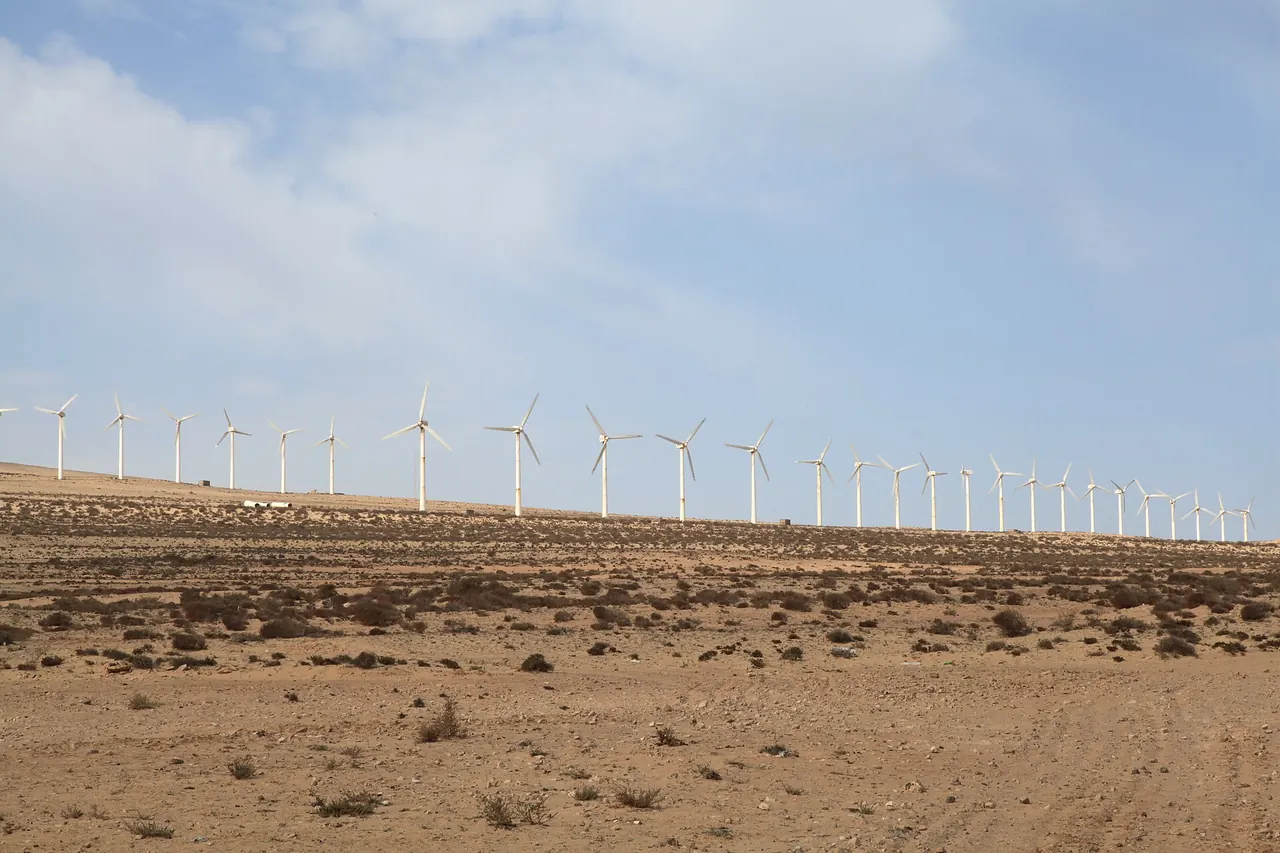
Jordan and Masdar sign an agreement for a fully UAE-funded 25 MW wind farm in Ma'an
Five turbines will go up in Batn Al-Ghul. Masdar handles technical oversight and supervision, while Samra Electric Power Generation Company appoints the EPC contractor and runs operations. 1 min read
Jordan’s wind pipeline grew by 25 megawatts in February, with the UAE picking up the entire bill.
On February 10, Jordan’s Ministry of Energy and Mineral Resources signed a cooperation agreement with Abu Dhabi Future Energy Company, better known as Masdar, to develop a 25 MW wind farm in the Batn Al-Ghul area of Ma’an. Energy Minister Saleh Al-Kharabsheh signed for Jordan and Ali Abdullah Al-Shimmari, Masdar’s Director of Strategic and Special Projects, for Masdar. The project is fully financed by the United Arab Emirates and will see five turbines installed. Masdar takes on technical oversight, implementation supervision, logistics and shipping, and progress reporting, while Samra Electric Power Generation Company will appoint the EPC contractor (selected by Masdar) and operate and maintain the plant, with the option to bring in Masdar for O&M. The Ministry of Energy will secure land and clear regulatory approvals.
What to look for
Watch the EPC selection timeline, since speed of execution is the real test of this kind of bilateral arrangement. Whether this Ma’an project brings follow-on Emirati capital into Jordan’s wind buildout is the question that matters.
What it means for MENA
We read this as intra-Arab capital recycling in action. Twenty-five megawatts is modest in absolute terms, yet the delivery model is what travels here: UAE finance, Emirati developer supervision, and local utility responsibility for operations, without multilateral debt stacking. Our read is that capital is the headline and the UAE’s full delivery model is the real export.
If you work on cross-border energy finance in this region, what does the next phase of UAE outbound clean energy capital look like?
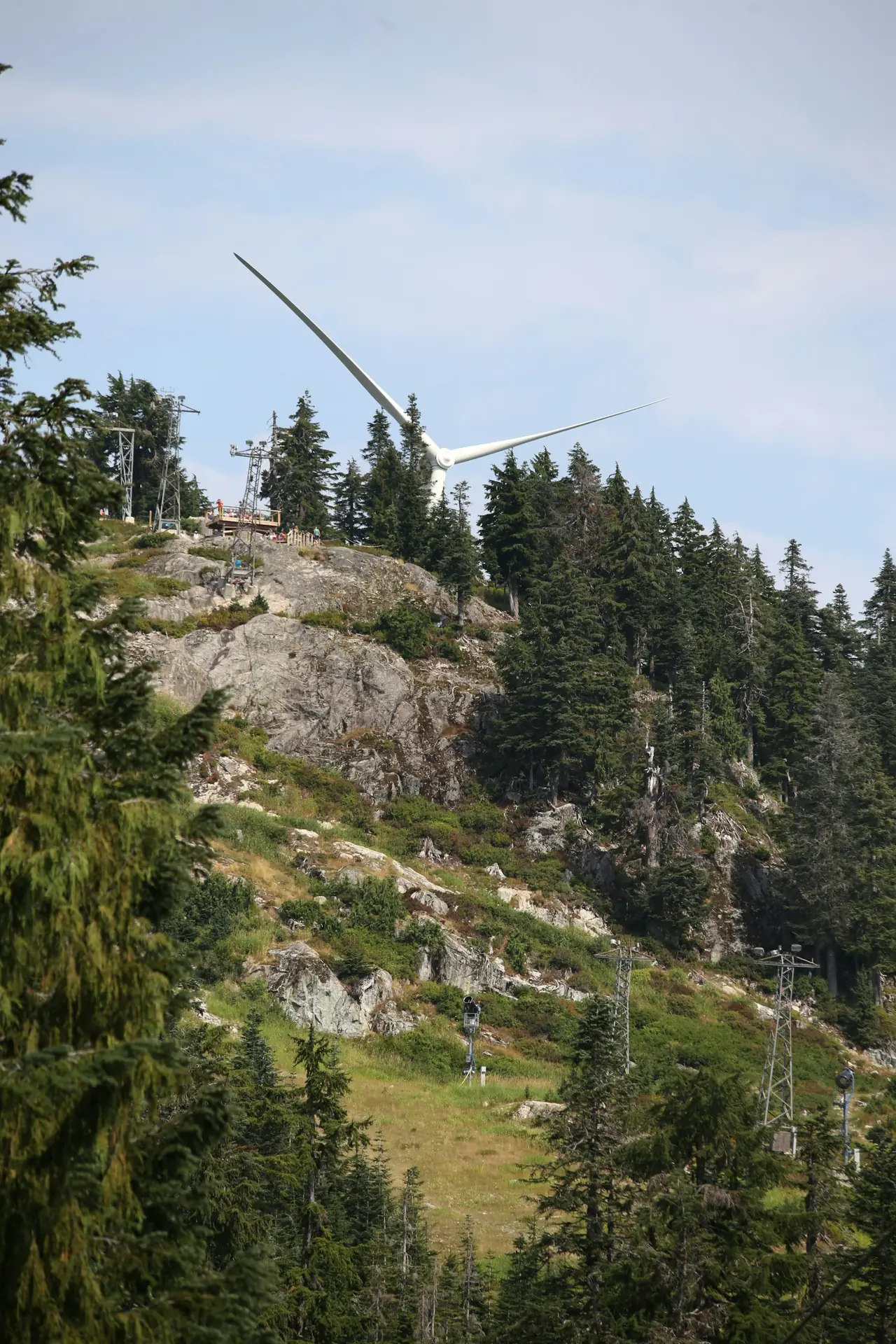
Masdar turns 20 with a portfolio above 65 GW and a 100 GW target for 2030
Masdar's portfolio capacity now exceeds 65 GW. It plans USD 30 to 35 billion in new equity and project finance to reach 100 GW, adding about 10 GW a year. 1 min read
In 2006, investing in wind and solar was a contrarian bet. The UAE took it anyway.
Masdar, Abu Dhabi’s state-backed clean energy company, turned 20 on April 23, 2026. Founded by President Sheikh Mohamed bin Zayed Al Nahyan through Mubadala when renewables were still unproven at scale, Masdar has grown its portfolio to over 65 gigawatts. The company is targeting 100 GW by 2030, backed by a planned $30 to 35 billion in new equity and project finance, which works out to an average of 10 GW of new capacity a year.
“Masdar didn’t ride the clean energy wave. We helped create it,” said Sultan Ahmed Al Jaber, Masdar’s founding CEO. The portfolio includes the world’s first floating offshore wind farm (30 MW Hywind Scotland) and Central Asia’s largest wind farm (500 MW Zarafshan in Uzbekistan). With EWEC, Masdar is now developing what it calls the world’s first gigascale integrated renewable project in Abu Dhabi: 5.2 GW of solar paired with 19 GWh of battery storage delivering 1 GW of uninterrupted baseload power.
What to look for
Watch whether Masdar’s 100 GW target by 2030 delivers meaningful wind additions alongside its solar-heavy portfolio. This month Masdar signed a binding agreement for a $2.2 billion, 50/50 JV with TotalEnergies that merges their onshore renewables in nine Asian countries. We read that as a sign of where growth capital is flowing. The question for MENA: does Masdar’s own backyard keep pace with its global footprint?
What it means for MENA
Masdar’s story is the UAE’s story. It was built on a bet that energy wealth can be converted into energy leadership. Twenty years on, we think the bet has paid off at scale. The harder test for the region now is whether it can build the industries around clean energy as well as the plants.
If you work in MENA energy, what do you see as Masdar’s most underappreciated contribution over the past 20 years?
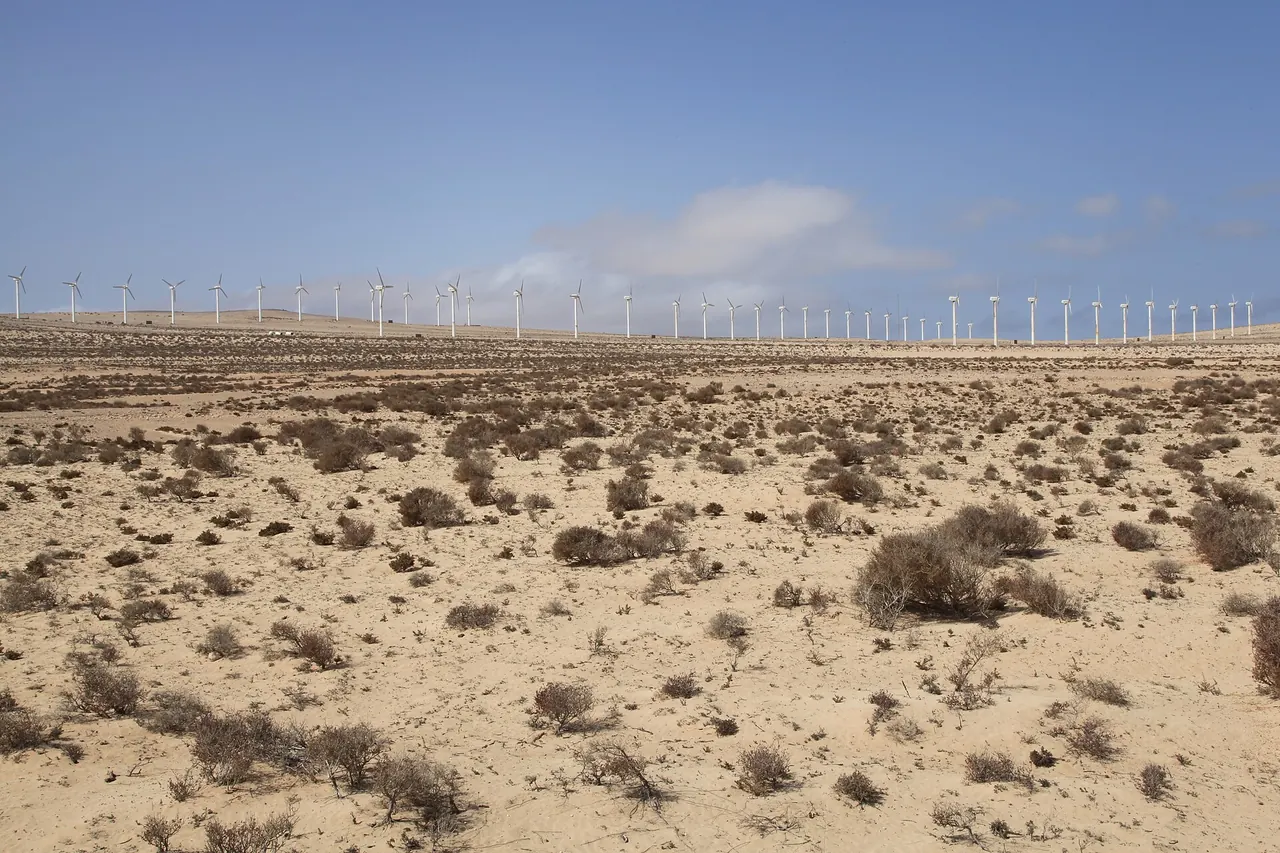
Morocco's installed wind capacity reached 2.63 GW at the end of 2025, up from 2.37 GW
An Attaqa.net report puts renewables above 46 percent of Morocco's electricity generation, against a 52 percent target for 2030. Wind is now the second largest source of electricity after coal. 1 min read
Morocco just quietly became Africa’s second fastest growing wind market, and the numbers tell you why.
By the end of 2025, Morocco’s installed wind capacity reached 2.63 GW, up from 2.37 GW a year earlier, according to a new report from US based energy platform Attaqa.net. Renewables now account for more than 46 percent of Morocco’s total electricity generation, putting the country within striking distance of its 52 percent target for 2030. Wind alone makes up more than half of that renewable mix, which means wind is now the second largest source of electricity in the entire country, sitting just behind coal. Between 2021 and 2025, Morocco added roughly 1.36 GW of wind, carried by projects like the 270 MW Jbel Lahdid farm and the modernization of the historic Koudia Al Baida site in the north.
What to look for
The pace of growth here is steady rather than flashy, and I think that matters more. Consistent yearly buildout is what investors price. Morocco is also studying offshore wind near Essaouira, which could add ocean scale capacity on top of its onshore base.
What it means for MENA
My read is that Morocco is proving a model the wider region can actually copy. The investor signal is clear when a country gets within six points of its 2030 target five years early. For Gulf and North African markets building wind pipelines right now, we see Morocco’s execution as the reference case.
Clean power in MENA is a scoreboard now, and Morocco just moved up a slot. Who climbs next?
Mawarid Turbine signs for a Duqm plant to make 800 to 1,000 MW of wind turbines a year
OPAZ granted land in the Special Economic Zone at Duqm in January. Phase one, valued at about RO70 million, covers turbine components and blades; phase two adds a tower factory. 2 min read
Oman has signed for a plant to build its own wind turbines.
On 26 January 2026 the Public Authority for Special Economic Zones and Free Zones (OPAZ) signed a usufruct agreement with Mawarid Turbine for a wind turbine manufacturing and assembly plant in the Special Economic Zone at Duqm (SEZAD). Two further agreements cover six wind turbines on separate plots to power the facility. The plant’s expected production capacity is 800 to 1,000 megawatts. Phase one is valued at about RO70 million and includes the manufacture of several turbine components and blades. Phase two will add a specialised factory for towers and other renewable energy components. Mawarid signed technology licensing, research centre, design and Omanisation agreements last year, and is developing an initial concept for a battery production project.
What to look for
The question for the coming months is how fast Mawarid moves from a land agreement to a working production line. Watch for the technology licensor and the turbine models to be named, and check whether new Oman wind tenders specify the machines Mawarid will build. If they do, Oman has created a local preference through the supply chain rather than through policy alone. Also worth following: whether the phase two tower factory moves to financial close.
What it means for MENA
Building the rotating machines is harder than rolling tower steel. If Mawarid’s Duqm facility hits its production range and delivers at scale, it becomes a potential regional supplier as well as a national one. SEZAD’s chief executive says the plant can sell internationally through exports via Duqm Port. In my view, a Middle Eastern turbine manufacturer with a free zone location and a local order book would change the economics for projects across the region, cutting delivery times, reducing currency exposure, and giving developers an alternative to a purely Chinese or European supply chain.
There is a longer story here too. MENA has exported raw materials for generations and imported the hardware built from them. Turbines are sophisticated, high-value capital goods. Every one assembled in Duqm is a step toward rebalancing that equation.
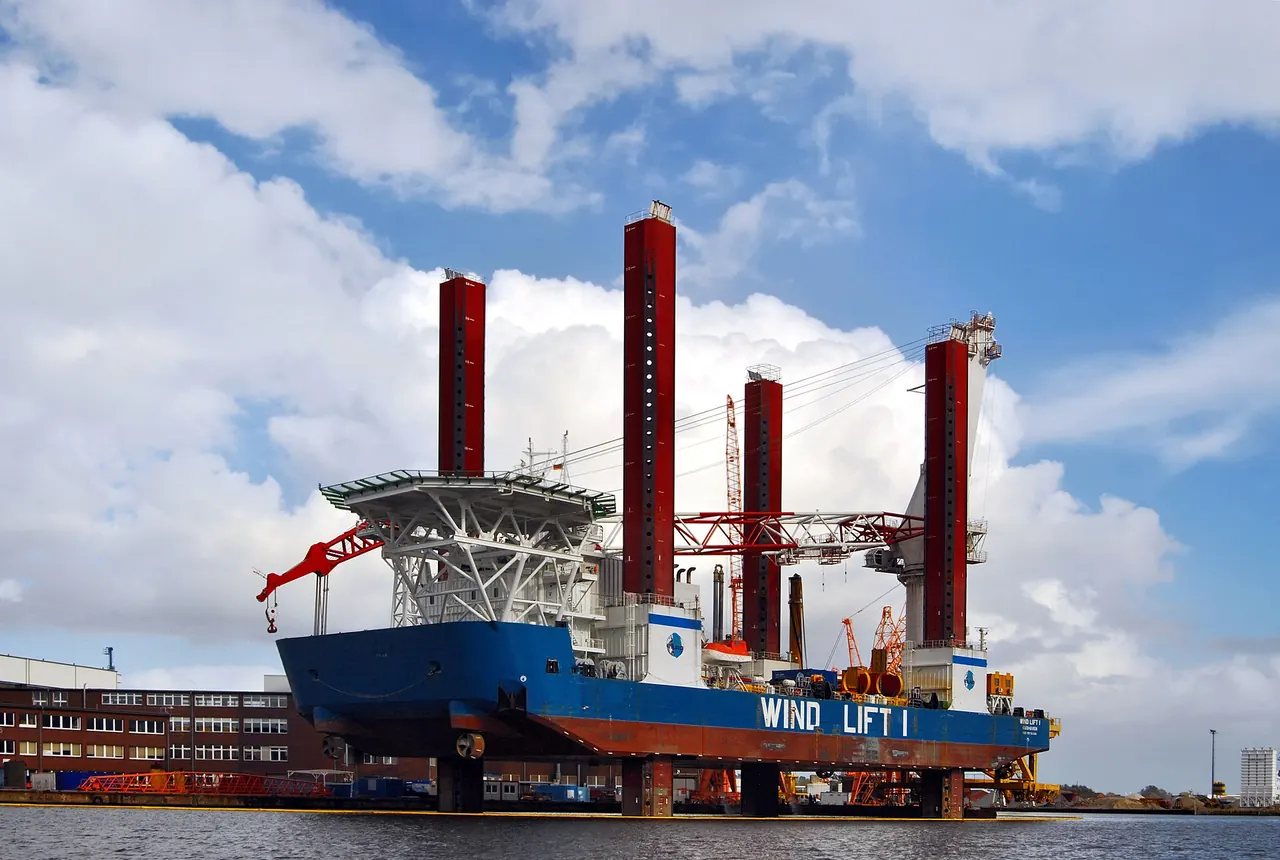
Al Yamamah Steel signs SAR 126 million tower deal for Saudi Arabia's 700 MW Yanbu wind farm
The contract supplies steel wind towers to EPC contractor SEPCO3, which won the Round 4 Yanbu EPC award in July 2025. 1 min read
Saudi wind just placed a nine-figure riyal order for locally made steel.
Al Yamamah Steel Industries has signed a 126 million riyal contract (around 33.6 million dollars) with EPC contractor SEPCO3 to supply steel wind towers for the 700 MW Yanbu Wind Farm in Madinah Province. SEPCO3 won the EPC contract in July 2025. Yanbu is a Round 4 project under Saudi Arabia’s National Renewable Energy Program.
What to look for
Watch whether Al Yamamah wins follow-on tower orders from later NREP rounds. One contract does not make a supply chain, and I would want to see repeat orders before calling this a trend.
What it means for MENA
In our view, a Saudi supplier feeding a Saudi farm should cut shipping times, currency exposure and logistics risk for future projects across the region. Egypt, Oman and Morocco could gain a regional tower partner rather than a distant one. MENA is starting to build some of the wind industry it used to only buy.
If you are developing wind, investing in MENA supply chains, or planning project EPC in the Gulf, what local content milestone would move your next project faster?
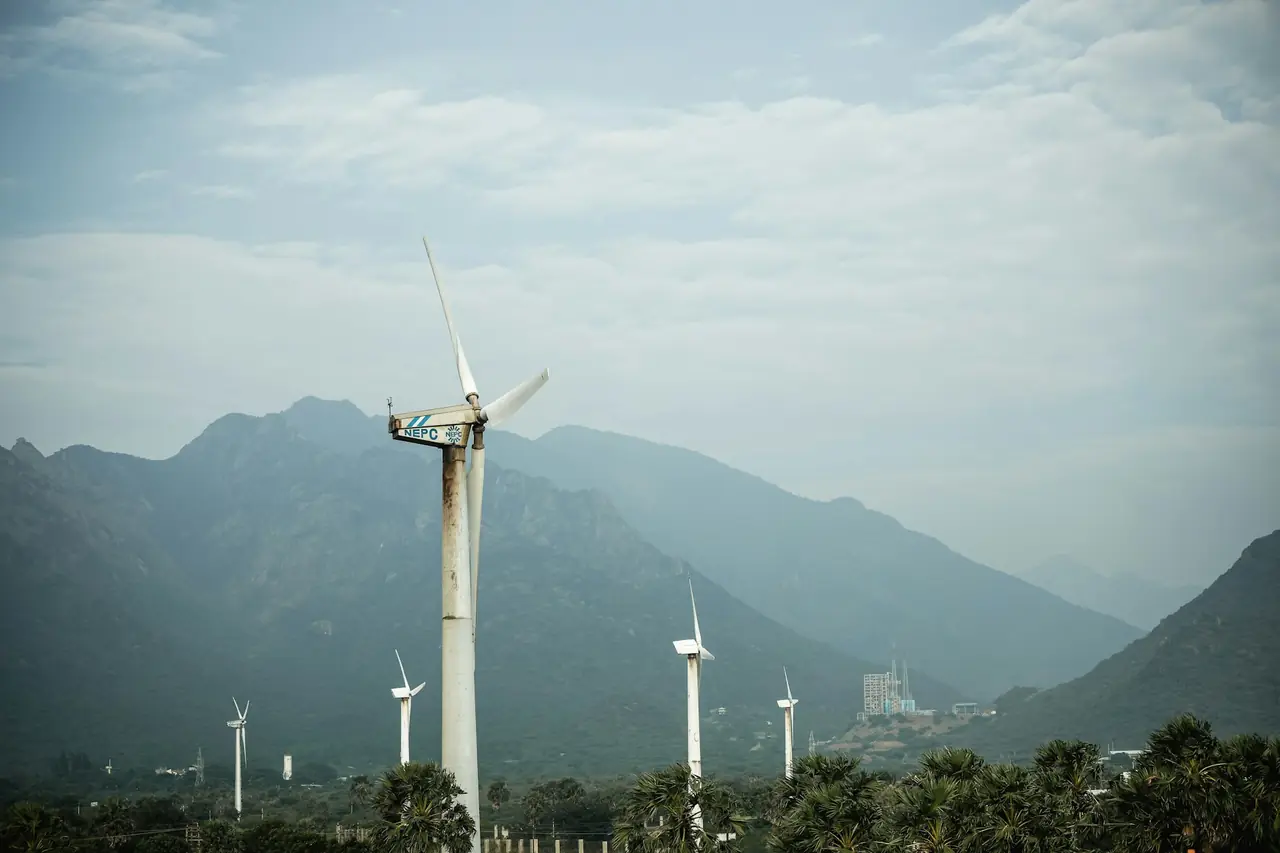
IRENA's 13 April advisory sets out a renewables playbook for the Middle East energy shock
"Renewables: From Energy Crisis to Energy Security" urges fast-tracked distributed renewables, time-of-use tariffs and hybrid mini-grids, anchored in a record 692 GW of renewables added globally in 2025. 1 min read
IRENA just turned the Middle East energy crisis into a policy blueprint.
On April 13, the International Renewable Energy Agency released a new advisory titled “Renewables: From Energy Crisis to Energy Security.” IRENA says the crisis stemming from the conflict in the Middle East exposes the structural weakness of energy systems that still rely on fossil fuels, and of markets where oil and gas prices drive electricity prices. The advisory sets out short, medium and long-term actions, and urges policy makers to direct investment and emergency responses toward faster deployment of renewable power and the electrification of energy-consuming sectors. IRENA anchors the argument in the record 692 GW of renewable capacity added globally in 2025. Governments are urged to fast-track distributed renewables, adopt time-of-use tariffs, and roll out hybrid mini-grids in weak-grid regions.
What to look for
Watch which MENA governments translate the IRENA brief into tender timelines this quarter. The signals we would look for are faster PPA cycles, bigger round sizes in Saudi Arabia and Egypt, and the first meaningful moves on time-of-use tariffs.
What it means for MENA
The region has wind resource and, now, geopolitical pressure to act. We read the IRENA brief as a policy invitation rather than a forecast. Which MENA government turns it into a tender first?
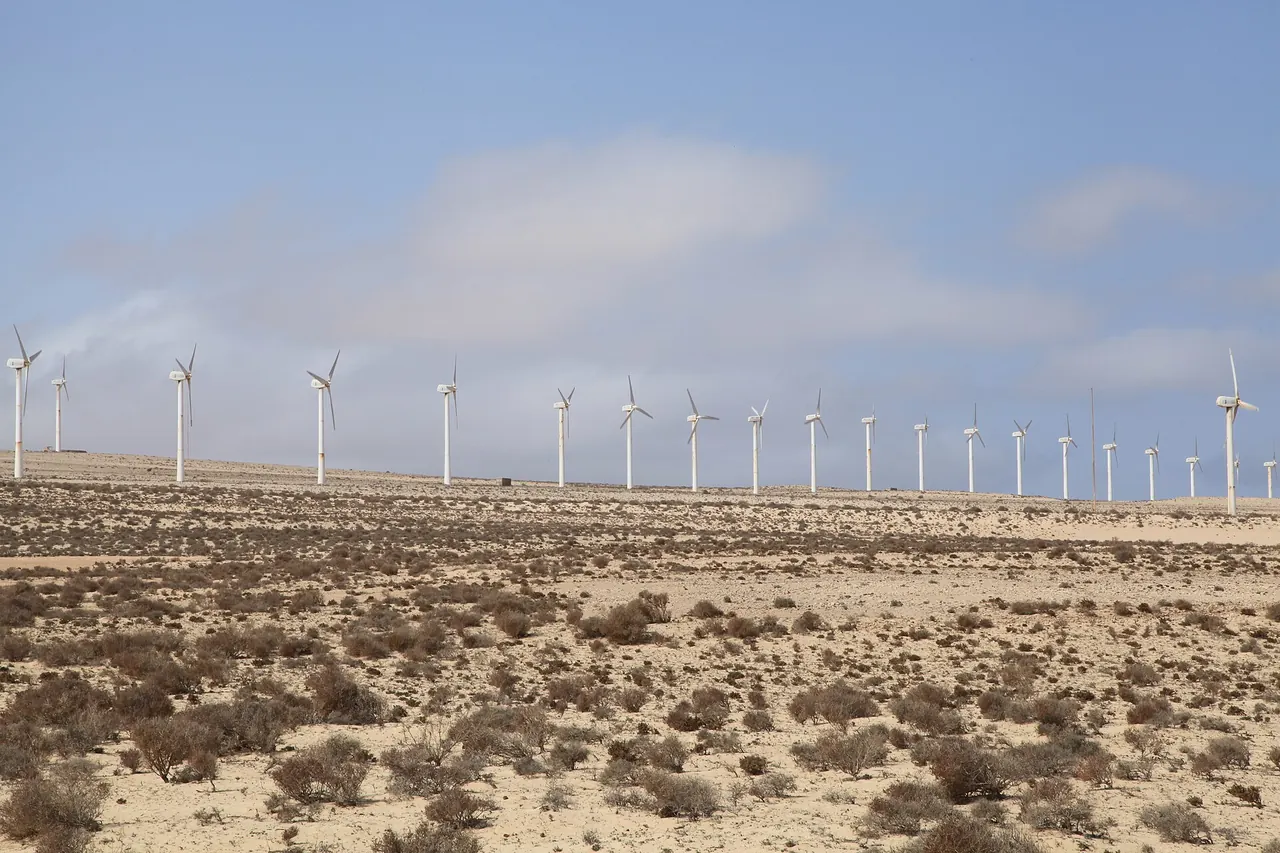
Wind covered 21% of Morocco's electricity demand in 2024 as output rose 43% to 9,363 GWh
Installed wind capacity reached 2,390 MW, up 19% year on year, and wind is now Morocco's largest renewable source. MASEN approved a 1.7 GW renewable programme set to launch in 2026. 1 min read
Morocco just hit a milestone the rest of the region should be studying closely.
In 2024, wind power generated 9,363 GWh in Morocco, a 43% jump from the year before, covering 21% of the country’s total electricity demand. Wind is now the single largest source of renewable electricity in the kingdom, ahead of both hydro and solar. Two projects powered that leap: the 270 MW Jbel Lahdid farm near Essaouira and the 100 MW repowering of Koudia al Baida in Tetouan. Total installed wind capacity now sits at 2,390 MW, up 19% year-on-year, while renewables as a whole cover 45% of Morocco’s electricity mix.
What to look for
MASEN approved a new 1.7 GW renewable program in December 2025, set to launch in 2026. Wind takes a substantial share of that pipeline, building on the Nassim Nord tender (400 MW across two northern farms) and additional IPP rounds. Morocco aims to cross 52% renewables in its electricity mix by 2030, and at the current pace we think it gets there.
What it means for MENA
Morocco is delivering its energy transition in commissioned megawatts. It is already past 2 GW installed and generating electricity at meaningful scale from wind. My read is that the model works: competitive IPP structures, strong Atlantic and Mediterranean wind corridors, and a state agency in MASEN that has moved from target-setting to commissioning. For developers and financiers across the region, we see Morocco as the clearest proof of what MENA wind can achieve when policy and procurement line up.
The Atlantic wind keeps blowing, and Morocco keeps building.